Mark Ratslayer
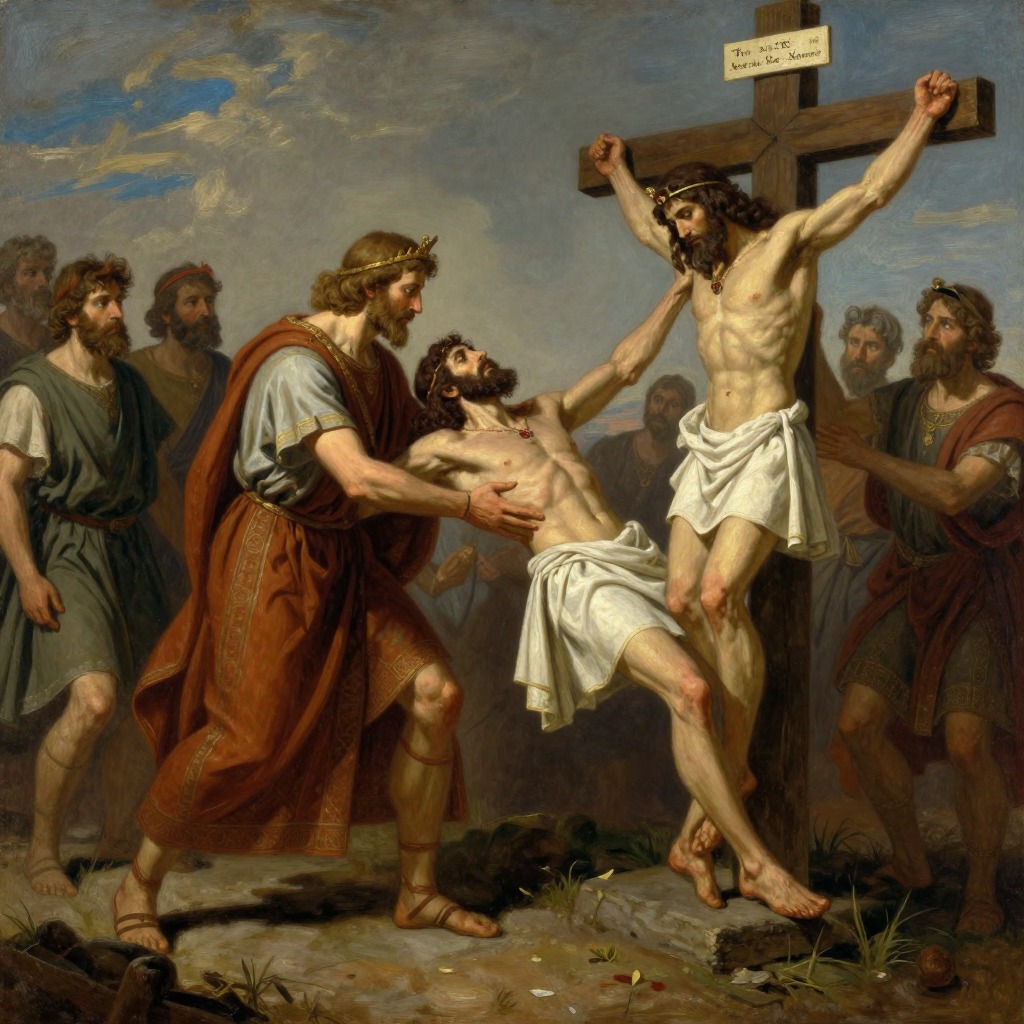
Mark Ratslayer, the centurion of the first century in the Twelfth Lightning Legion, is one of the most physically imposing and morally troubling figures in the Yershalaim narrative. A head taller than the tallest soldier of the legion and so broad in the shoulders that he completely blocked out the sun, he is introduced as the enforcer of Roman discipline. His face is disfigured: his nose had once been smashed by a blow from a Germanic club. This disfigurement is not merely a physical mark; it is the visible scar of a history of violence that has shaped him into a cold and convinced torturer.
Identity and Background
Mark's past is revealed in a rare moment of personal disclosure by Pontius Pilate. During the interrogation of Yeshua, Pilate recounts that he himself witnessed the battle of Idistaviso in the Valley of the Virgins, where German warriors fell on Mark like dogs on a bear, fastening on his neck, arms, and legs. The infantry maniple was encircled, and only the intervention of a cavalry turm commanded by Pilate saved the centurion. This experience, Pilate explains, is why Mark became cruel and hard. Yeshua, hearing this, muses that if he could speak with Mark, he is sure the centurion would change sharply—a hope Pilate dismisses as impossible, noting that he would not bring much joy to the legate of the legion if he decided to talk with any of his officers or soldiers.
Role in the Trial of Yeshua
Mark's first appearance in the narrative is as the instrument of Pilate's will. When Yeshua addresses Pilate as "good man," the procurator orders Mark to take the prisoner outside and explain how he ought to be spoken to, but with the instruction "no maiming." Mark, swinging easily, strikes the bound man across the shoulders with a whip. The blow is casual and light, yet Yeshua instantly collapses on the ground as if his legs had been cut from under him, gasping for air, the colour draining from his face. Mark then heaves the fallen man into the air like an empty sack, sets him on his feet, and speaks nasally in poorly pronounced Aramaic, instructing Yeshua that the Roman procurator is called Hegemon and that he must stand at attention. This scene establishes Mark as a figure of terrifying physical power and unquestioning obedience, a man who has internalized the violence of the empire.
Command of the Execution
Later, Mark is placed in command of the execution on Bald Mountain. He leads the century that conveys the condemned men, the carts with the implements for execution, and the executioners themselves. On the mountain, he paces tirelessly, holding his hands to his heavy belt with bronze plaques, glancing sternly at the posts with the executed men and at the file of soldiers, kicking aside human bones and small flints with the toe of his shaggy boot. The sun beats straight down on him without doing him any harm, and the silver lions' muzzles on his chest are impossible to look at, the eyes devoured by the dazzling gleam of the silver boiling in the sun. His mutilated face expresses neither weariness nor displeasure, and it seems he could pace like that all day, all night, and the next day—for as long as necessary. When the tribune arrives from Yershalaim with orders, Mark salutes and moves towards the group of executioners. He is present when the executioner gives Yeshua the drink from the sponge and then kills him with a gentle prick to the heart, whispering "Praise the magnanimous hegemon!"
Thematic Significance
Mark Ratslayer is a figure of pure, unreflective force. His disfigurement and his history of suffering at the hands of the "good people" he now serves to brutalize create a tragic irony: he has become the very thing that maimed him. Yeshua's observation that Mark is unhappy because the good people disfigured him points to a cycle of violence that the novel explores through the character of Pilate as well. Mark is not a villain in the sense of having chosen evil; he is a product of a world where violence is the only language of power. His presence on Bald Mountain, indifferent to the sun and the suffering, is a stark embodiment of the Roman order that Pilate represents and that Yeshua's preaching of a kingdom of truth and justice challenges. In the end, Mark is the instrument of that order's final, brutal assertion: the execution of the philosopher who dared to speak of a world without authority.