Maximilian Andreevich Poplavsky
Maximilian Andreevich Poplavsky, the uncle of the late Mikhail Alexandrovich Berlioz, is a figure of calculated self-interest whose journey from Kiev to Moscow is motivated less by familial grief than by a covetous ambition to inherit his nephew's coveted Moscow apartment. His encounter with the supernatural inhabitants of Apartment No. 50 exposes the hollowness of his materialistic designs and serves as a pointed satire of the desperate housing politics that corrupt human relations in Bulgakov's Moscow.
Identity and Motivation
Poplavsky is introduced as an industrial economist living in Kiev on the former Institutsky Street, a man considered one of the most intelligent in his city. Despite the spring beauty of Kiev—the flooding Dnieper, the view from the monument to Prince Vladimir, the sunlight on Vladimir's Hill—he takes no delight in any of it. His sole, gnawing desire is to move to Moscow, a fixation that has begun to disturb his sleep. He has tried to exchange his Kiev apartment for smaller quarters in Moscow through newspaper advertisements, but no takers have been found, or their offers have been disingenuous. This frustrated ambition explains his reaction to the telegram announcing Berlioz's death: while he feels a measure of sorrow for his wife's nephew, his practical mind immediately seizes on the opportunity presented by the vacant living space.
Arrival and the Deceptive Telegram
Poplavsky arrives in Moscow from Kiev in a first-class sleeping car, carrying a small fibreboard suitcase. The telegram that summoned him read: "Have just been run over by tram-car at Patriarch's Ponds funeral Friday three pm come. Berlioz." The message is a masterpiece of ambiguity, and Poplavsky, applying his intelligence, concludes that a telegraphic error has occurred: the word "have" must belong to another telegram, while "Berlioz" was misplaced at the end. This rationalization allows him to interpret the message as a tragic but clear summons to a funeral, justifying his hurried departure. His wife's initial outburst of grief subsides, and he prepares for the journey, his true purpose concealed beneath a veneer of familial duty.
Confrontation with the Supernatural
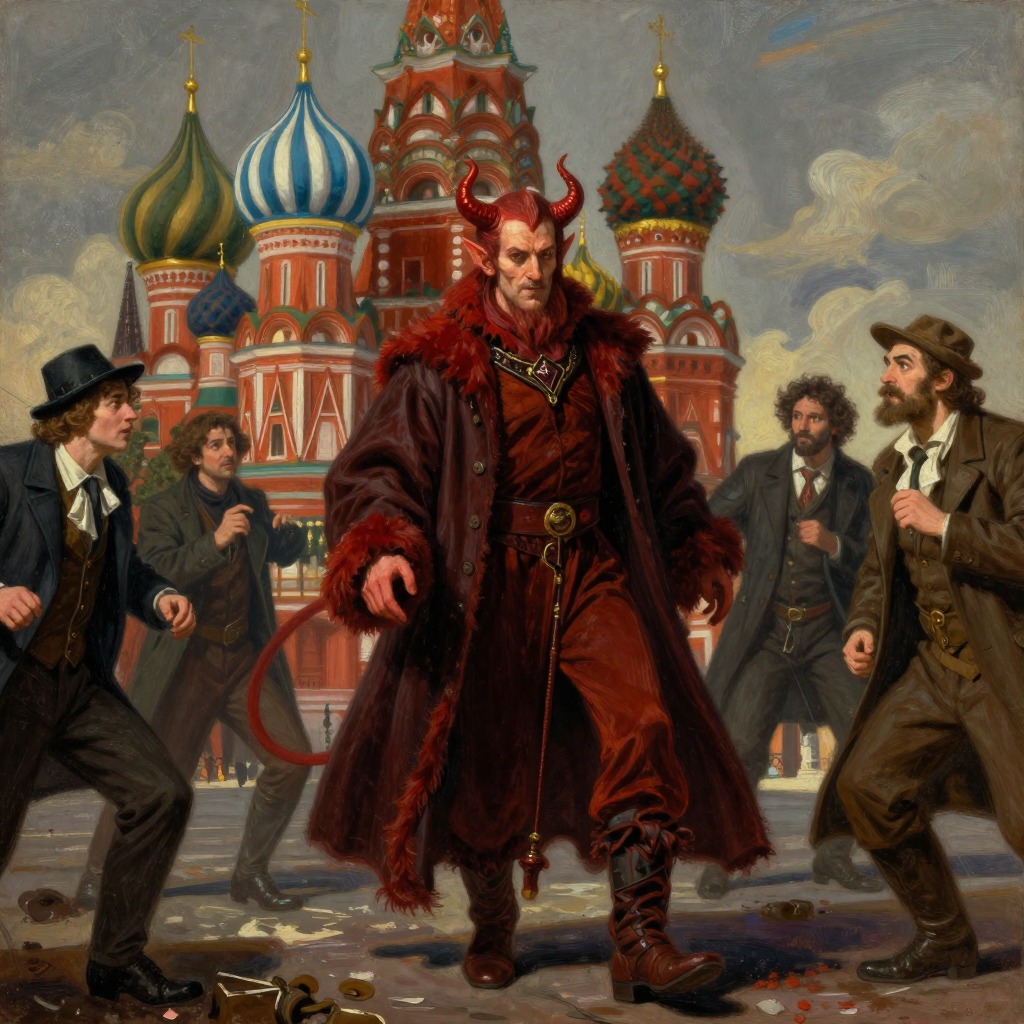
Poplavsky's scheme unravels when he arrives at the late Berlioz's apartment, Apartment No. 50 on Sadovaya Street. The apartment, already under the sway of Woland and his retinue, proves to be a trap for the avaricious uncle. He is met not by grieving relatives but by the demonic figures who have taken up residence. The encounter is brief and terrifying. The supernatural inhabitants, likely Koroviev or Behemoth, mock his pretensions and his greed. They make it brutally clear that he has no claim to the apartment and that his presence is unwelcome. The confrontation is a swift and decisive expulsion, both physical and symbolic, of his materialistic ambitions.
Thematic Significance
Poplavsky's role in the novel is that of a cautionary figure, a representative of the mundane greed that the novel's supernatural forces expose and punish. His single-minded pursuit of the apartment, a symbol of the "housing problem" that Woland himself identifies as a corrupting force in Muscovite life, renders him blind to the extraordinary events unfolding around him. He is a foil to the master and Margarita, whose love and artistic integrity transcend such petty concerns. His failed inheritance plot underscores the novel's central theme: that the true treasures of life—love, art, and spiritual freedom—cannot be secured through calculation and material desire, and that those who attempt to do so will find themselves outmatched by forces they cannot comprehend.