Sawa Potapovich Kurolesov
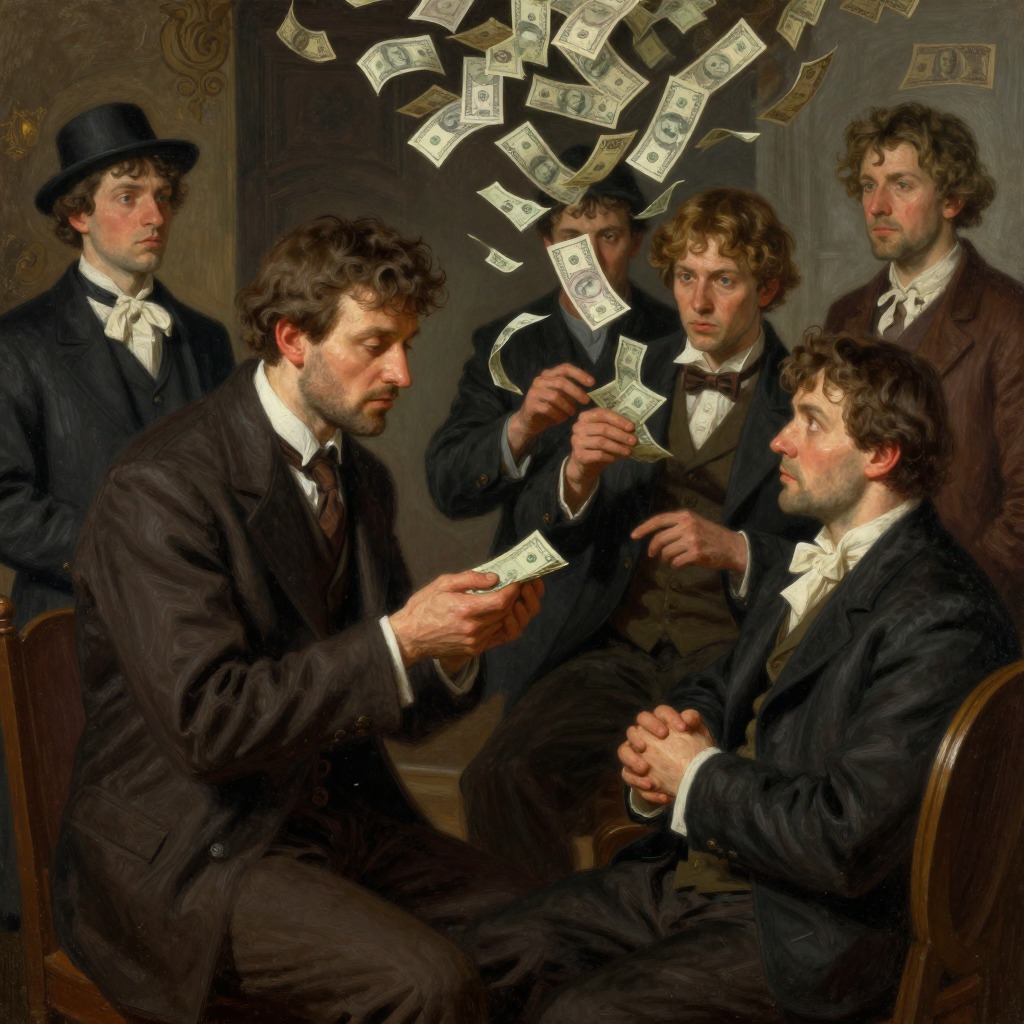
Sawa Potapovich Kurolesov is a minor character in Mikhail Bulgakov's The Master and Margarita who appears only within the dream of Nikanor Ivanovich Bosoy, the chairman of the tenants' association at No. 302-bis on Sadovaya Street. In that dream, which takes the form of a surreal theatre programme designed to pressure currency hoarders into surrendering their hidden wealth, Kurolesov is introduced as a "famous dramatic talent" and a "strapping and beefy man, clean-shaven, in a tailcoat and white tie." He performs an excerpt from Alexander Pushkin's The Covetous Knight, a monologue in which the speaker confesses to having refused a widow who knelt before him in the rain, and ends by dying of a stroke on his chest of currency and jewels. Kurolesov's performance is the centrepiece of the dream's moralistic spectacle, and his fate serves as a warning to the dream's audience of currency dealers.
Identity and Role in the Dream
Kurolesov is described as a "strapping and beefy man, clean-shaven, in a tailcoat and white tie." He is introduced by the master of ceremonies as a "famous dramatic talent" who has been "especially invited" to perform. The master of ceremonies announces that Kurolesov will perform excerpts from The Covetous Knight by Pushkin. Kurolesov appears on stage without any preliminaries, concocts a gloomy face, knits his brows, and begins speaking in an unnatural voice, glancing sidelong at a golden bell. His performance is a confession of greed and cruelty: he tells how a "wretched widow" went on her knees to him, howling in the rain, but failed to move his callous heart. The monologue culminates in the knight's death, crying out "Keys! My keys!" before collapsing on the floor, gasping and tearing off his tie. After dying, Kurolesov gets up, brushes the dust from his trousers, bows with a false smile, and withdraws to thin applause.
Thematic Significance
Kurolesov's performance is the climax of the dream's coercive logic. The master of ceremonies explicitly interprets the monologue for the audience: "This knight hoped that frolicking nymphs would come running to him, and that many other pleasant things in the same vein would occur. But, as you see, none of it happened, no nymphs came running to him, and the muses paid him no tribute, and he raised no mansions, but, on the contrary, ended quite badly, died of a stroke, devil take him, on his chest of currency and jewels." The master of ceremonies then warns the audience that "the same sort of thing, if not worse, is going to happen to you if you don't turn over your currency!" Kurolesov's performance thus functions as a grotesque parable of greed and punishment, reinforcing the dream's message that hoarding currency leads to ruin. The fact that Kurolesov is a fictional character within a dream within a novel underscores the layered, theatrical nature of the dream's reality, and his performance is a key element in the dream's attempt to coerce Nikanor Ivanovich into confessing to currency speculation.
Narrative Role and Evaluation
Kurolesov is a minor character who appears only in Nikanor Ivanovich's dream, and his role is entirely symbolic. He is not a real person in the novel's Moscow world, but a figure conjured by the dream's logic to serve as a cautionary example. His performance of The Covetous Knight is a direct reference to Pushkin's work, which Nikanor Ivanovich, before his dream, had been completely ignorant of, though he knew the poet's name and used it in everyday phrases like "And who's going to pay the rent - Pushkin?" The dream thus introduces Nikanor Ivanovich to Pushkin's poetry in a context of coercion and fear. Kurolesov's performance, with its vivid depiction of a miser's death, contributes to the dream's overall atmosphere of grotesque, carnivalesque justice, and his fate is a warning that resonates with the novel's broader themes of greed, punishment, and the corrupting power of money.