Calypso
Calypso, the daughter of the magician Atlas, is a powerful goddess who lives alone on the remote, wooded island of Ogygia, far from all human and divine neighbors. She is introduced as the one who detains the hero Odysseus, holding him in her hollow caves and longing to have him as her husband. Her role is that of a divine captor and would-be lover, offering Odysseus immortality and eternal youth if he would stay with her, but he rejects this offer, yearning instead for his wife Penelope and his home in Ithaca. Calypso's island is described as a place of extraordinary natural beauty, with a thick wood of alder, poplar, and cypress, a vine loaded with grapes, and four running rills that irrigate beds of violets and luscious herbage. Even a god could not help being charmed by such a lovely spot, yet for Odysseus it is a prison of longing, where he spends his days on the seashore weeping and gazing at the barren ocean, dying of sheer homesickness.
Captivity and Divine Command
Calypso's captivity of Odysseus lasts for seven years, during which she keeps him in her cave and forces him to sleep with her at night, though it is she, not he, who desires this. The gods, however, eventually decide that Odysseus must return home. Zeus sends the messenger god Hermes to Ogygia to deliver the command that Calypso must release him. Hermes finds Calypso at her loom, singing beautifully, and delivers the decree. Calypso trembles with rage, accusing the gods of jealousy, citing precedents such as the goddess Dawn's love for Orion and Demeter's love for Iasion, both of which ended in the mortal's death. She protests that she found Odysseus alone and shipwrecked, cherished him, and intended to make him immortal, but she cannot oppose Zeus's will. She agrees to release him, though she cannot provide a ship or crew, only advice and materials for a raft.
The Release and the Raft
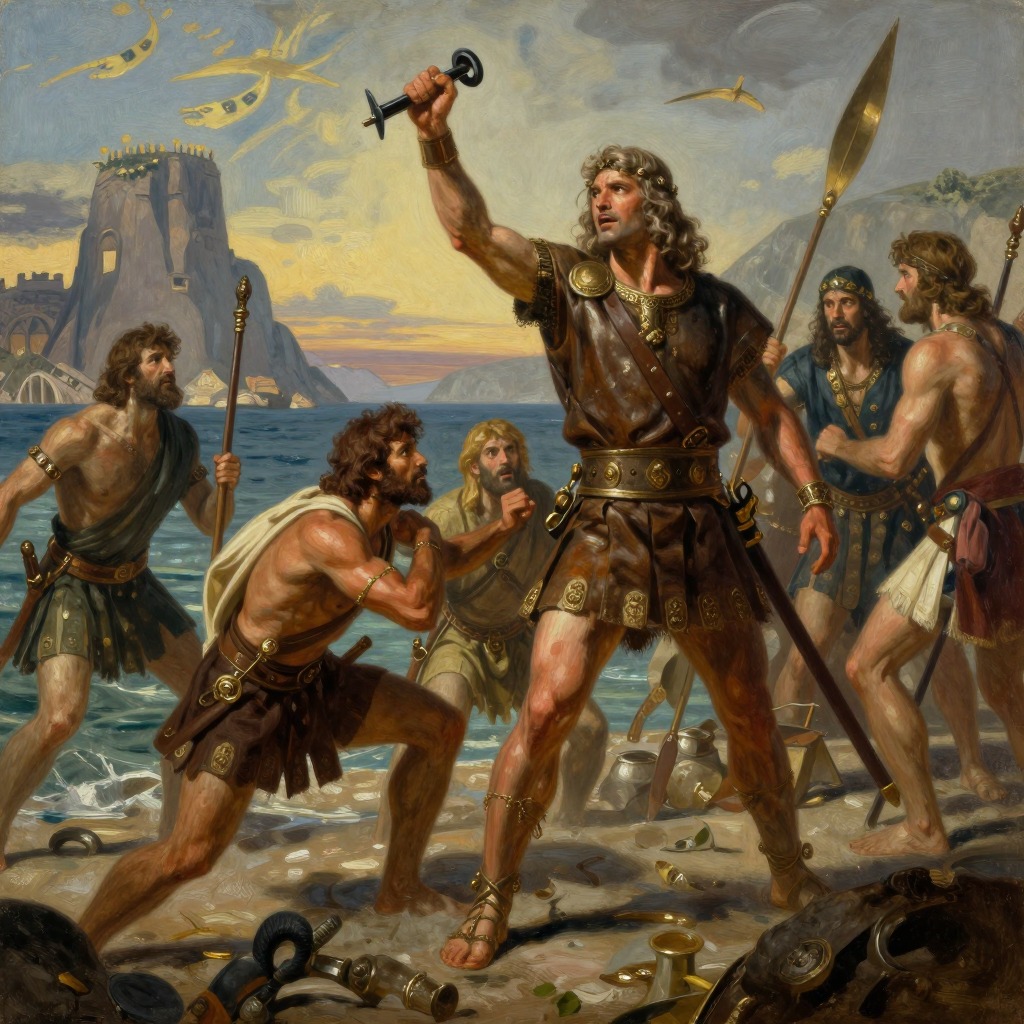
Calypso, having accepted the divine command, goes to find Odysseus on the beach. She tells him he shall not stay grieving any longer and that she will send him away of her own free will. She instructs him to cut beams of wood and build a large raft with an upper deck, promising to provide bread, wine, water, clothes, and a fair wind. Odysseus, suspicious, demands a solemn oath that she means him no mischief. Calypso swears by the river Styx, the most solemn oath a god can take, and then leads him to her cave. She gives him a great bronze axe and a sharp adze, and leads him to the far end of the island where the largest trees grow. Odysseus cuts down twenty trees, adzes them smooth, and builds the raft in four days, with Calypso providing linen for sails. On the fifth day, after washing him and giving him clean clothes, she sends him off with a goatskin of black wine, a larger one of water, a wallet of provisions, and a fair, warm wind. Odysseus sails for seventeen days, navigating by the stars as Calypso had instructed, until he sights the Phaeacian coast.
Character and Thematic Significance
Calypso embodies the theme of temptation and the conflict between divine desire and mortal destiny. She offers Odysseus everything a hero might desire—immortality, eternal youth, and a life of ease in a paradise—yet he refuses, choosing instead the mortal, uncertain journey home. Her name, derived from the Greek word "kalypto" (to hide, conceal), reflects her role as one who conceals Odysseus from the world. Her island, Ogygia, is a place of concealment and enchantment, a "navel of the sea" that is both beautiful and isolating. Calypso's character also serves as a foil to Penelope: where Penelope is faithful and mortal, Calypso is possessive and divine; where Penelope weaves and unweaves a shroud, Calypso weaves at her loom, singing. Calypso's eventual compliance with Zeus's command demonstrates the limits of even a goddess's power against the will of the Olympian order, and her release of Odysseus sets in motion the final stages of his journey home.