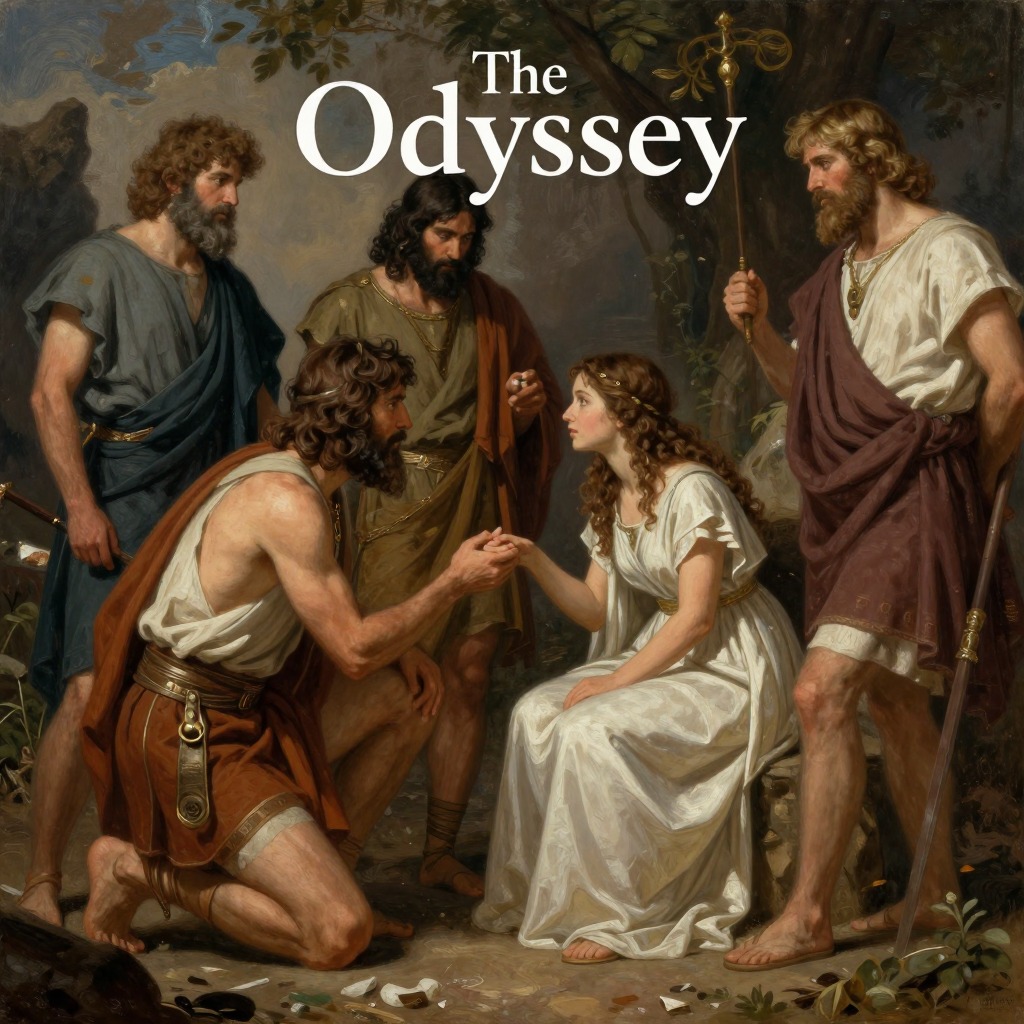
Demodocus
Demodocus, the blind bard of the Phaeacians, occupies a unique position in the Odyssey as a figure whose art both mirrors and activates the poem's own storytelling. He is the only professional singer whose performances are described in detail within the narrative, and his songs serve as the immediate cause for Odysseus's self-revelation. Through Demodocus, the epic explores the power of poetry to preserve fame, to stir emotion, and to compel truth.
Identity and Role
Demodocus is introduced as a singer "whom the muse had dearly loved, but to whom she had given both good and evil, for though she had endowed him with a divine gift of song, she had robbed him of his eyesight." This pairing of artistic brilliance with physical blindness marks him as a figure of profound insight, one who sees more clearly than the sighted. At the feast in Alcinous's palace, a servant leads him in and seats him against a bearing-post, hanging his lyre on a peg above his head so he can reach for it. The bard is treated with honor: a table with victuals and a cup of wine are set beside him, and he is expected to sing at the company's pleasure. His blindness, far from diminishing his authority, enhances it—he is a vessel for divine inspiration, and his songs carry the weight of truth.
Performances and Their Immediate Effects
Demodocus sings three distinct songs during Odysseus's stay among the Phaeacians, each with a specific function in the narrative. The first, performed after the initial feast, recounts "the quarrel between Ulysses and Achilles, and the fierce words that they heaped on one another as they sat together at a banquet." This song, drawn from the epic tradition of the Trojan War, immediately affects Odysseus: he draws his purple mantle over his head and weeps, ashamed to let the Phaeacians see his grief. When the bard pauses, Odysseus wipes his tears and makes a drink-offering, but when the Phaeacians press Demodocus to continue, Odysseus again covers his face and weeps bitterly. Only Alcinous notices the stranger's distress, and he calls for athletic contests to change the mood.
The second performance occurs after the games, when Alcinous orders the dancers to perform and Demodocus to sing of "the loves of Mars and Venus, and how they first began their intrigue in the house of Vulcan." This song—a comic tale of adultery, divine trickery, and the laughter of the gods—provides a stark contrast to the pathos of the first. It delights the Phaeacian audience and showcases the bard's versatility, but it also serves a structural purpose: it lightens the atmosphere before the more serious revelation to come.
The third and most consequential song is sung at Odysseus's own request. After the feast, Odysseus cuts a piece of roast pork and sends it to Demodocus with a message: "Bards are honoured and respected throughout the world, for the muse teaches them their songs and loves them." He then asks the bard to change his theme and sing of the wooden horse, the stratagem by which the Greeks sacked Troy. Demodocus obliges, taking up the story from the point where the Argives set fire to their tents and hid within the horse, and he sings of how the city fell. This song breaks Odysseus completely: he weeps "as a woman weeps when she throws herself on the body of her husband who has fallen before his own city and people." Alcinous, observing this, stops the performance and directly asks the stranger to reveal his name and his story.
Narrative Function and Significance
Demodocus's role extends beyond that of a mere entertainer. His songs function as a narrative device that forces Odysseus to confront his past and, ultimately, to declare his identity. The bard's art is presented as a form of memory—he sings of events he did not witness, yet his accuracy is so great that Odysseus marvels: "You must have studied under the Muse, Jove's daughter, and under Apollo, so accurately do you sing the return of the Achaeans with all their sufferings and adventures." This praise underscores the epic's own claim to truth and its reliance on divine inspiration.
Moreover, Demodocus embodies the theme of kleos (fame) that pervades the poem. His songs preserve the deeds of heroes, ensuring that they live on in memory. When Alcinous later praises Odysseus's storytelling, he says, "You have told the story of your own misfortunes, and those of the Argives, as though you were a practiced bard." This comparison elevates Odysseus to the level of a singer, blurring the line between the hero who acts and the poet who commemorates. Demodocus, then, is not only a character but also a figure for the Odyssey itself—a blind singer who, through inspired song, brings the past into the present and compels recognition and revelation.