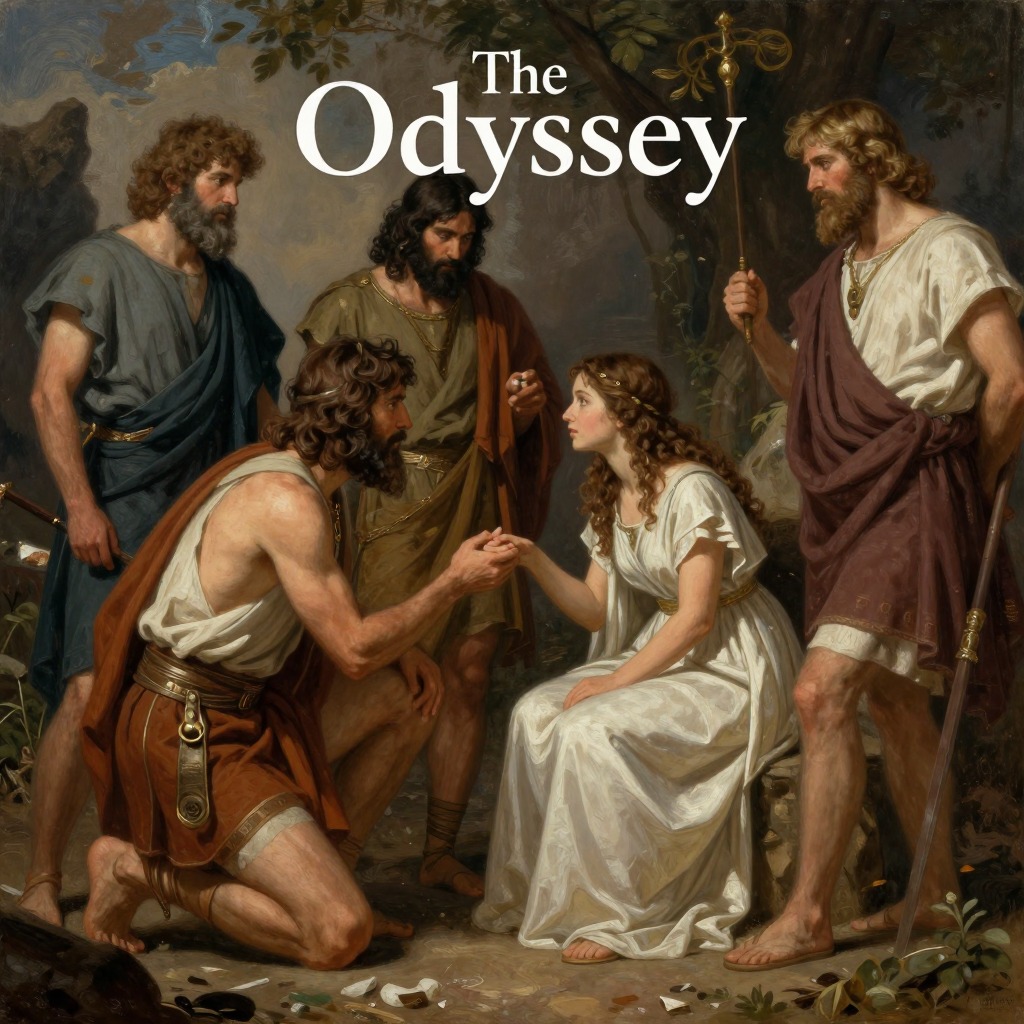
Laodamas
Laodamas, the favorite son of King Alcinous and Queen Arete of the Phaeacians, is a young prince whose athletic skill and social initiative serve as a crucial catalyst in Odysseus's journey home. As the best boxer among the Phaeacian youth, he embodies the physical excellence and competitive spirit of his seafaring people. Yet his most significant act is not a victory but a challenge: he is the one who, after the athletic contests, publicly urges the still-disguised and sorrowful Odysseus to prove his mettle, an act that directly leads to Odysseus's stunning display of strength and the eventual revelation of his identity. Laodamas thus functions as a narrative hinge, moving the story from hospitality and sport toward the epic tale of suffering and return that forms the heart of the poem.
Identity and Position in the Phaeacian Court
Laodamas is the eldest and most prominent of King Alcinous's three sons, the others being Halios and Clytoneus. He is described as the king's favorite son, a position of clear honor and responsibility. When the ragged stranger Odysseus enters the palace and sits as a suppliant by the hearth, it is Laodamas's seat that Alcinous commands him to take, signaling the highest degree of guest-friendship. This act places Laodamas in a subordinate but honored role, yielding his place to the unknown visitor. The prince is also noted as the best boxer among the Phaeacians, a detail that establishes his physical prowess and competitive nature within a culture that values athletic excellence.
The Challenge to Odysseus and the Athletic Contest
Laodamas's defining moment comes during the games held in Odysseus's honor. After the footraces, wrestling, jumping, discus, and boxing have concluded, Laodamas takes the initiative to address the stranger directly. He approaches Odysseus in the midst of the crowd and issues a public challenge, urging him to participate in any competition. Laodamas frames the invitation as a matter of personal honor, stating that nothing brings a man more credit throughout his life than showing his prowess with hands and feet. He also offers reassurance, telling Odysseus that his return home will not be long delayed, as the ship and crew are already prepared. This challenge, though well-intentioned, provokes the taunt of the younger athlete Euryalus, who insults Odysseus by calling him a grasping trader rather than a true athlete. Stung by the insult, Odysseus seizes a massive discus and throws it far beyond any Phaeacian mark, instantly silencing his detractors and proving his heroic caliber. Laodamas's challenge thus inadvertently creates the dramatic tension that allows Odysseus to reclaim his identity as a warrior and hero.
Narrative Role and Thematic Significance
Laodamas's role extends beyond that of a mere athletic competitor. He is a figure of youthful confidence and social propriety within the idealized Phaeacian society. His challenge to Odysseus, while born of a desire to honor the guest, also reflects the Phaeacian cultural value of competitive display. More importantly, Laodamas serves as a narrative instrument: his action directly precipitates the sequence of events—Odysseus's athletic triumph, his subsequent request for the bard Demodocus to sing of the Trojan Horse, and his own tearful reaction to that song—that finally compels King Alcinous to ask the stranger his name and story. This moment of revelation launches Odysseus's great apologue (Books 9–12), the core of his epic narrative. Laodamas, therefore, is not a major character in terms of personal development or conflict, but a functional and symbolic figure who embodies the youthful vigor of the Phaeacians and whose well-meaning challenge sets the entire second half of the poem's central narrative in motion.