Medon
Medon is a herald in the palace of Odysseus in Ithaca, a servant who waits upon the suitors during their long occupation of the house but who secretly remains loyal to Penelope and Telemachus. He is the one who overhears the suitors' plot to ambush and murder Telemachus on his return voyage from Pylos, and he risks his own safety to report the conspiracy to the queen. After the slaughter of the suitors, Medon is spared by Odysseus on the intercession of Telemachus, who testifies that the herald was always kind to him as a boy. Medon later appears before the angry assembly of Ithacans to testify that the killing of the suitors was carried out with divine sanction, helping to avert a civil war. His role thus spans from passive service to active loyalty, from witness to peacemaker.
Role in the Palace and Service to the Suitors
Medon is introduced as a herald who is a favorite servant of the suitors and who waits upon them at table. When the suitors are at dinner, Medon addresses them directly, saying, "Now then, my young masters, you have had enough sport, so come inside that we may get dinner ready. Dinner is not a bad thing, at dinner time." This familiarity indicates that Medon has daily, close contact with the suitors and is trusted by them to manage the household's serving arrangements. He is present in the banqueting hall when the bard Phemius sings to the suitors, and he is among the servants who bring in the bard Demodocus and set a seat for him among the guests in the house of Alcinous on Scheria. His position as a herald places him at the center of the palace's social life, where he can observe the suitors' behavior and overhear their private conversations.
The Warning to Penelope
The decisive moment of Medon's loyalty comes when he overhears the suitors plotting to ambush and kill Telemachus as he returns from Pylos and Lacedaemon. Medon crosses the threshold of Penelope's room, and Penelope, seeing him, asks, "Medon, what have the suitors sent you here for? Is it to tell the maids to leave their master's business and cook dinner for them?" Medon replies, "I wish, Madam, that this were all; but they are plotting something much more dreadful now—may heaven frustrate their design. They are going to try and murder Telemachus as he is coming home from Pylos and Lacedaemon, where he has been to get news of his father." Penelope's heart sinks within her, and she is speechless for a long time, her eyes filled with tears. When she asks why her son left, Medon answers, "I do not know whether some god set him on to it, or whether he went on his own impulse to see if he could find out if his father was dead, or alive and on his way home." This act of reporting the conspiracy is a direct act of loyalty to the queen and a betrayal of the suitors' trust, placing Medon in personal danger.
Survival and Pardon During the Slaughter
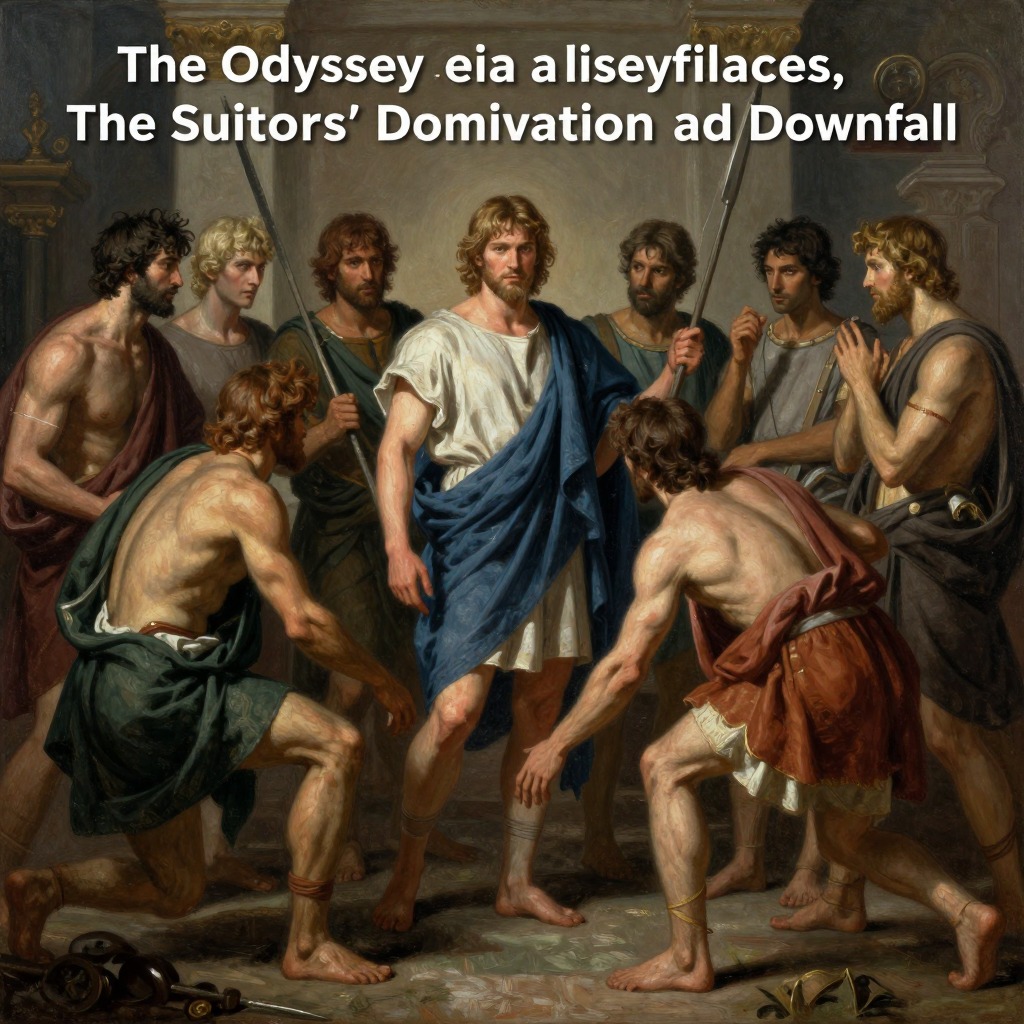
During the killing of the suitors, Medon hides to save his life. He crouches under a seat, covering himself with a freshly flayed heifer's hide. When Telemachus hears the minstrel Phemius pleading for his life, he calls out to his father, "Hold! the man is guiltless, do him no hurt; and we will spare Medon too, who was always good to me when I was a boy, unless Philoetius or Eumaeus has already killed him, or he has fallen in your way when you were raging about the court." Medon, hearing these words, throws off the hide, goes up to Telemachus, and lays hold of his knees, saying, "Here I am, my dear sir; stay your hand therefore, and tell your father, or he will kill me in his rage against the suitors for having wasted his substance and been so foolishly disrespectful to yourself." Odysseus smiles at him and answers, "Fear not; Telemachus has saved your life, that you may know in future, and tell other people, how greatly better good deeds prosper than evil ones. Go, therefore, outside the cloisters into the outer court, and be out of the way of the slaughter—you and the bard—while I finish my work here inside." Medon and Phemius then go into the outer court as fast as they can and sit down by Jove's great altar, looking fearfully round, still expecting to be killed.
Testimony Before the Assembly and Role in the Peace
After the slaughter, when the people of Ithaca gather in angry assembly, led by Eupeithes who mourns his son Antinous, Medon and the bard Phemius wake up and come to them from the house of Odysseus. Everyone is astonished at seeing them alive. Medon stands in the middle of the assembly and speaks: "Hear me, men of Ithaca. Odysseus did not do these things against the will of heaven. I myself saw an immortal god take the form of Mentor and stand beside him. This god appeared, now in front of him encouraging him, and now going furiously about the court and attacking the suitors whereon they fell thick on one another." On hearing this, pale fear lays hold of the assembly. Medon's testimony provides crucial evidence that the massacre was divinely sanctioned, which directly supports the argument of Halitherses that the people should not go out against Odysseus. This testimony helps to split the assembly, with more than half raising a loud shout and leaving, while the rest arm themselves and march to their doom. Medon thus serves as a witness whose word carries weight in the public sphere, helping to establish the legitimacy of Odysseus's return and revenge.
Thematic Significance
Medon embodies the theme of loyalty among servants in the Odyssey. Unlike the disloyal maids and the treacherous goatherd Melanthius, Medon remains faithful to the household even while serving its enemies. His survival is explicitly linked to his past kindness to Telemachus, reinforcing the poem's moral economy in which good deeds are rewarded and evil punished. His role as a herald—a figure who moves between groups and carries messages—makes him a natural conduit for information and a witness to events. His testimony before the assembly transforms him from a passive servant into an active agent of reconciliation, helping to prevent further bloodshed between Odysseus and the Ithacan people. In this, Medon serves as a minor but structurally important figure who bridges the private world of the palace and the public world of the city, and who demonstrates that loyalty, even when exercised quietly, can have decisive consequences.