Menelaus
Menelaus, son of Atreus and king of Lacedaemon, is one of the most prominent Achaean leaders to survive the Trojan War and return home, yet his story in the Odyssey is defined as much by loss and longing as by his legendary wealth. He is the brother of Agamemnon, whose murder at the hands of Aegisthus and Clytemnestra casts a long shadow over Menelaus's own homecoming. More than any other character, Menelaus provides the crucial link between Telemachus's quest for news of his father and the wider fate of the Achaean heroes, offering both a personal narrative of suffering and a prophetic account of Odysseus's captivity. His palace, gleaming with bronze, gold, amber, and ivory, is a monument to his successful return, but his heart remains heavy with the memory of comrades lost, especially Odysseus, whom he calls the man who "worked so hard or risked so much" as he did.
Identity and Background
Menelaus is introduced as the younger son of Atreus, the king who ruled over Mycenae and Argos. He married Helen, the daughter of Zeus, whose abduction by Paris was the immediate cause of the Trojan War. After the war, Menelaus endured a long and troubled nostos, wandering for eight years to Cyprus, Phoenicia, Egypt, Ethiopia, and Libya before finally reaching Sparta. This prolonged absence, during which his brother was murdered, defines his character: he is a man who has seen the world's farthest reaches and paid a heavy price for his return. He is also the son-in-law of Zeus, a status that, according to the prophecy of Proteus, will grant him an afterlife in the Elysian plain rather than death, because he married Helen and is thus "Jove's son-in-law."
Life and Plot Trajectory
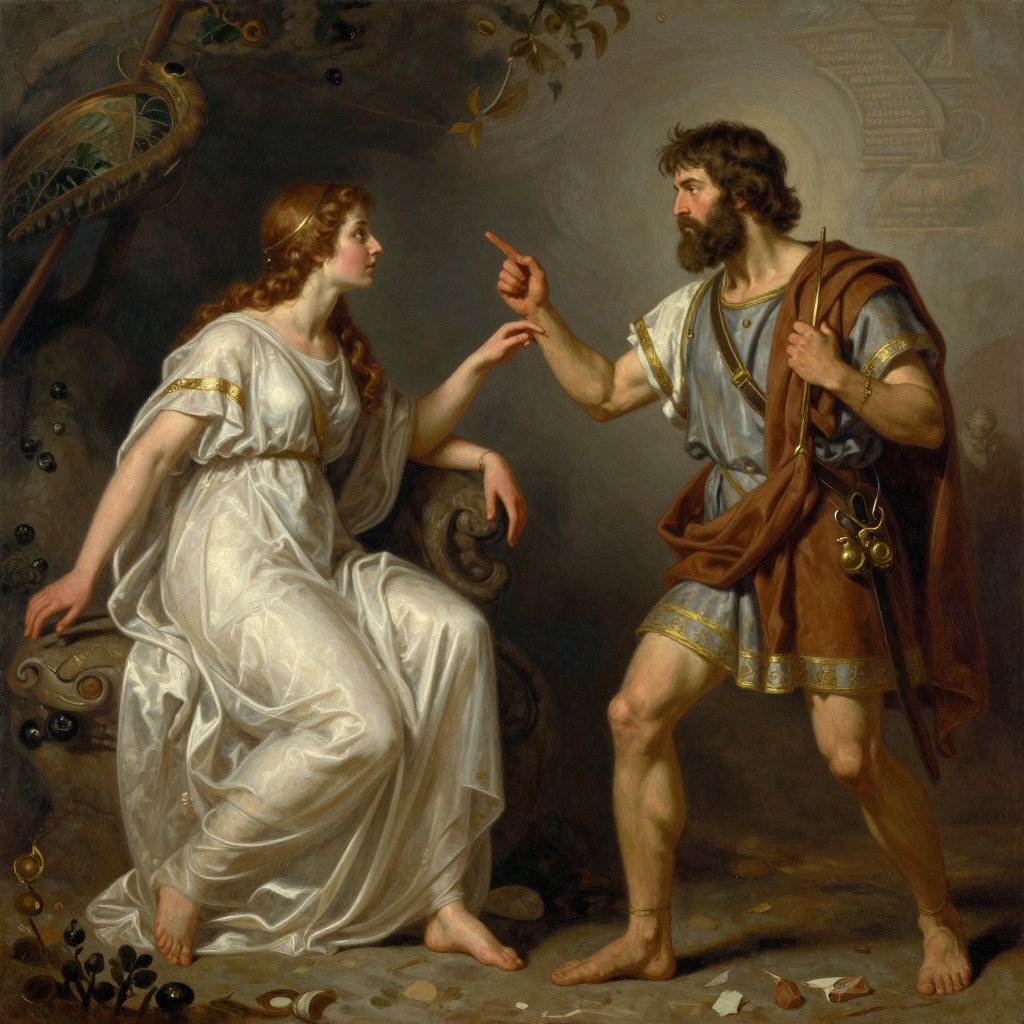
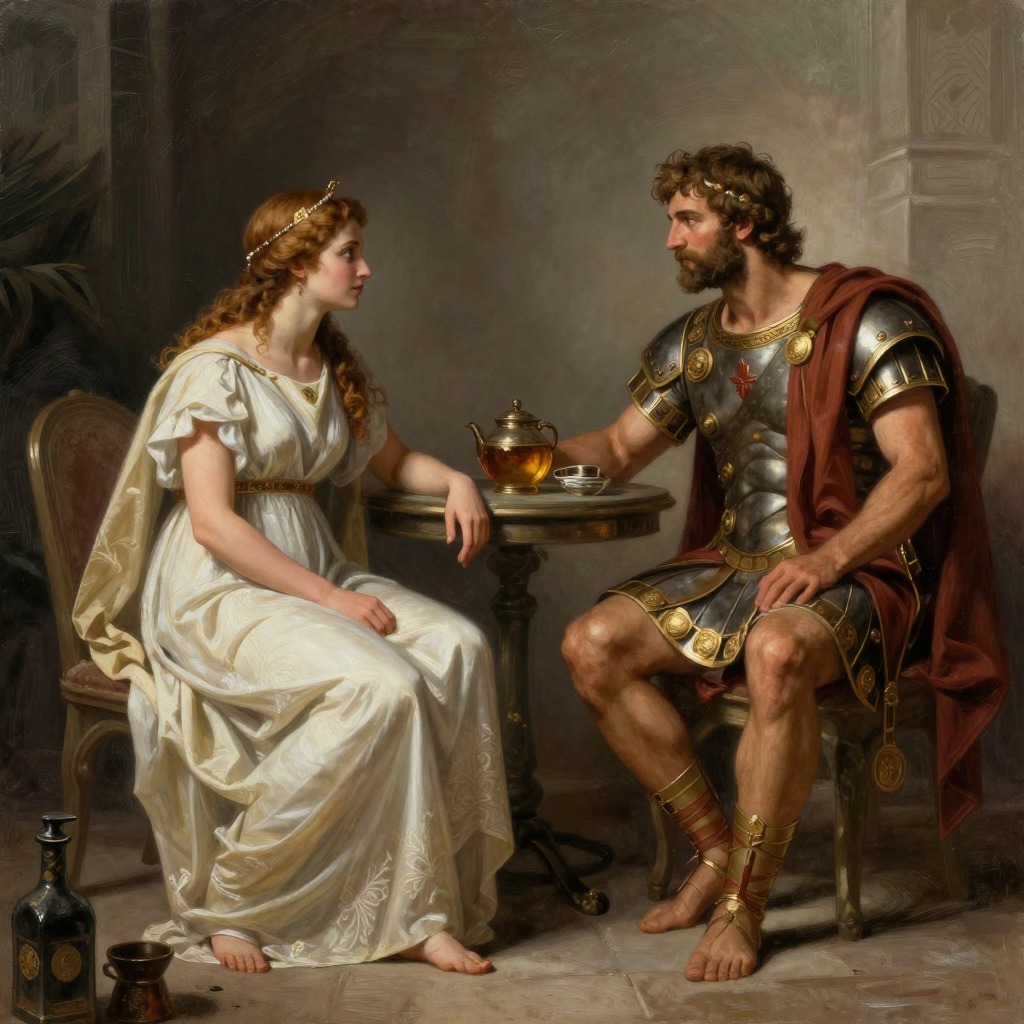
Menelaus's role in the Odyssey is primarily that of a host and informant. When Telemachus and Pisistratus arrive at his palace in Lacedaemon, they find him celebrating the double wedding of his daughter Hermione to Neoptolemus and his son Megapenthes to a Spartan bride. Menelaus welcomes them with lavish hospitality, recounting his own wanderings and his grief for Odysseus. The emotional climax of his narrative is his encounter with the Old Man of the Sea, Proteus, on the island of Pharos. Trapped in Egypt by a dead calm for twenty days, Menelaus, following the advice of Proteus's daughter Idothea, ambushes the shape-shifting god. Proteus reveals that Menelaus's failure to sacrifice properly to the gods is the cause of his detention and commands him to return to Egypt to offer hecatombs. More importantly, Proteus delivers the news that Odysseus is alive but imprisoned by Calypso on Ogygia, and he foretells the fates of other Achaean leaders, including the murder of Agamemnon and the death of Ajax. This prophecy is the first definitive word Telemachus receives that his father is still alive.
Key Actions and Objectives
Menelaus's primary objective in the narrative is to fulfill the duties of xenia, or hospitality, toward his guests. He offers Telemachus not only food and shelter but also magnificent gifts, including a chariot, three horses, and a silver mixing bowl of Hephaestus's workmanship, a gift from the Sidonian king Phaedimus. His secondary objective is to share his own story of suffering and survival, which serves as a parallel to Odysseus's journey and a lesson in perseverance. His account of capturing Proteus is a masterclass in cunning and endurance, as he and his men hold fast to the god through his transformations into a lion, a dragon, a leopard, a boar, running water, and a tree, until the god submits and answers his questions. This episode underscores the Odyssean themes of metis (cunning) and patience in the face of overwhelming odds.
Relationships and Conflict
Menelaus's relationship with Helen is complex and marked by a shared history of both glory and trauma. Helen, who recognizes Telemachus by his resemblance to Odysseus, tells the story of Odysseus's secret mission into Troy disguised as a beggar, a tale that reveals her own conflicted loyalties. Menelaus, in turn, recounts the episode of the Trojan Horse, where Helen, accompanied by Deiphobus, circled the wooden horse and called out to the Achaean leaders in the voices of their wives, a trick that nearly betrayed the ambush. This story highlights the lingering tension and mutual awareness between the couple, as well as the deep scars left by the war. Menelaus's conflict is not with a living enemy but with the memory of the dead, particularly Odysseus, whose absence he mourns with an intensity that disrupts his own enjoyment of his restored wealth. He tells Telemachus that he cannot even think of Odysseus "without loathing both food and sleep."
Change and Ending
Menelaus undergoes no dramatic transformation within the Odyssey, but his character is defined by a shift from the warrior-king of the Iliad to a reflective, sorrowful survivor. His wealth, while immense, is a hollow consolation for the loss of his comrades. The prophecy of Proteus, however, offers him a unique and peaceful end: he will not die in Argos but will be transported to the Elysian plain, a paradise at the ends of the earth where life is easy and the West wind blows. This fate, granted because he married Helen and is Zeus's son-in-law, sets him apart from the other heroes and provides a counterpoint to the violent deaths of Agamemnon and Ajax. His final act in the poem is to send Telemachus on his way with gifts and a favorable omen—an eagle carrying a goose—which Helen interprets as a sign that Odysseus is already home and plotting revenge.
Narrative Role and Evaluation
Menelaus serves as a crucial narrative device, a living witness to the aftermath of Troy who can confirm both the reality of Odysseus's survival and the dangers that await him. His story of Proteus is the most detailed prophecy in the poem outside of the underworld, and it directly motivates Telemachus's hope and Penelope's eventual recognition. He also functions as a foil to Agamemnon: where Agamemnon was murdered by a faithless wife, Menelaus has returned to a faithful, if complicated, Helen and a prosperous kingdom. His wealth, described in terms that make Telemachus compare his palace to the house of Olympian Zeus, symbolizes the rewards of a successful nostos, while his grief reminds the reader that even the most fortunate survivors carry the weight of their past. In the broader structure of the epic, Menelaus embodies the theme of kleos (glory) tempered by pathos, and his hospitality to Telemachus is a model of the xenia that the suitors in Ithaca have so flagrantly violated.