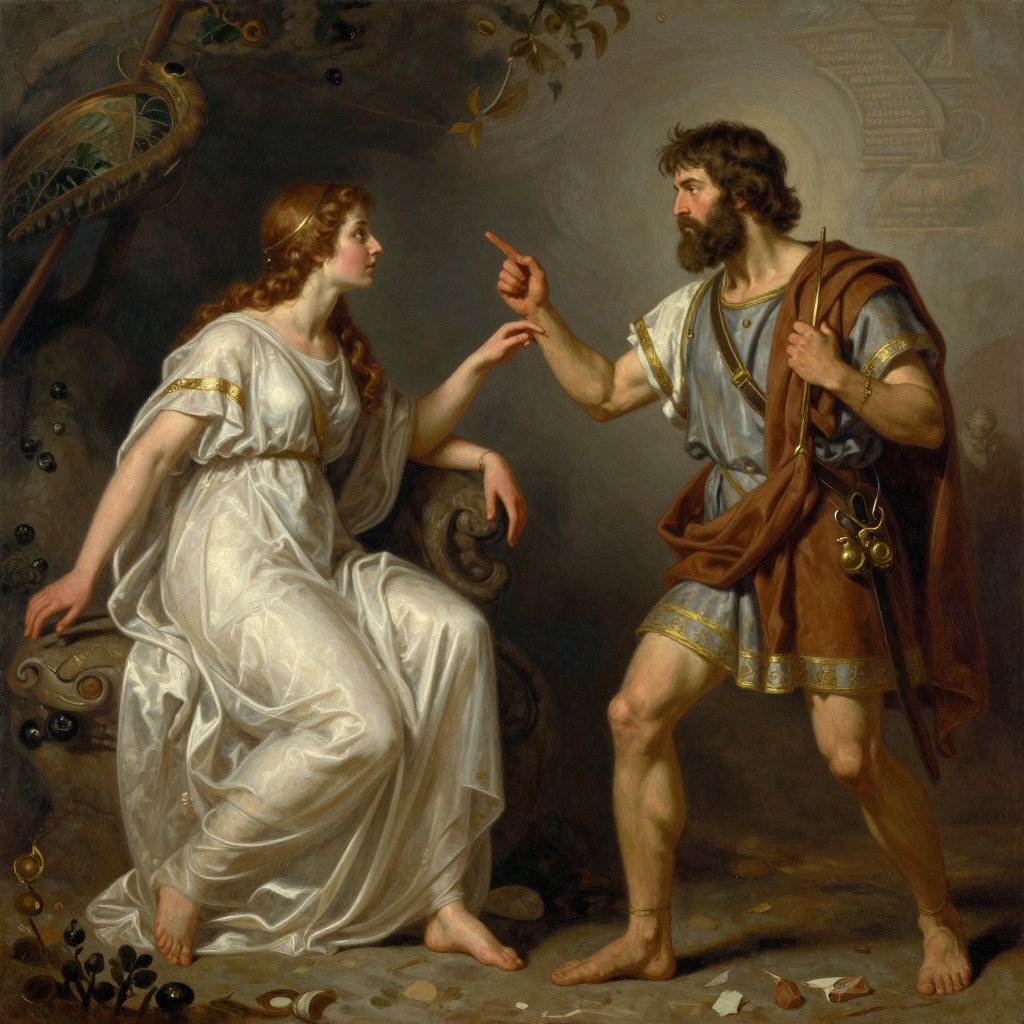
Orestes
Orestes, the son of Agamemnon and Clytemnestra, stands as the poem's central exemplar of filial vengeance, a figure whose decisive act of killing his father's murderer, Aegisthus, is repeatedly invoked to shape the expectations and anxieties of the younger generation. His story, told in fragments by Zeus, Nestor, and the ghost of Agamemnon himself, provides a moral and narrative template against which the fates of Odysseus, Telemachus, and even the suitors are measured. Orestes is not a character who appears in the poem's present action, but his absent presence haunts the epic, defining the possibilities of justice, inheritance, and the restoration of a household's honor.
The Crime and the Prophecy
The foundation of Orestes's story is laid before the poem begins, in the murder of his father, Agamemnon, by Aegisthus and the complicity of Clytemnestra. Zeus himself recounts the event in the first divine council, emphasizing that Aegisthus acted with full knowledge of the consequences. The god had sent Hermes to warn Aegisthus not to kill Agamemnon nor to woo his wife, for "the son of Atreus shall be avenged at the hand of Orestes, so soon as he shall come to man's estate and long for his own country." This prophecy establishes Orestes's role as the destined instrument of divine justice, a role he fulfills in the eighth year after the murder, when he returns from Athens to kill Aegisthus and, in the same act, celebrates the funeral rites of his mother and the usurper. The narrative thus frames his vengeance not as a personal vendetta but as the fulfillment of a cosmic and moral order that punishes transgression.
The Model for Telemachus
Orestes's story is most directly and urgently applied to Telemachus, who is repeatedly urged to emulate him. Nestor, during Telemachus's visit to Pylos, explicitly draws the parallel: "See what a good thing it is for a man to leave a son behind him to do as Orestes did, who killed false Aegisthus the murderer of his noble father. You too, then—for you are a tall smart-looking fellow—show your mettle and make yourself a name in story." This exhortation directly links Orestes's achievement of kleos (immortal fame) to the act of avenging a father, presenting it as the highest calling for a young man. Telemachus himself acknowledges the model, telling Nestor that "the Achaeans applaud Orestes and his name will live through all time for he has avenged his father nobly," before lamenting that the gods have not granted him a similar fortune. The parallel is further reinforced by Athena, who, in her guise as Mentor, reminds Telemachus of Orestes's fame to spur him into action against the suitors. Orestes thus functions as the aspirational ideal that defines Telemachus's own coming-of-age journey.
The Contrast with Agamemnon's Fate
The ghost of Agamemnon, encountered by Odysseus in the Underworld, provides the most poignant and personal perspective on Orestes's deed. Agamemnon, still bitter and sorrowful, contrasts his own miserable end—killed by his wife and her lover without even the comfort of seeing his son—with the glorious death of Achilles. He then directly asks Odysseus for news of Orestes, revealing a father's lingering concern for his son's fate and his legacy. The ghost's narrative underscores that Orestes's vengeance, while successful, cannot undo the fundamental tragedy of Agamemnon's homecoming. This contrast deepens the thematic resonance of Orestes's story: it is a model of successful revenge, but it is also a reminder of the irreparable loss that necessitates such revenge. The happiness of a restored household, as Odysseus will eventually achieve, remains a more complete resolution than mere retribution.
The Narrative Role and Significance
Orestes's primary function in the Odyssey is as a narrative and thematic paradigm. He is the proof that a son can and should avenge a father, a principle that drives Telemachus's maturation and justifies the eventual slaughter of the suitors. His story also serves as a foil to the fates of other heroes: unlike Agamemnon, who was murdered before his son could act, Odysseus returns in time to participate in the vengeance alongside Telemachus. Furthermore, the suitors themselves, in their hubris, fail to learn from Orestes's example, as Antinous's plot to kill Telemachus mirrors Aegisthus's original crime and invites a similar punishment. Orestes, though absent, is the moral compass of the epic's second half, a fixed point of filial duty and divine justice that orients the actions of the living.