Telemachus
Telemachus, the only son of Odysseus and Penelope, is the central figure of the poem's first four books and a crucial ally in its violent climax. His arc from a brooding, powerless adolescent to a decisive, courageous young man who helps his father destroy the suitors forms one of the Odyssey's core narratives of maturation and the restoration of legitimate rule in Ithaca.
Identity and Background
Telemachus is introduced as a young man sitting "moodily among the suitors," thinking about his absent father and how he would drive the suitors from the house if he could. He is acutely aware of his precarious position, telling the disguised Athena that he is the son of Odysseus but adding, "it is a wise child that knows his own father." He laments that he inherits "nothing but dismay" from his father's disappearance and that the suitors are "eating up" his estate. His mother Penelope, though faithful, is unable to act decisively, and Telemachus feels the weight of his household's disintegration. He is described as a "fine looking fellow" who resembles his father "about the head and eyes," and he is cared for by the old nurse Euryclea, who nursed him as a baby and loves him "better than any of the other women in the house."
Journey and Growth
Athena, disguised as Mentes, visits Telemachus and urges him to take action: call an assembly, confront the suitors, and then sail to Pylos and Sparta to seek news of his father. This advice galvanizes him. He stands before the assembly of Ithaca and delivers a passionate speech denouncing the suitors' waste, dashing his staff to the ground and bursting into tears. Though the assembly offers no practical help, Telemachus has publicly asserted his authority. He then secretly prepares a ship and, with Athena disguised as Mentor, sails to Pylos. There, Nestor receives him hospitably and tells him of the returns of other heroes, but has no news of Odysseus. Nestor sends him on to Sparta with his son Pisistratus. In Sparta, Menelaus recounts his own journey and the prophecy of Proteus, who revealed that Odysseus is alive but held captive by Calypso on Ogygia. Throughout this journey, Telemachus grows in confidence, speaking boldly to the kings and learning the stories of his father's renown.
Return and Reunion with Odysseus
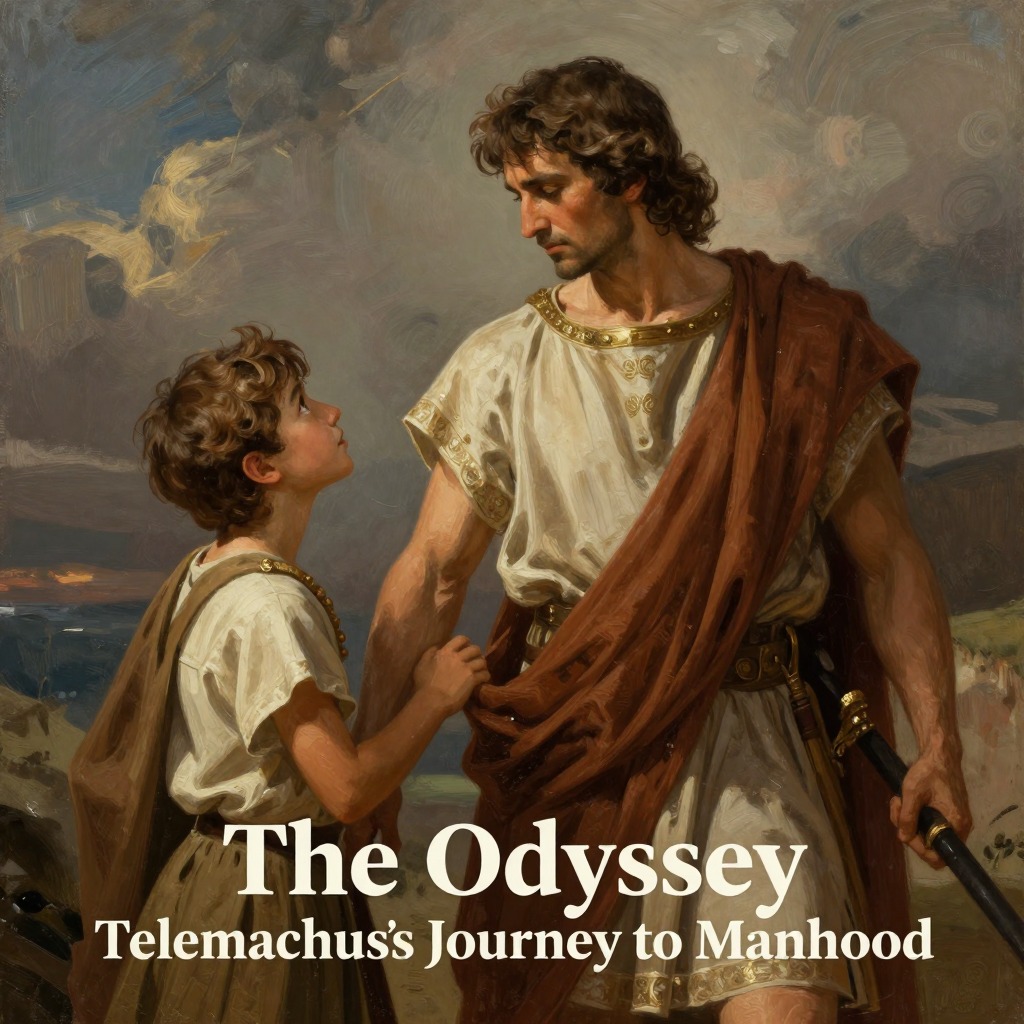
While Telemachus is away, the suitors plot to ambush and kill him on his return. Warned by Athena in a dream, he avoids the ambush and lands at a secret harbor. He goes first to the hut of the swineherd Eumaeus, where he finds a disguised Odysseus. After sending Eumaeus to tell Penelope of his safe return, Athena transforms Odysseus back to his true form. Telemachus is initially astounded, thinking he is a god, but Odysseus convinces him: "I am your father, on whose account you grieve and suffer so much at the hands of lawless men." They weep together, and Telemachus embraces his father. Odysseus then outlines his plan for revenge, and Telemachus pledges his full support, saying, "We will follow you with right good will."
Role in the Slaughter of the Suitors
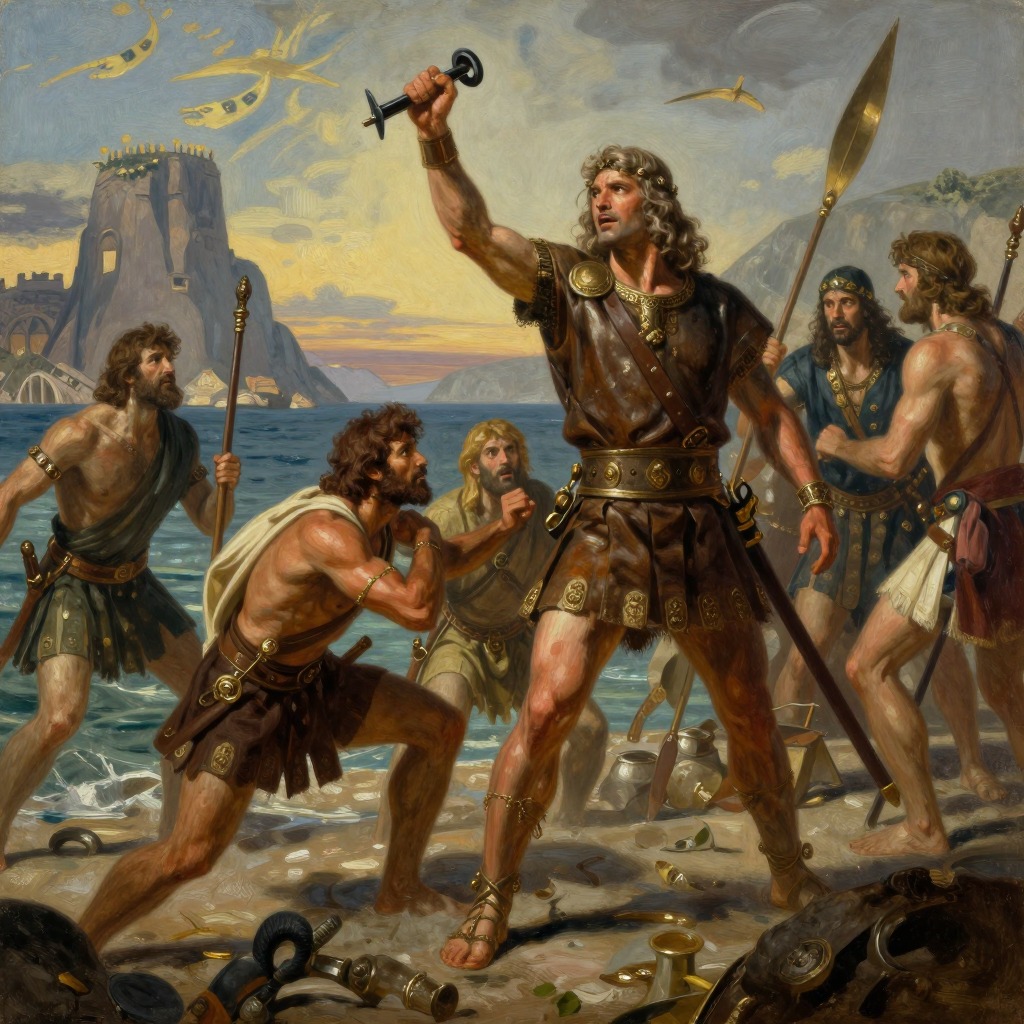
Telemachus plays a vital, active role in the killing of the suitors. He follows his father's instructions to remove the weapons from the hall, and during the contest of the bow, he tries and fails to string it, but his attempt is a feint to test the suitors. When the slaughter begins, Telemachus stands armed beside his father. He kills Amphinomus with a spear thrust from behind, and later kills Euryades and Leocritus. He also prevents the execution of the innocent bard Phemius and the herald Medon. After the battle, he is the one who hangs the twelve disloyal maidservants, stringing them up with a ship's cable. This act, though brutal, cements his role as the new master of the house, executing justice on those who betrayed his family.
Relationship with Penelope and the Bed
Telemachus's relationship with his mother is marked by a growing assertion of his own authority. Early in the poem, he tells Penelope to go to her room and busy herself with her loom, declaring, "speech is man's matter, and mine above all others." Later, when Penelope hesitates to recognize Odysseus, Telemachus rebukes her, saying, "Mother—but you are so hard that I cannot call you by such a name—why do you keep away from my father in this way?" He is impatient with her caution, but ultimately respects the private knowledge that finally convinces her: the secret of the bed built around the olive tree. Telemachus thus stands as the bridge between his father's return and his mother's acceptance, the living proof of the marriage that the Odyssey celebrates.