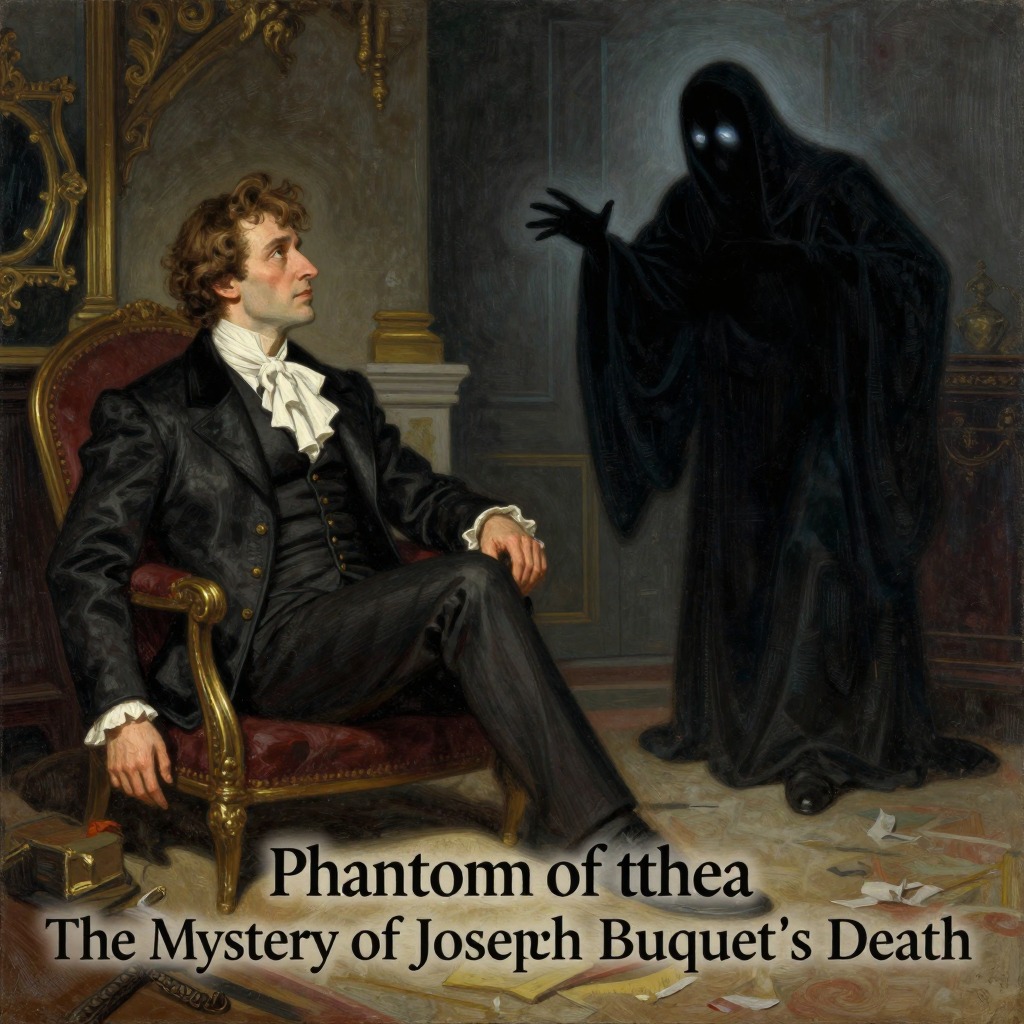
Joseph Buquet
Joseph Buquet, the chief scene-shifter at the Paris Opera House, is the first character to provide a concrete, horrifying description of the Opera Ghost, and his sudden, unexplained death transforms the ghost from a rumor into a deadly reality. His testimony and his fate become the foundational evidence that the ghost is not merely a superstition but a physical, murderous entity, driving the plot forward and deepening the atmosphere of terror that pervades the Opera.
Identity and Role
Joseph Buquet is the chief scene-shifter at the Paris Opera House, a position that places him in constant contact with the building's vast, shadowy infrastructure. He is described as a "serious, sober, steady man, very slow at imagining things," a detail that lends considerable weight to his account of seeing the ghost. His reliability as a witness makes his testimony all the more disturbing when he describes the ghost as "extraordinarily thin," with a dress-coat hanging on a "skeleton frame," eyes that are "two big black holes, as in a dead man's skull," and skin stretched across his bones "like a drumhead," a "nasty yellow" color. He notes the "absence of that nose" as a horrible thing to look at, and mentions only "three or four long dark locks" of hair on the forehead and behind the ears. This description, circulated among the ballet girls and others, becomes the canonical image of the ghost, a figure of skeletal, noseless horror.
Death and Its Aftermath
Buquet's death occurs on the same evening as the retirement gala for managers Debienne and Poligny. His body is discovered hanging in the third cellar, between a farm-house set piece and a scene from the opera Roi de Lahore. The news is brought to the dressing-room of the dancer Sorelli by Ma Jammes, the mother of the ballet girl little Jammes, who bursts in and announces, "Joseph Buquet is dead!" The immediate reaction among the superstitious ballet girls is to blame the ghost, with little Giry blurting out, "It's the ghost!" The official verdict at the inquest is "natural suicide," but the circumstances are suspicious. In his Memoirs of a Manager, Moncharmin records that when he rushed to cut the body down, the rope had already disappeared, a detail that the narrator of the novel suggests points to the ghost's involvement. The narrator speculates that "somebody must have been interested in seeing that the rope disappeared after it had effected its purpose." The body is later carried past Raoul de Chagny on a stretcher, covered with a white sheet, as he wanders dazed through the Opera.
Narrative Significance
Buquet's death serves as the first major, indisputable act of violence attributed to the Opera Ghost, transforming the ghost from a subject of gossip and pranks into a genuine threat. His detailed description of the ghost's appearance provides the visual template for the monster that haunts the narrative, a template that is later confirmed and deepened when Christine Daae tears off Erik's mask. Furthermore, the location of Buquet's death—between the set piece and the scene from Roi de Lahore in the third cellar—is precisely the spot where the Persian later discovers the secret entrance to Erik's house on the lake. The Persian finds the Punjab lasso, the instrument of strangulation, at the foot of the iron tree in the torture chamber, and concludes that Buquet must have stumbled upon Erik's secret, tried to enter the chamber, and was hanged there, his body then moved to the public location as a warning. Buquet's fate thus not only establishes the ghost's murderous capability but also physically marks the threshold to the monster's hidden domain.