Ely
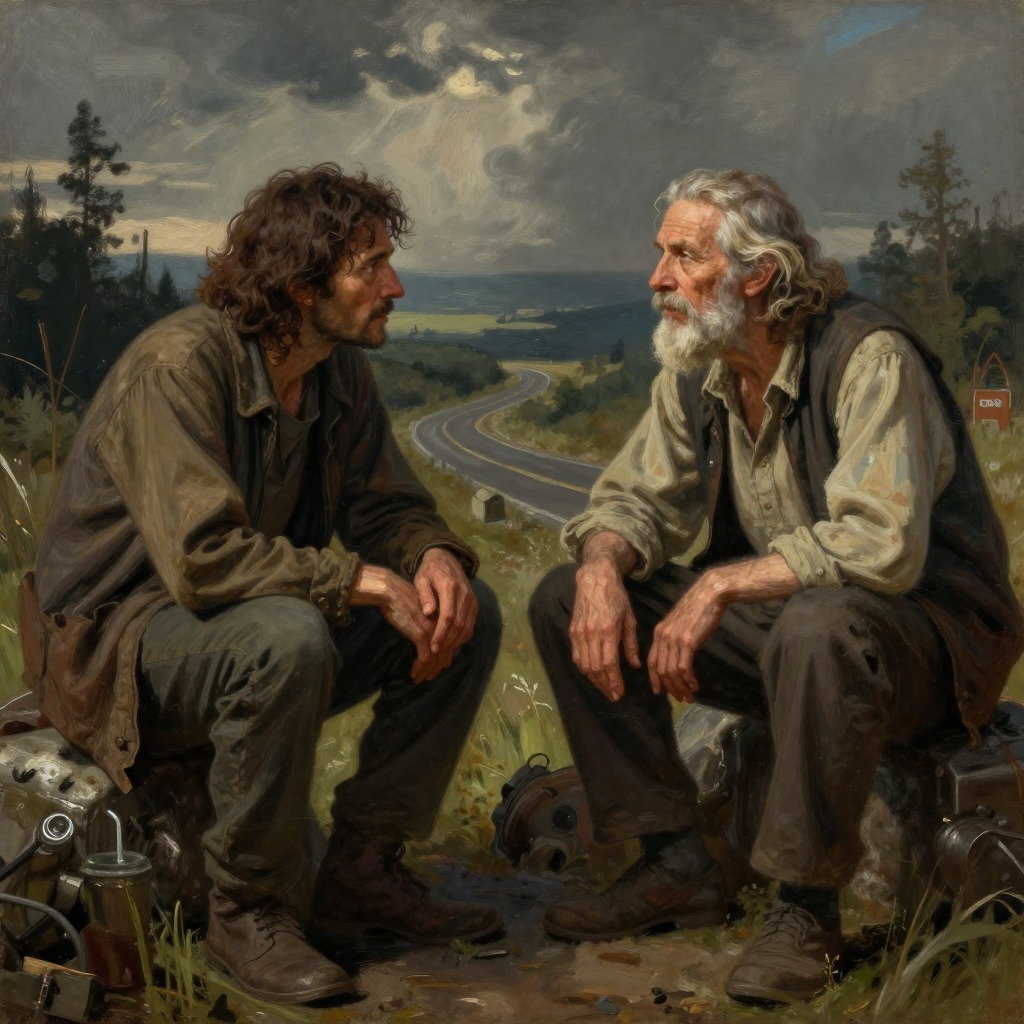
Ely is a small, bent, and ancient traveler who appears on the road late in the man and the boy's journey, a figure who seems to have stepped out of a storybook from an antique time. He carries an old army rucksack and taps along with a peeled stick for a cane, his feet wrapped in rags and cardboard. He is filthy and smells terrible, and his first words to the armed man are a desperate claim of having nothing. He is a survivor who has lived by his wits, a self-described "nothing" who has been on the road for so long he claims he was "always on the road." His arrival forces a direct confrontation between the boy's innate compassion and the man's hardened pragmatism, and his cynical philosophy provides a dark counterpoint to the father's desperate hope.
Encounter and Character
The man and the boy first spot Ely as a small, bent figure shuffling down the road. When they overtake him, he is terrified, veering to the side and insisting he has nothing. He is nearly blind, and his appearance is one of extreme decrepitude: he wears a filthy towel tied under his jaw, his feet are wrapped in rags and cardboard, and he smells terrible. He claims to be ninety years old, a lie he tells so people won't hurt him, though he admits it does not work. He refuses to give his real name, saying he cannot trust anyone with it, and offers the name "Ely" instead. He is a man who has lived like an animal, and he admits he has eaten things he does not want to remember. When he first sees the boy, he thinks he has died and that the child is an angel.
Philosophy and Beliefs
Ely is a thoroughgoing pessimist and a nihilist. He claims he always believed the end of the world was coming, but he never tried to prepare for it, because he did not believe in tomorrow. He argues that there is no God, and that if there were, he and the man would be his prophets. He tells the man that to be on the road with the last god would be a terrible thing, and he hopes it is not true. He believes that things will be better when everybody is gone, and that death himself will eventually have nothing to do. He is a figure of pure survival, stripped of all sentiment, and his worldview is a stark rejection of the man's belief that the boy is a warrant for the world's continued meaning.
The Boy's Compassion and the Man's Pragmatism
The boy is immediately moved by Ely's condition, wanting to give him food and even asking if they can keep him. The man, however, is deeply suspicious, seeing Ely as a potential decoy or a threat. He reluctantly agrees to let the old man eat with them, but he is curt and guarded. The boy's compassion is a direct challenge to the man's survival logic, and the man's anger at the boy's insistence reveals the deep tension between their two moral codes. The man ultimately gives Ely some canned goods, but only after the boy argues for it, and he refuses to give him a spoon. The encounter ends with the man refusing to wish Ely luck, and the old man walking away, dwindling on the road behind them like a storybook peddler, soon to vanish forever.
Thematic Significance
Ely serves as a dark mirror to the man, embodying a future the man fears: a life of pure, isolated survival without love or purpose. He is a living refutation of the man's belief that the boy is the word of God, and his cynical philosophy forces the man to confront the possibility that his own hope is a lie. The boy's compassion for Ely, however, is a crucial test of his character, proving that he is still capable of seeing the good in others even when his father cannot. Ely's final, haunting question—"What if I said that he's a god?"—lingers over the rest of the novel, suggesting that the boy's goodness may be the only sacred thing left in a world that has lost all faith.