Coppelius
Coppelius is the central antagonist of E. T. A. Hoffmann's "The Sandman", a figure who embodies the story's deepest terrors by straddling the line between the childhood bogeyman and a real, malevolent adult. He is the agent of Nathaniel's most devastating traumas—the violent assault in his father's hidden laboratory, the father's mysterious death, and the shattering revelation that Nathaniel's beloved Olympia is a lifeless automaton—and his reappearances across the narrative drive Nathaniel from a state of anxious dread into full-blown madness and suicide. Coppelius is not merely a villain but a principle of horror: the familiar made monstrous, the repressed returning with annihilating force.
Identity and Appearance
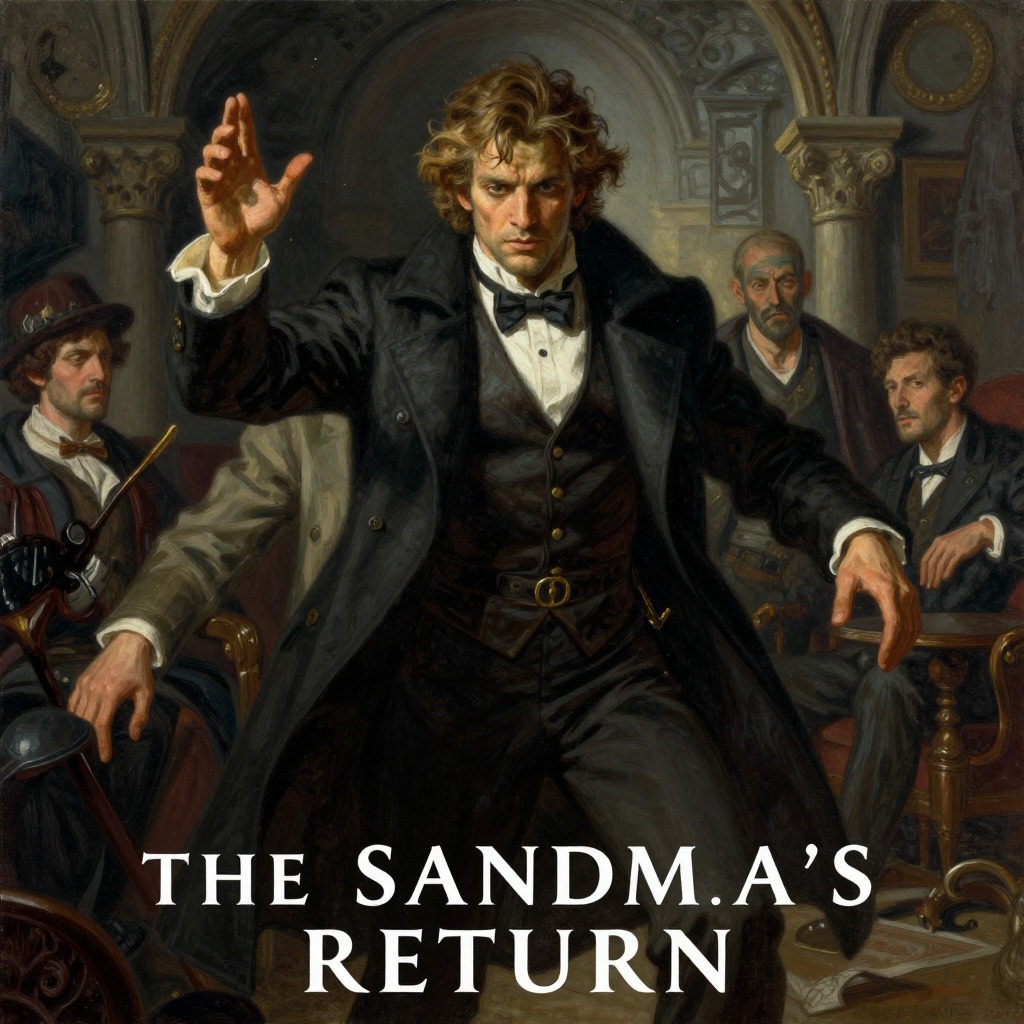
Coppelius is introduced to the reader through Nathaniel's childhood memory as the old barrister who sometimes dined with the family for lunch. His physical description is one of the most grotesque in the story: a big, broad-shouldered man with a misshapen, clumpish head, an ochre-coloured face, and grey, bushy eyebrows beneath which a pair of piercing, greenish cat's eyes peer forth. A big nose bends down over his upper lip, and his crooked mouth often twists into a crafty snigger, at which dark red spots appear on his cheeks and a curious hissing tone issues from between his clenched teeth. He always dresses in an old-fashioned ash-grey coat, a waistcoat and pants of the same colour, with black socks and shoes affixed with tiny buckles. His minuscule toupee hardly covers his skull, his ear-locks hang out over his big red ears, and a big, half-hidden tuft of hair pokes out from the scruff of his neck, revealing the silver clasp of his collar. His entire appearance is repulsive and disgusting, but what disgusts the children most are his big, knotty, hairy fists. He takes great pleasure in using these fists to spoil the children's treats: he grazes a piece of cake or sweet fruit that their mother has surreptitiously dropped on their plates, so that repulsion keeps them from enjoying it, and he passes his fist over a glass of sweet wine, even bringing it to his blue lips, laughing a devilish laugh when the children vent a sniffle of anger. He always calls the children "little beasts." Nathaniel's mother seems to hate him as much as the children do; as soon as he appears, her high spirits and cheerful manner fade into a sad and dour solemnity. Nathaniel's father, by contrast, behaves in his presence as if he were a higher being whose incivility must be tolerated, making only timid suggestions and serving his favourite dishes and finest wines.
The Sandman and the Childhood Trauma
Coppelius is the real-world identity of the Sandman, the figure of Nathaniel's childhood terror. The Sandman is first invoked by Nathaniel's mother as a bedtime threat: "Now children, to bed! To bed with you! The Sandman's coming, I can sense it!" The old nanny gives the Sandman a gruesome mythology: he is a bad man who flings sand in children's eyes so they scratch themselves bloody, then flings them in his bag and carries them off to the half-moon to feed his children, who sit up there in their nest with crooked beaks like owls with which they pick out the eyes of naughty human brats. Nathaniel's childish imagination paints a grim picture of this Sandman, and he trembles with fear and horror whenever he hears the lumbering step on the stairs. Even when he grows old enough to know the nanny's story cannot be true, the Sandman remains entrenched in his mind as a hair-raising spook. The desire to see the fabled Sandman with his own eyes grows stronger from year to year. When Nathaniel finally hides in his father's study to catch a glimpse, he discovers that the Sandman is none other than the old barrister Coppelius. The realization is devastating: the Sandman is no longer a fairy-tale bogeyman but a hideous, ghastly fiend who brings misery and want, temporal and eternal rack and ruin wherever he appears.
The Alchemical Laboratory and the Assault on Nathaniel
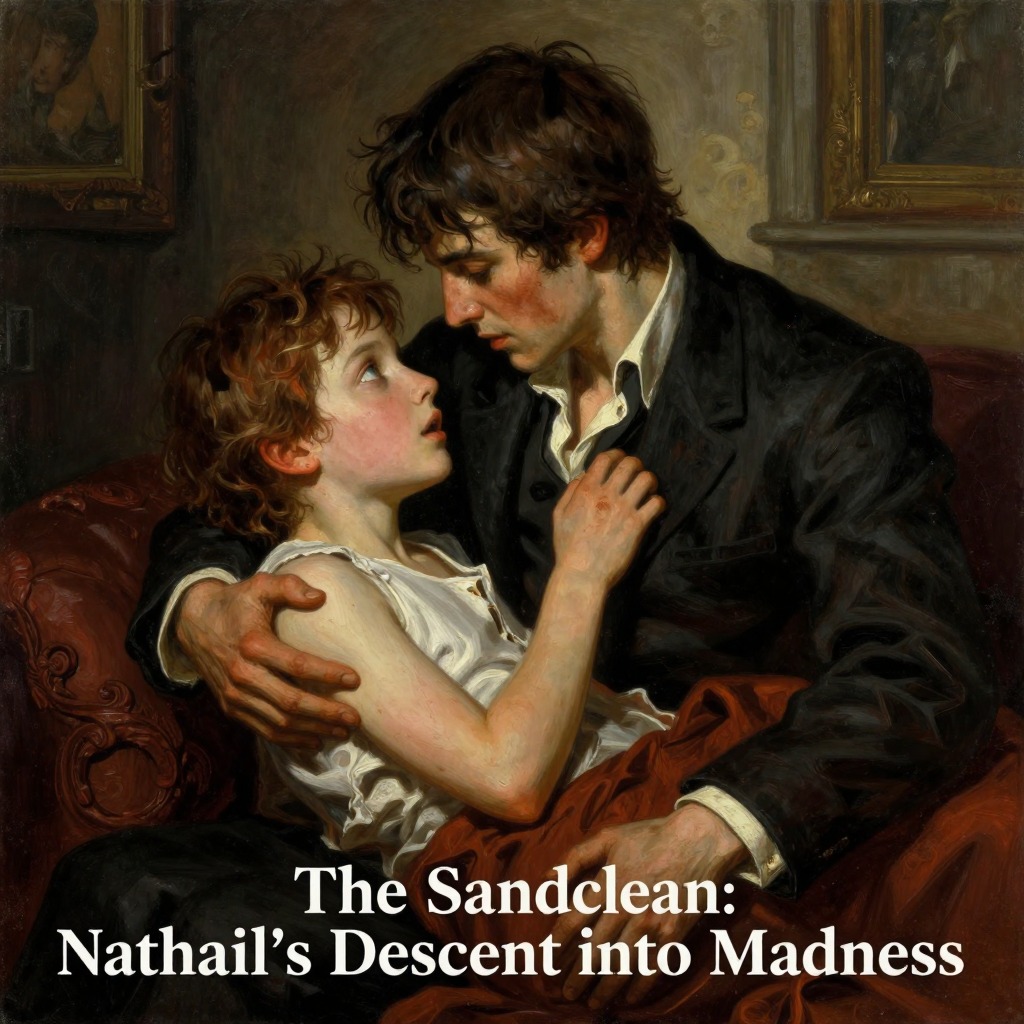
The night of Nathaniel's discovery reveals Coppelius's true activity. Nathaniel, hidden behind a curtain, watches as his father receives Coppelius respectfully. Coppelius cries "Up now! To work!" and throws off his coat. In grim-faced silence, father flings off his dressing gown, and both pull on long black smocks. Father opens the folding door of a wall closet, which is not a closet at all but a dark, hidden space fitted with a small hearth. Coppelius steps forward, and a blue flame flickers forth. All kinds of curious instruments are scattered about. As Nathaniel's old father bends down towards the fire, he looks altogether different: a ghastly convulsive pain seems to have twisted his gentle, honest features into a devilish grimace, making him look just like Coppelius. The latter swings red-hot tongs and fetches a bright, flickering mass of ore out of the thick vapour, which he then assiduously hammers. It seems to Nathaniel as if human faces become visible all about, but without eyes—dreadful, deep, black hollows where the eyes ought to be. Coppelius cries out with a muffled, roaring voice: "Eyes out, eyes out!" Gripped by wild terror, Nathaniel lets out a scream and bursts out of his hiding place onto the floor. Coppelius grabs hold of him and, baring his teeth, grumbles, "Little beast! Little beast!" Picking him up, he hurls him at the hearth, so that the flames singe his hair. He whispers, "Now we've got eyes—eyes—a lovely pair of children's eyes," and with his fists grabs glowing cinders from the flames which he intends to strew in Nathaniel's eyes. Nathaniel's father pleads with hands folded in prayer: "Master! Master! Let my Nathaniel keep his eyes! Let him keep them, I beg you!" Coppelius gives off a shrill laugh and cries out: "Let the boy keep his eyes and whimper his lesson through life; but let us take a close look at the mechanism of the hands and feet." He then grasps Nathaniel so hard that his joints snap, and twists off his hands and feet and reinserts them here and there, sputtering and lisping: "'Tis not right this way! 'Twas good the way it was! The old man got it right!" Everything goes dark, a sharp cramp flits through Nathaniel's nerves and limbs, and he feels nothing. He awakens as if out of a deathlike sleep, with his mother bent over him, and his first words are: "Is the Sandman still here?" He lies sick with a high fever for several weeks.
The Death of Nathaniel's Father
About a year after the assault, Coppelius returns. The family is sitting at the round table when, at the strike of nine, they hear the front door hinges creak and slow, leaden steps thump through the hallway and up the steps. Nathaniel's mother goes pale and says, "It's Coppelius." Father confirms with a weak and broken voice, "Yes! It is Coppelius." Tears stream from mother's eyes. She cries, "But father, father! Must it be so?" He replies, "This one last time, it's the last time he comes here, I promise you. Just go, go with the children! Go! Go to bed! Goodnight!" Nathaniel feels as if pressed into cold, heavy stone; his breath stands still. He cannot sleep. At around midnight, a terrible boom goes off, as if a cannon had been fired. The whole house rumbles, it rattles and roars past his door, the front door is slammed shut with a mighty clatter. Nathaniel cries out, "That's Coppelius!" and leaps from his bed. A piercing shriek and a wretched wail follow, and he rushes to his father's room. The door stands open, a suffocating steam hits him in the face, the chambermaid cries out: "Oh, the master! The master!" In front of the steaming hearth, Nathaniel's father lies dead on the floor with his terribly contorted face burnt black. Nathaniel cries out, "Coppelius, you cursed Satan, you killed my father!" and loses consciousness. Two days later, when they lay his father in his coffin, his expression is once again mild and gentle as it had been in life. The explosion awakens the neighbours; the incident seems suspicious, and the authorities issue a warrant for Coppelius's arrest, but he has disappeared without a trace.
Reappearance as Coppola and the Destruction of Nathaniel
Years later, when Nathaniel is a student in the city of G., Coppelius reappears under the alias Giuseppe Coppola, a Piedmontese mechanic and barometer salesman. Nathaniel immediately recognizes him: "Coppelius' physique and facial features are too deeply engraved in my memory for me to mistake him for another. Moreover, Coppelius did not even change his name. He now pretends to be a Piedmontese mechanic and calls himself Giuseppe Coppola." Nathaniel resolves to confront him and avenge his father's death. However, Professor Spalanzani, a physicist of Italian descent, claims to have known Coppola for a good many years and assures Nathaniel that he is genuinely Piedmontese, not the German Coppelius. Nathaniel is not altogether calmed down, but he begins to doubt his own perception. The decisive encounter occurs when Coppola visits Nathaniel's room to sell his wares. He shoves aside his barometers, reaches into his deep coat pocket, and pulls out spectacles and eyeglasses, laying them out on the table. He says, "Look—glass—glass—what you put on you nose, eyes a pretty—eyes a pretty!" A thousand eyes seem to peep and twitch and stare at Nathaniel; he is overcome by frantic horror and cries out, "Stop it! Stop it, you wretched creature!" But Coppola shakes himself free and, with a hoarse, repulsive laugh, mutters, "Oh! This not for you! But look here, lovely glass!" He sweeps up all the eyeglasses and pulls out a number of big and little telescopes and field glasses. Nathaniel, calming down, decides to buy something to make amends. He reaches for a small, very finely crafted pocket looking-glass and, to test it, peers out of the window. Through this lens, he sees Olympia, Spalanzani's daughter, for the first time with startling clarity. Her eyes, which had appeared strange, blank, and dead, now seem to flash open in moist moonbeams; her glances grow livelier and livelier. Nathaniel is transfixed. He buys the looking-glass for three ducats. From that moment, Olympia's image erases Clara's from his heart, and he becomes obsessed with the figure he sees through Coppola's glass.
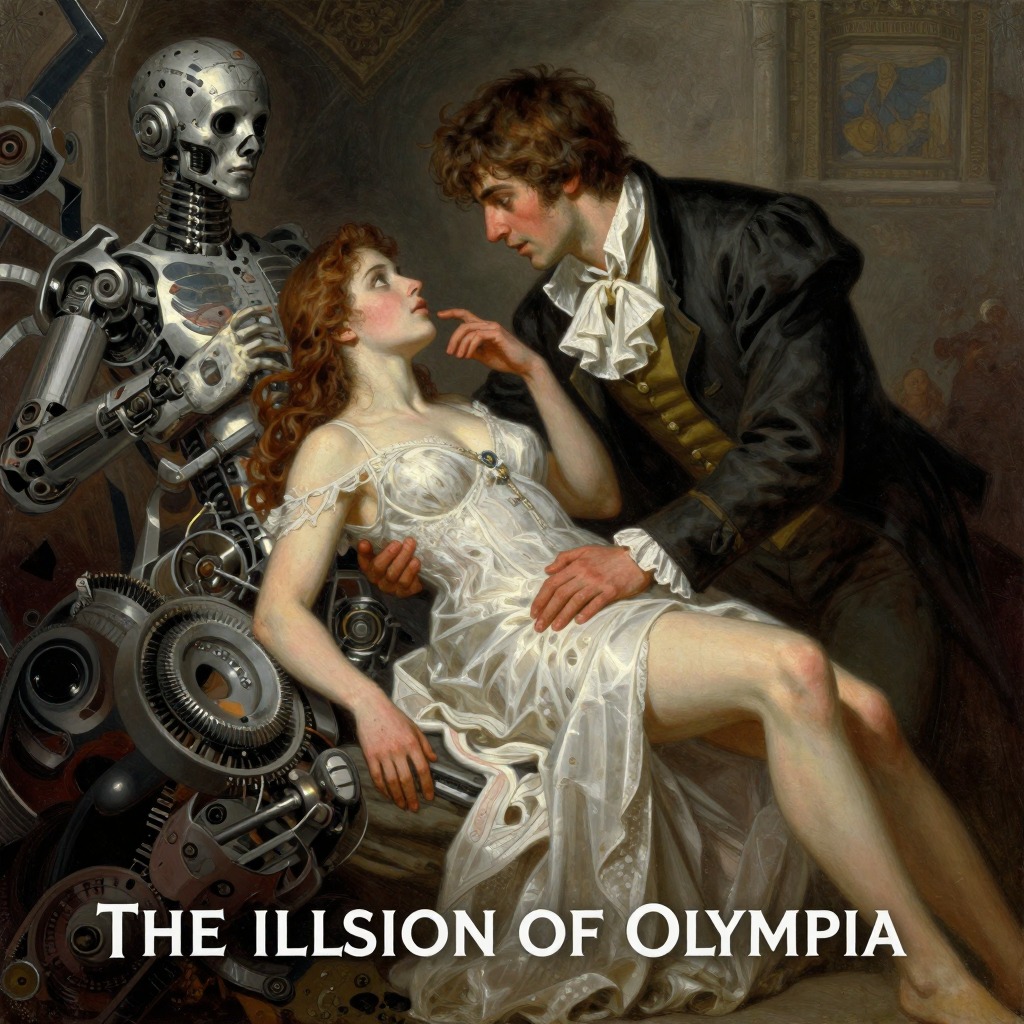
The climax of Coppelius's destructive work comes at the moment of Olympia's revelation. Nathaniel, having decided to propose to Olympia, rushes to Spalanzani's house and hears a strange din: a stamping of feet, a clatter, a shoving, a pounding on the door, interspersed with coarse words and hurled imprecations. The voices of Spalanzani and Coppelius screech and rage. Nathaniel bursts in and sees the Professor holding a female figure by the shoulders, while Coppola holds her by the feet; they tug and tear her here and there, furiously fighting for possession. Nathaniel recognizes the figure as Olympia. With a mighty burst of strength, Coppola yanks the figure free from the Professor's hands and, swinging her in his direction, lands Nathaniel such a stunning blow that he tumbles backwards over the work table, toppling and knocking down phials, retorts, bottles, and measuring glasses. Then Coppola flings the figure over his shoulder and races with a repulsive, shrill laugh down the steps, so that the ugly dangling feet of the figure bang with a wooden thud and thump on the steps. Nathaniel sees all too clearly that Olympia's deathly pallid wax face has no eyes, but black hollows in their stead; she is a lifeless doll. Spalanzani, bleeding from glass shards, cries out: "After him—after him—why do you waver? Coppelius—Coppelius has robbed me of my finest automaton—twenty years' work—life and limb invested—the clockwork—speech—step—all mine—the eyes—the eyes robbed from you. Cursed hellhound! After him—fetch me back Olympia—there are her eyes!" Nathaniel then spots a pair of bloody eyes peering at him from the floor. Spalanzani grasps them with his uninjured hand and flings them at him so that they strike him on the breast. At that moment, madness grabs Nathaniel, and he begins to rave about a "ring of fire" and a "wooden doll." He is taken to the madhouse.
Final Appearance and Nathaniel's Death
Coppelius's final appearance is at the market square, just before Nathaniel's suicide. Nathaniel, seemingly recovered and living with his mother, Clara, and Lothar, climbs the town hall tower with Clara. He mechanically reaches into his coat pocket, finds Coppola's looking-glass, and turns it sideways. Clara is in the eye of the lens. A spasmodic quiver starts up in his veins and arteries; turning deathly pale, he peers at Clara, but soon sparks of fire flash from his rolling eyes. He lets out a horrible cry like a hunted animal, jumps high in the air, and screams out shrilly: "Turn, little wooden doll, turn!" He grabs hold of Clara and tries to hurl her off the balcony. Lothar rescues her, but Nathaniel keeps flailing about on the lookout gallery, jumping and crying: "Ring of fire, turn! Ring of fire, turn!" A throng gathers below, including the lawyer Coppelius, who has just come to town and made straight for the market place. Some people want to climb the tower to capture the madman, but Coppelius laughs and says: "Ha ha, just be patient, he'll be down shortly on his own initiative!" Nathaniel suddenly stops dead in his tracks. He leans down, spots Coppelius below, and with a shrill shriek—"Ha! Eyes a pretty! Eyes a pretty!"—he leaps over the parapet. As Nathaniel lands, his skull smashes on the cobblestones, while Coppelius disappears in the crowd. Coppelius thus vanishes from the story as he has always done, leaving destruction in his wake and never facing justice.