Pearl
Pearl is the daughter of Hester Prynne and Arthur Dimmesdale, born three months before the novel opens and introduced as a baby of some three months old who winces at the too vivid light of day when her mother emerges from prison. She is named Pearl by her mother, not for a calm white lustre but as being of great price—purchased with all her mother had, her only treasure. From infancy she is a creature of extraordinary beauty and strangeness: perfect in shape, vigorous, and naturally dexterous, with a native grace that makes even the simplest attire seem the very garb that becomes her best. Yet there is always a trait of passion in her, a certain depth of hue she never loses, and her outward mutability indicates the various properties of her inner life—a nature that lacks reference and adaptation to the world into which she was born, as if a great law had been broken in giving her existence and the result were a being whose elements are beautiful and brilliant but all in disorder.
Identity and Appearance
Pearl is described as tall for her age, with dark and abundant hair, a bright complexion, and eyes possessing intensity both of depth and glow. Her mother, with a morbid purpose, dresses her in the richest tissues that can be procured, arraying her in a crimson velvet tunic abundantly embroidered with fantasies and flourishes of gold thread. This garb irresistibly reminds the beholder of the scarlet letter on Hester's bosom—it is the scarlet letter in another form, the scarlet letter endowed with life. Pearl herself seems the unpremeditated offshoot of a passionate moment, and there is fire in her and throughout her. She is the very brightest little jet of flame that ever danced upon the earth. Yet a russet gown, torn and soiled with rude play, makes a picture of her just as perfect, for her aspect is imbued with a spell of infinite variety, comprehending the full scope between the wild-flower prettiness of a peasant-baby and the pomp of an infant princess.
Life and Plot Trajectory
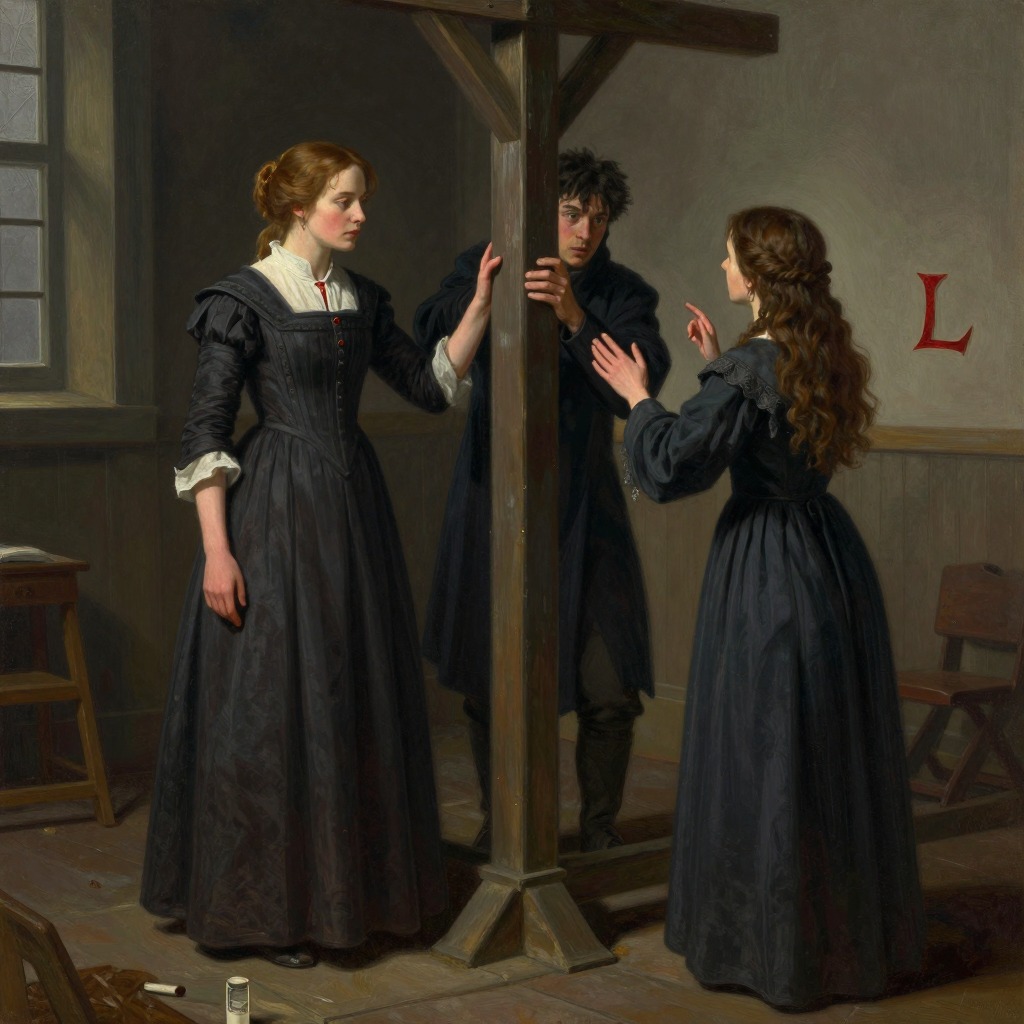
From the moment of her birth, Pearl is an outcast. She is a born outcast of the infantile world, an imp of evil, emblem and product of sin, with no right among christened infants. She comprehends her loneliness by instinct, and never seeks to make acquaintance with other children. When the little Puritans gather about her, she grows positively terrible in her puny wrath, snatching up stones to fling at them with shrill, incoherent exclamations. At home, she creates a wide and various circle of imaginary acquaintance, throwing her intellect into a vast variety of forms with no continuity but always in a state of preternatural activity. She never creates a friend but seems always to be sowing broadcast the dragon's teeth, whence springs a harvest of armed enemies against whom she rushes to battle. As she grows, she becomes the constant companion of her mother's walks about the town, holding a forefinger with her whole grasp and tripping along at the rate of three or four footsteps to one of Hester's. She is present at the Governor's hall when the attempt is made to take her away, and it is her father's eloquent plea that saves her for her mother. She is present at the minister's midnight vigil on the scaffold, where she asks him to stand with her and her mother tomorrow noontide, and when he refuses, she laughs and attempts to pull away her hand. In the forest, she refuses to cross the brook to her mother until the scarlet letter is resumed, and she washes off the minister's kiss from her forehead in the water. On Election Day, she is in the marketplace, and when the minister finally reveals his sin on the scaffold, she kisses his lips, and a spell is broken.
Key Actions and Objectives
Pearl's most significant actions are driven by an uncanny instinct to confront the truth of the scarlet letter. The very first thing she noticed in her life was the scarlet letter on Hester's bosom; as an infant, she grasped at it with a decided gleam, causing her mother infinite torture. Throughout her childhood, she repeatedly points at the letter, throws flowers at it, and arranges prickly burrs along its lines. She asks persistent questions about its meaning and about why the minister keeps his hand over his heart. In the forest, when Hester removes the scarlet letter, Pearl refuses to cross the brook until it is put back on, and she kisses the letter after kissing her mother's cheeks. Her final act is to kiss her dying father's lips on the scaffold, which breaks the spell and develops all her sympathies, pledging that she will grow up amid human joy and sorrow and be a woman in it.
Relationships and Conflict
Pearl's relationship with her mother is one of intense love and mutual torture. Hester feels that Pearl keeps her in life and punishes her too, that she is the scarlet letter only capable of being loved and so endowed with a millionfold the power of retribution for her sin. Pearl often seems more an airy sprite than a human child, with a look so intelligent yet inexplicable and perverse that Hester cannot help questioning whether she is human. Yet there is love in the child's heart, though it mostly reveals itself in passion. Her relationship with her father is marked by instinctive recognition and rejection. She is kind to him twice in her little lifetime: once when she lays her cheek against his hand at the Governor's hall, and once when she kisses him on the scaffold. But she refuses to cross the brook to him in the forest, and she washes off his kiss. She is hostile to other children, and the little Puritans scorn her and her mother. She is also connected to the supernatural world through Mistress Hibbins, who calls her of the lineage of the Prince of Air and invites her to ride with her.
Change and Ending
After the revelation on the scaffold, Pearl undergoes a profound transformation. The great scene of grief develops all her sympathies, and as her tears fall upon her father's cheek, they are the pledge that she will grow up amid human joy and sorrow, nor forever do battle with the world, but be a woman in it. Towards her mother, her errand as a messenger of anguish is fulfilled. After Roger Chillingworth's death, Pearl becomes the richest heiress of her day in the New World, inheriting a very considerable amount of property both in England and in New England. She then disappears with her mother, and though no tidings of them are received for many years, it is believed that she is not only alive but married, happy, and mindful of her mother, and that she would most joyfully have entertained that sad and lonely mother at her fireside.
Narrative Role and Evaluation
Pearl functions as the living hieroglyphic of the novel's central secret, the visible union of her parents' sin and love. She is the connecting link between Hester and Dimmesdale, and her presence forces both to confront the truth. She is also a symbol of the wild, natural world that stands in opposition to the rigid Puritan society. Her elfish, preternatural qualities make her seem at times more a spirit than a child, and she is associated with the forest, the brook, and the natural world. Her final transformation into a sympathetic human being signals the possibility of redemption and the breaking of the cycle of guilt and secrecy. She is one of the most memorable and complex child characters in American literature, embodying both the consequences of sin and the promise of a new beginning.