Roger Chillingworth
Roger Chillingworth is one of the central figures in Nathaniel Hawthorne's The Scarlet Letter, a man whose identity is defined by a single, consuming purpose: the pursuit of revenge. He arrives in Boston as a stranger, a physician of great skill, but is secretly the long-lost husband of Hester Prynne. His entire arc is a study in moral decay, as he willingly transforms himself from a man of intellect and principle into a fiend, whose only joy comes from the protracted torment of his victim. He is the embodiment of a cold, calculated evil that operates in the shadows, a dark mirror to the public shame of Hester and the private agony of Dimmesdale.
Identity and Arrival
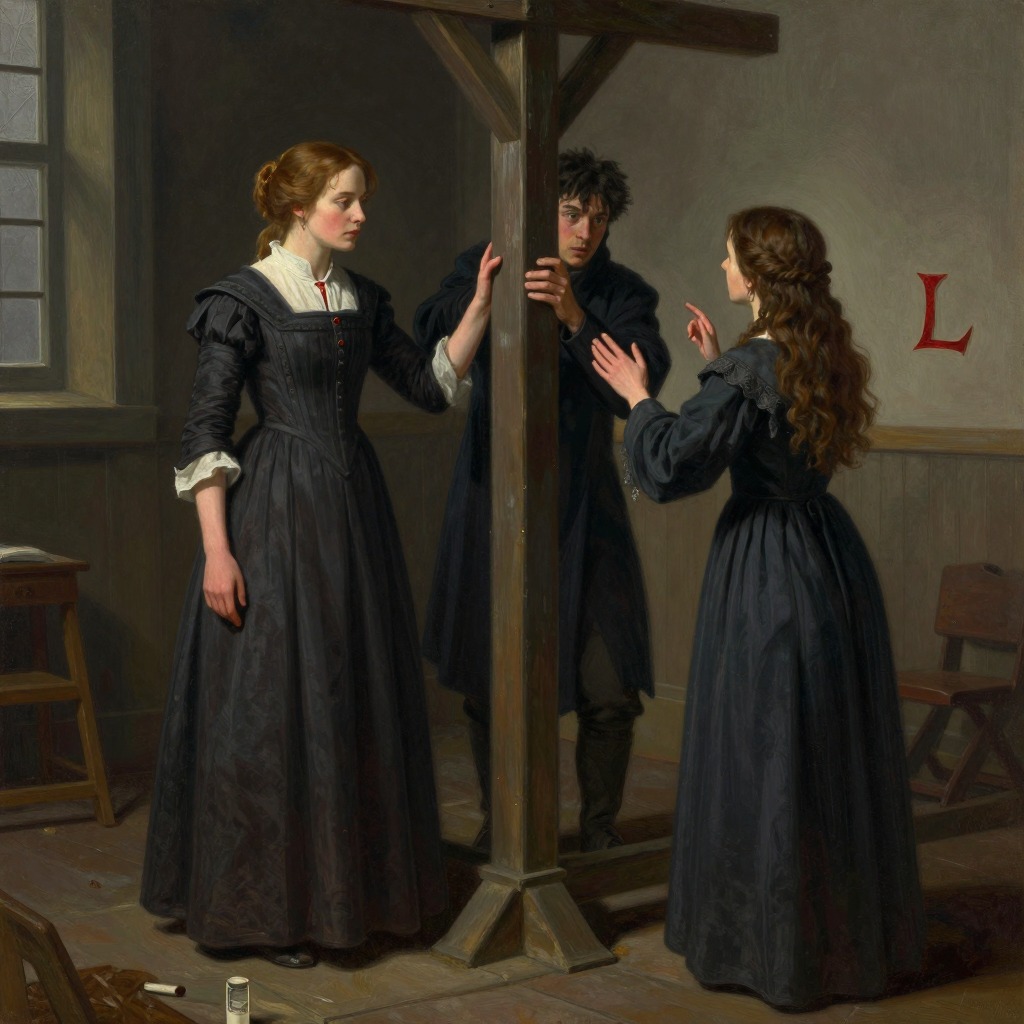
Chillingworth first appears in the novel as a figure on the outskirts of the crowd during Hester Prynne's public shaming on the scaffold. He is described as small in stature, with a furrowed visage and a remarkable intelligence in his features. A key physical detail, one that Hester immediately recognizes, is a slight deformity: one of his shoulders rises higher than the other. He is clad in a strange disarray of civilized and savage costume, standing beside an Indian, and he presents himself as a man who has been a wanderer, held in bonds among heathen folk to the southward. His name is announced as Roger Chillingworth when he is lodged in the prison, not as a suspect, but as a convenient arrangement until his ransom can be settled. He presents himself to the Puritan community as a physician, a man of skill in all Christian modes of physical science, also familiar with medicinal herbs and roots taught by the savage people. His arrival is seen as providential, especially given the failing health of the young minister, Arthur Dimmesdale.
The Scholar and the Husband
Before his transformation, Chillingworth was a man of thought and study. He describes himself as a book-worm of great libraries, a man already in decay who had given his best years to feed the hungry dream of knowledge. He admits to Hester in the prison that his heart was a habitation large enough for many guests, but lonely and chill, and that he drew her into it, seeking to warm himself by her presence. He acknowledges his own folly in marrying a young and beautiful woman, recognizing that his misshapen form and intellectual preoccupations were a poor foundation for love. He tells Hester, "I felt no love, nor feigned any," and she confirms this. His initial reaction to her public shame is not one of hot-blooded rage, but of a cold, calculating bitterness. He resolves to discover her partner in iniquity, stating, "He will be known!" and he makes Hester swear an oath to keep his true identity a secret, a bond he uses to control her.
The Leech and His Patient
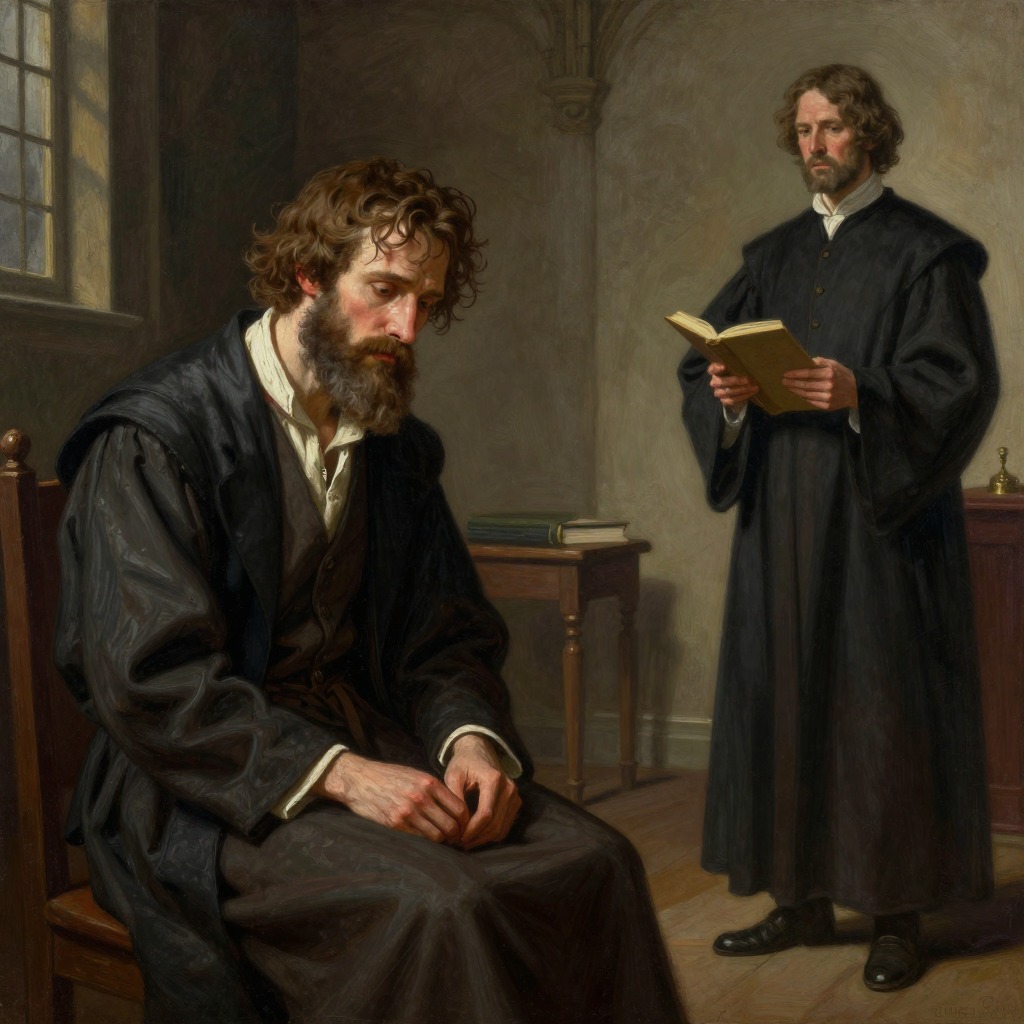
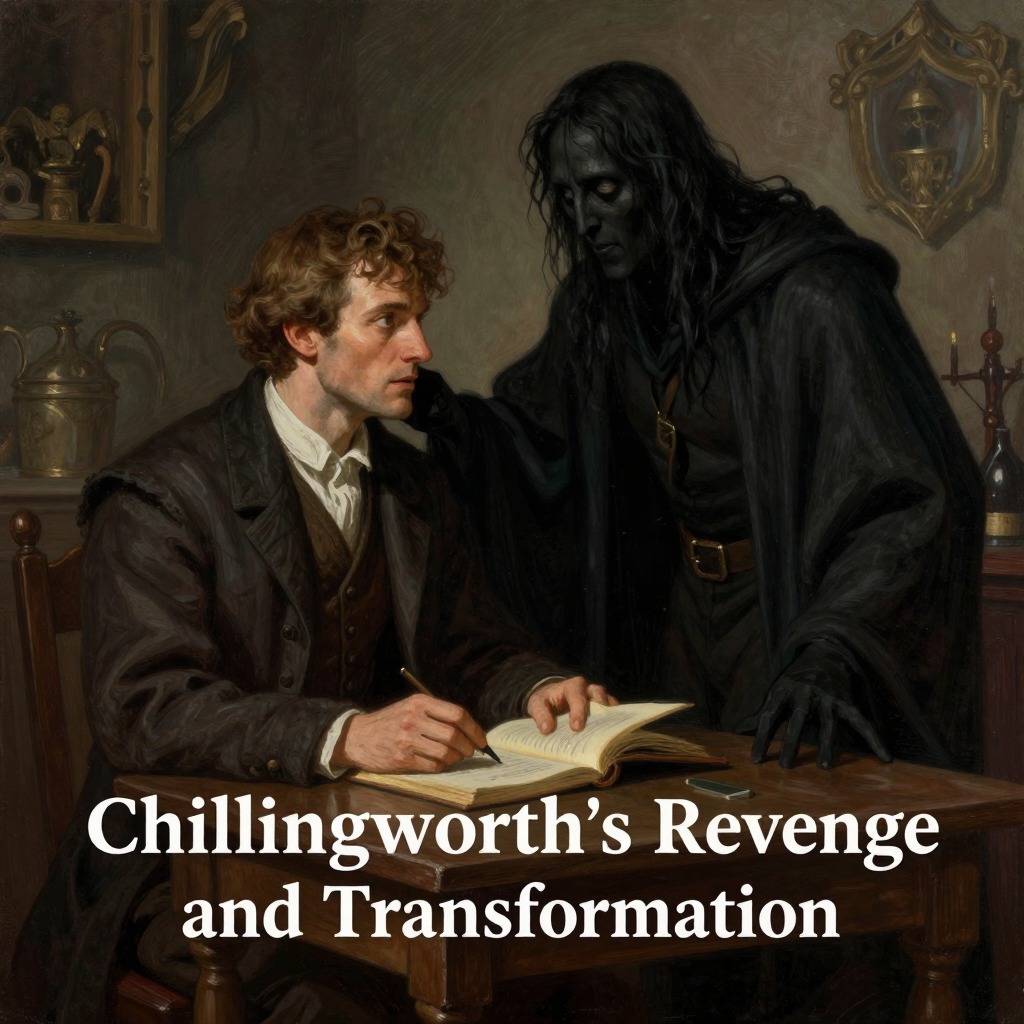
Chillingworth's primary role in the narrative is as the physician and constant companion to Arthur Dimmesdale. He moves into the same house as the minister, ostensibly to care for his failing health, but in reality to probe his soul. He becomes a "leech" in both the medical and the parasitic sense, drawing close to his victim to feed on his secret. He is described as a miner searching for gold, or a sexton delving into a grave, as he digs into the poor clergyman's heart. His method is one of psychological torture, using his intimate knowledge of the minister's sensitive nature to keep him in a state of constant agony. He becomes a chief actor in the poor minister's interior world, able to play upon him as he chooses, arousing him with a throb of agony or startling him with sudden fear. The moment of his greatest triumph comes when he discovers the secret, finding Dimmesdale asleep and thrusting aside his vestment to reveal the mark on his breast. His reaction is one of wild wonder, joy, and horror, a ghastly rapture that makes him seem like Satan himself.
Transformation into a Fiend
The most significant aspect of Chillingworth's character is his moral transformation. He begins his investigation with the severe and equal integrity of a judge, but a terrible fascination seizes him, and he never sets himself free. He devotes himself for seven years to the constant analysis of a heart full of torture, deriving his enjoyment from it and adding fuel to the fiery tortures he analyzes. Hester is shocked by the change in him, seeing that his former aspect of an intellectual and studious man has vanished, replaced by an eager, searching, almost fierce look. A glare of red light comes out of his eyes, as if his soul were on fire. He himself admits to Hester, "I have already told thee what I am—a fiend!" He acknowledges that a mortal man, with once a human heart, has become a fiend for the especial torment of Dimmesdale. His entire existence becomes defined by his revenge, and when his victim dies, he is left with nothing, withering up and shriveling away, as if the principle of his life has been removed.
Death and Bequest
After Dimmesdale's death, Chillingworth's purpose is gone. He dies within the year, a hollow shell of the man he once was. In a final, complex act, he bequeaths a very considerable amount of property to little Pearl, the daughter of Hester Prynne and Arthur Dimmesdale. This act makes Pearl the richest heiress of her day in the New World, a final, ironic twist from a man who had dedicated his life to destroying her father. The narrator suggests that in the spiritual world, the old physician and the minister, mutual victims as they have been, may have found their earthly stock of hatred and antipathy transmuted into golden love. Chillingworth's legacy is thus one of profound ambiguity: a life of calculated evil that ends with an act of material generosity, leaving the reader to ponder the ultimate nature of his soul.