Aramis
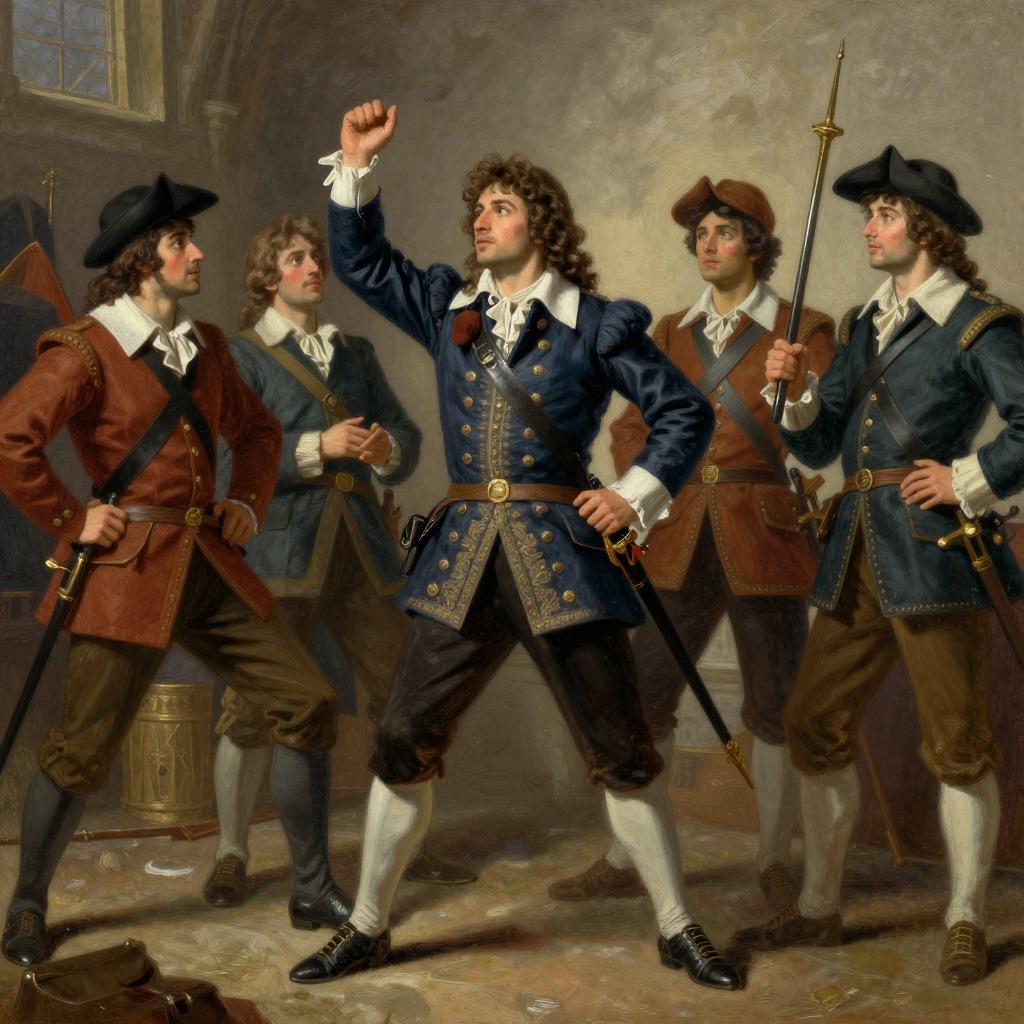
Aramis is the most complex and contradictory of the four inseparables who form the heart of Alexandre Dumas's The Three Musketeers. A Musketeer only provisionally, he is at heart a churchman, a poet, and a lover, whose life is a constant negotiation between the worldly and the spiritual. His elegance, his secret love for the powerful Madame de Chevreuse, and his ultimate decision to abandon the military life for the Church make him a figure of mystery and quiet ambition, a foil to the more straightforward bravado of his companions.
Identity and Background
Aramis, whose real name is the Chevalier d'Herblay, is introduced as a young man of about twenty-two or twenty-three, with an open, ingenuous countenance, a black, mild eye, and cheeks rosy and downy as an autumn peach. He is fastidious about his appearance, taking great care of his hands and his fine teeth, and speaks little and slowly, with a habitual bow. Unlike the taciturn Athos or the boastful Porthos, Aramis is defined by a surface of mildness and grace that conceals a deeper, more calculating nature. He is a Musketeer against his will, having been dragged into the corps by Athos and Porthos to occupy him after a scandal forced him to leave the seminary. His true vocation, he insists, is the Church, and he continues to study theology, waiting only for the right moment to resume his cassock. His servant, Bazin, a devout Berrichon, is perpetually hopeful that his master will finally take orders, and dresses in black in anticipation of serving a churchman.
Life and Plot Trajectory
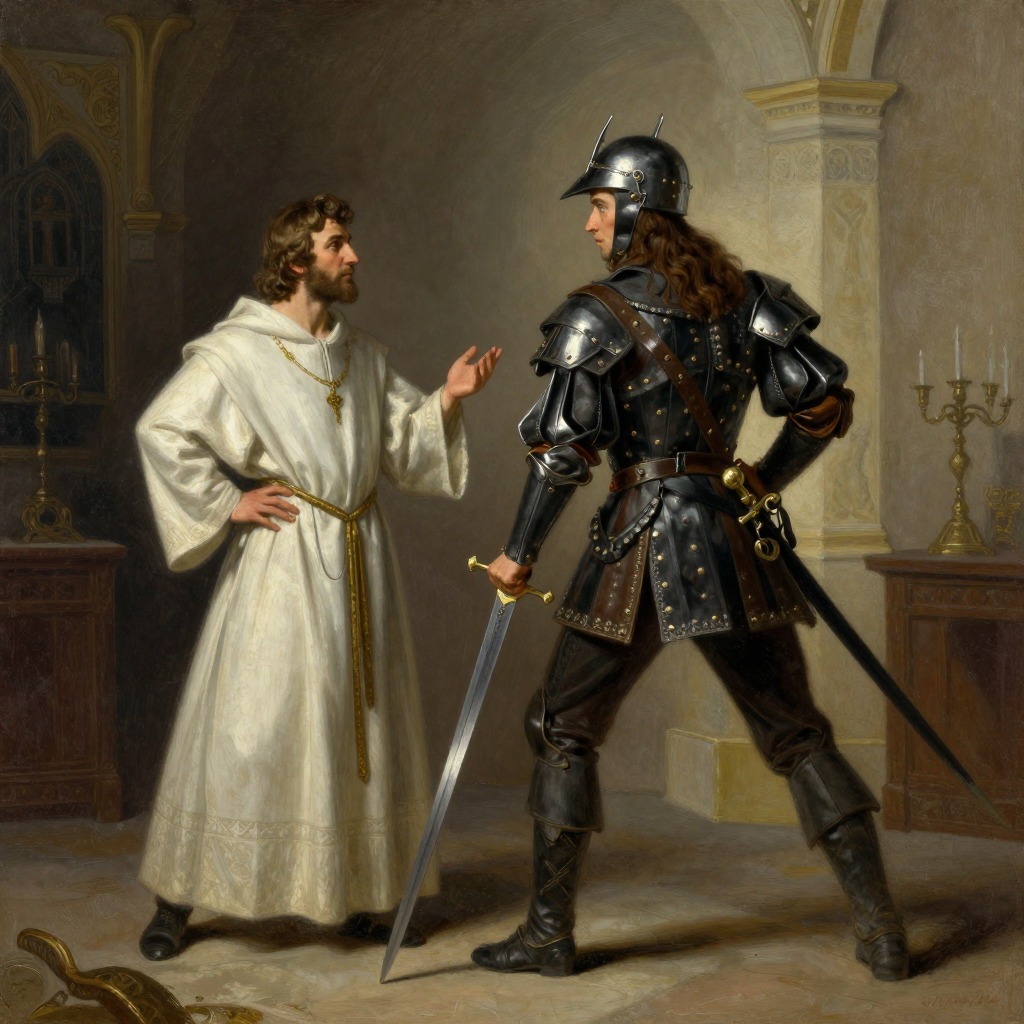
Aramis's trajectory is marked by a series of oscillations between his military duties and his clerical aspirations. He is present at the famous duel with the Cardinal's Guards, where he fights alongside his friends, and later participates in the dangerous journey to England to retrieve the queen's diamond studs. During this journey, he is wounded in the shoulder at Crevecoeur, an event he interprets as a divine warning. This wound, combined with the sudden disappearance of his mistress, throws him into a profound spiritual crisis. When d'Artagnan finds him at Crevecoeur, he is dressed in a black gown, engaged in a theological debate with a Jesuit and a curate about his thesis for ordination, a scene that parodies his intellectual pretensions. However, the arrival of a perfumed letter from his beloved, Madame de Chevreuse, instantly shatters his pious resolve, and he abandons his thesis for a feast of wine and meat. This pattern of retreat and return defines his character: he is perpetually tempted by the world even as he professes to renounce it.
Key Actions and Objectives
Aramis's primary objective is to navigate the conflicting demands of his heart, his ambition, and his faith. He is a skilled swordsman, but he fights with reluctance, preferring to use his wit and his connections. He is the group's strategist and diplomat, often providing the clever plan or the crucial piece of information. He is deeply involved in the court intrigue surrounding the queen, acting as a secret intermediary between her and Madame de Chevreuse. It is Aramis who, through his "cousin" Marie Michon (a pseudonym for Madame de Chevreuse), obtains the queen's order to release Constance Bonacieux from the convent at Bethune. He also writes the crucial letters warning Lord de Winter of Milady's plans and informing the queen of Buckingham's danger, demonstrating his skill with the pen. His actions are consistently motivated by a desire to serve his friends and his secret love, while maintaining the appearance of a man detached from worldly concerns.
Relationships and Conflict
Aramis's most significant relationship is his secret love affair with Madame de Chevreuse, a powerful and dangerous woman who is an enemy of Cardinal Richelieu. This connection gives him access to the highest levels of court intrigue but also places him in constant peril. His friendship with d'Artagnan, Athos, and Porthos is the bedrock of his existence, and he is bound by the oath "All for one, one for all." He is the most intellectually inclined of the four, often engaging in theological debates and writing poetry. His relationship with his servant, Bazin, is a comic reflection of his own divided nature; Bazin longs for him to become a priest, while Aramis repeatedly disappoints him. His primary conflict is internal: the struggle between his worldly desires (for love, adventure, and glory) and his spiritual aspirations (for a life of piety and learning). This conflict is externalized in his rivalry with the Cardinal's Guards and his secret maneuvering against the cardinal's plans.
Change and Ending
Aramis's arc culminates in his decision to leave the Musketeers and enter the Church. After the siege of La Rochelle, he disappears, and his friends learn only later that he has retired to a convent, the location of which remains unknown. This is not a sudden conversion but the fulfillment of a long-deferred intention. The death of Constance Bonacieux and the execution of Milady, events that deeply affect his friends, may have also contributed to his disillusionment with the world. He refuses the lieutenant's commission that d'Artagnan offers him, stating that his determination is irrevocable. His servant Bazin becomes a lay brother, fulfilling his own pious ambitions. Aramis thus achieves a kind of peace, withdrawing from the turbulent world of court and camp into the quiet of a monastery, a final, decisive choice that resolves the central tension of his life.
Narrative Role and Evaluation
Aramis serves as the intellectual and spiritual counterpoint to the more action-oriented d'Artagnan, Athos, and Porthos. He is the group's strategist, its link to the powerful women of the court, and its resident poet and theologian. His character adds a layer of mystery and sophistication to the narrative, and his secret love affair provides a parallel to the more open romance of d'Artagnan and Constance. While he is capable of great bravery and loyalty, he is also the most self-interested and calculating of the four, a man who always has a plan. His ultimate retreat into the Church is a fitting end for a character who was always, in his own words, a Musketeer only for a time. He is a man of masks and contradictions, and his story is one of a soul caught between two worlds, finally choosing the one that promises eternal, rather than temporal, reward.