Cardinal Richelieu
Cardinal Richelieu is the supreme architect of power in The Three Musketeers, a figure whose political genius, personal passions, and ruthless methods shape the novel's every major conflict. As the de facto ruler of France under the weak King Louis XIII, he wages war on multiple fronts—against the Huguenot stronghold of La Rochelle, against England and its favorite the Duke of Buckingham, and against the queen, Anne of Austria, whose suspected love for Buckingham fuels his most vindictive schemes. Yet for all his omnipotence, Richelieu repeatedly finds himself outmaneuvered by four young men whose courage and loyalty to one another—and to the queen—prove a match for his vast network of spies, agents, and guards. He is at once the novel's most formidable antagonist and its most complex figure: a man who can coldly order an assassination and yet, in a rare moment of magnanimity, promote his most persistent adversary.
Identity and Historical Portrait
Richelieu is introduced not through his own actions but through the awe he inspires in others. D'Artagnan the elder instructs his son to "endure nothing from anyone except Monsieur the Cardinal and the king," placing the minister on a level with the monarch himself. The narrator confirms this extraordinary status: the cardinal is "this second, or rather this first king of France," who maintains his own guard of Musketeers to rival the king's and who "dreaded" nothing—except, as it emerges, the queen's defiance and Buckingham's audacity. Physically, he is described as a man of "middle height, of a haughty, proud mien; with piercing eyes, a large brow, and a thin face" made longer by a royal beard and mustache, already graying at thirty-six or thirty-seven. He wears buff boots still dusty from the saddle, "a soldier" in appearance except for the sword. This is not the frail, broken figure of later legend but "an active and gallant cavalier, already weak of body, but sustained by that moral power which made of him one of the most extraordinary men that ever lived." His eyes are repeatedly compared to those of a tiger or a hawk, capable of penetrating the deepest secrets.
Political Mastery and the Art of Manipulation
Richelieu's genius lies in his ability to manipulate everyone around him—king, queen, nobles, and commoners alike—while remaining himself inscrutable. He plays upon Louis XIII's insecurities with exquisite skill, feeding the king's jealousy of the queen and his suspicion of Buckingham while simultaneously appearing as the king's most loyal servant. When the king, furious at the news that Buckingham has been in Paris, demands the queen's papers, Richelieu feigns reluctance: "It seems to me that it is neither your Majesty nor myself who can charge himself with such a mission." He then suggests sending the keeper of the seals, Monsieur de Seguier, to search the queen—a humiliation he knows will serve his purposes while allowing him to appear moderate. When the seized letter proves to be a political attack on himself rather than a love letter, he instantly pivots, advising the king to reconcile with the queen and to give a ball at which she will wear the diamond studs—a seemingly generous gesture that is in fact a trap, for he has already arranged for two of those studs to be stolen.
His manipulation extends to the lowest as well as the highest. When the terrified mercer Bonacieux is brought before him, Richelieu first terrifies the man, then offers him a purse of a hundred pistoles and calls him "my friend," transforming a potential enemy into a spy. "That man would henceforward lay down his life for me," the cardinal reflects with satisfaction. He understands that fear and reward are the twin levers of power, and he uses both with equal precision.
The Campaign Against Buckingham and the Queen
Richelieu's hatred of Buckingham is both political and personal. The duke has humiliated him—most notably in the affair of the diamond studs, where d'Artagnan's successful mission to England thwarted the cardinal's plan to expose the queen's gift of the jewels to her lover. The cardinal's vengeance is therefore directed not only at England but at the man who has won what he himself desires: the queen's affection. As the narrator observes, "Richelieu, as everyone knows, had loved the queen. Was this love a simple political affair, or was it naturally one of those profound passions which Anne of Austria inspired in those who approached her?" Whatever its nature, it fuels a campaign that is "grand and striking and worthy in every way of a man who held in his hand, as his weapon for combat, the forces of a kingdom."
He dispatches Milady to England with instructions to cut off two of the twelve diamond studs Buckingham will wear at a ball—a theft that would prove the queen had given them to him. When that plot fails, he sends her again, this time with a more terrible mission: to assassinate Buckingham or to find a fanatic who will do so. In their secret meeting at the Red Dovecot, Richelieu outlines the leverage he holds—knowledge of Buckingham's disguises when he visited the queen, of the adventure at Amiens, of the compromising letter from Madame de Chevreuse—and then, when Milady presses him on what to do if the duke persists, he speaks of "events which change the destinies of states," alluding to the assassination of Henry IV. He does not explicitly order murder, but he creates the conditions for it, and Milady understands him perfectly.
The Siege of La Rochelle: War as Personal Vengeance
The siege of La Rochelle is the cardinal's great military enterprise, and the novel makes clear that it serves his private as well as his public ends. "Richelieu's object" in the war with England is "not only to get rid of an enemy of France, but to avenge himself on a rival." He knows that in humiliating England he humiliates Buckingham, and in humiliating Buckingham he humiliates the queen. The siege therefore becomes a personal vendetta conducted on a national scale. He presses the construction of the famous dyke that will starve the city into submission, and he personally oversees the campaign from his quarters at the bridge of La Pierre, a "simple house without any entrenchment." He makes nocturnal excursions to confer with commanders and to meet secret messengers, and he is said to have narrowly escaped assassination on several occasions—though the narrator notes that "the enemies of the cardinal said that it was he himself who set these bungling assassins to work, in order to have, if wanted, the right of using reprisals."
Encounters with the Four Friends
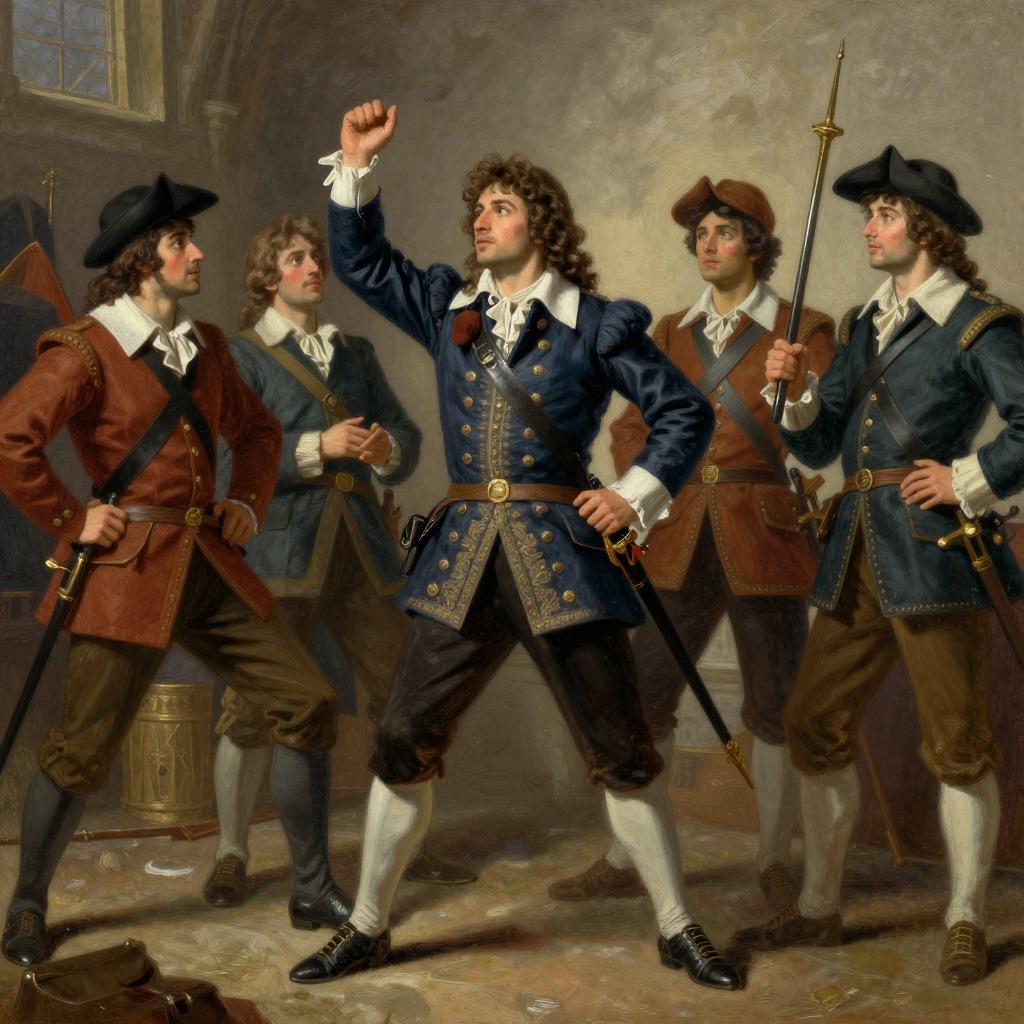
Richelieu's repeated confrontations with d'Artagnan and the three Musketeers form a central thread of the novel. He first hears of d'Artagnan through the report of his agent at Meung, who steals the young man's letter of recommendation to Monsieur de Treville. He later attempts to recruit d'Artagnan into his own service, offering an ensign's commission in his Guards—an offer the young man refuses, choosing loyalty to his friends and to the king's Musketeers. The cardinal's response is a mixture of anger and grudging respect: "You refuse to serve me, monsieur... remain free, then, and guard your hatreds and your sympathies." He warns d'Artagnan that from the moment he withdraws his protection, he would not give "an obolus for your life." Yet when the four friends distinguish themselves in the bastion of St. Gervais, Richelieu, hearing their names, murmurs, "Still my three brave fellows!... Still my young scapegrace. Positively, these four men must be on my side." He orders that d'Artagnan be transferred into the Musketeers, a promotion that binds the young man more closely to the corps he serves.
The Final Reckoning and Unexpected Clemency
The climax of Richelieu's relationship with d'Artagnan comes after the death of Constance Bonacieux and the execution of Milady. D'Artagnan is arrested by Rochefort and brought before the cardinal, who accuses him of corresponding with the enemies of the kingdom and thwarting the plans of his general. D'Artagnan responds by revealing Milady's crimes—the poisoning, the attempted assassinations, the branding—and confesses that he and his friends have tried, condemned, and executed her. The cardinal, after a moment of shock, reads the safe-conduct that Athos had taken from Milady, a document signed by Richelieu himself: "It is by my order and for the good of the state that the bearer of this has done what he has done." He tears up the paper, but instead of punishing d'Artagnan, he writes a new commission—a lieutenant's commission in the Musketeers—and gives it to him, saying, "I have taken from you one carte blanche to give you another. The name is wanting in this commission; you can write it yourself." When d'Artagnan protests that his friends are more worthy, the cardinal replies, "You are a brave youth, d'Artagnan... Do with this commission what you will; only remember, though the name be blank, it is to you I give it." He then calls Rochefort and commands the two former enemies to greet each other, declaring, "I receive him among the number of my friends."
This act of clemency is the cardinal's most surprising moment. It reveals that beneath his ruthlessness lies a genuine appreciation for courage and loyalty—qualities he recognizes in the very men who have opposed him. He does not destroy d'Artagnan; he promotes him, perhaps seeing in the young Gascon a future servant of the state more valuable than any enemy. It is a gesture that complicates the novel's moral landscape, suggesting that even the most Machiavellian of ministers can be moved by the virtues he himself lacks.
The Man Behind the Power
Richelieu is not merely a political machine; he is also a man of culture and ambition beyond the political. He writes poetry—the tragedy Mirame—and is found correcting his manuscript when d'Artagnan is brought before him. He is capable of irony and even humor, as when he jokes about the king's boredom or teases the Musketeers about their "conspiracy." He is also, in his way, a lonely figure, surrounded by spies and agents but trusting no one fully. His relationship with Milady is one of mutual exploitation; he uses her for the most dangerous missions, but he is not sorry to be rid of her when she is finally executed. "He felt something like a secret joy at being forever relieved of this dangerous accomplice," the narrator notes.
In the end, Cardinal Richelieu remains an enigma—a man who can order the assassination of a duke and yet spare the life of the man who thwarted him, who can terrify a king and yet serve him faithfully, who can wage war for love and yet deny that love has any part in his calculations. He is the novel's most powerful figure and its most inscrutable, a force of nature as inexorable as the tide, yet capable, in a single moment, of an act of grace that changes everything.