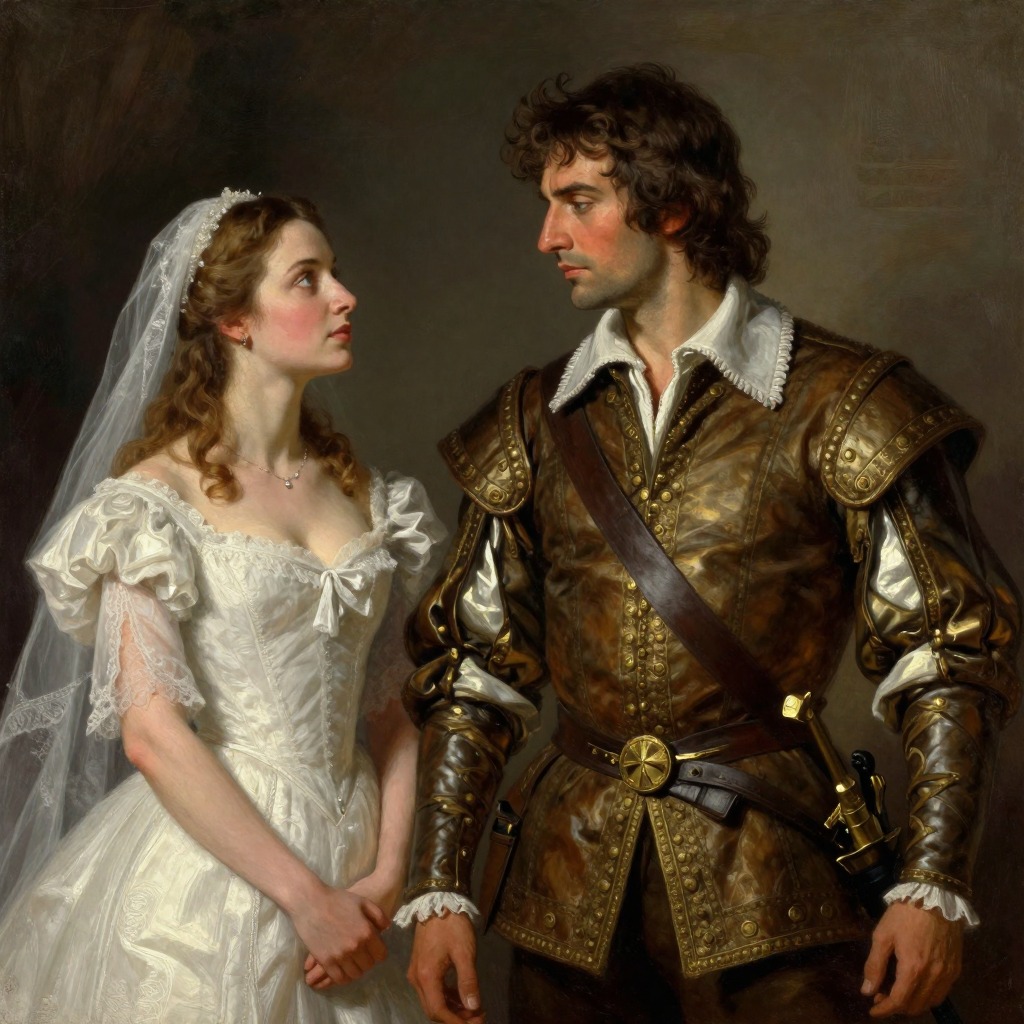
Constance Bonacieux
Constance Bonacieux, the young wife of a mercer and a seamstress to Queen Anne of Austria, is the love interest of d'Artagnan and a central figure in the court intrigues that drive the plot of The Three Musketeers. Her abduction, imprisonment, and eventual murder by Milady transform her from a charming, mysterious confidante into a tragic victim whose death catalyzes the final, decisive confrontation between the heroes and their demonic enemy.
Identity and Background
Constance Bonacieux is introduced as the wife of a mercer, Monsieur Bonacieux, who is d'Artagnan's landlord in the Rue des Fossoyeurs. She is described as a charming woman of twenty-five or twenty-six years, with dark hair, blue eyes, a slightly turned-up nose, admirable teeth, and a complexion marbled with rose and opal. Her hands are white but without delicacy, and her feet do not bespeak a woman of quality, marking her as a member of the citizen class rather than the nobility. She is the goddaughter of Laporte, the queen's cloak bearer, who placed her near her Majesty as a seamstress so that the queen might have someone in whom she could place confidence, abandoned as she was by the king, watched by the cardinal, and betrayed by everybody. Her husband, Monsieur Bonacieux, is a man of profound selfishness mixed with sordid avarice, the whole seasoned with extreme cowardice, and his love for his wife is a secondary sentiment. Constance, married at eighteen to this man, has always lived among his friends, people little capable of inspiring any sentiment in a young woman whose heart is above her position.
Life and Plot Trajectory
Constance's first major action is to confide in her husband that the queen fears someone has written to the Duke of Buckingham in her name to draw him into a snare. This confidence, overheard by d'Artagnan, draws him into the queen's service. Shortly after, Constance is abducted from her workroom by agents of the cardinal, an event that sets d'Artagnan on a path of investigation and devotion. She escapes her captors by letting herself down from a window with the help of sheets and returns to her home, where she is rescued from a second capture by d'Artagnan, who fights off four men in black. She then entrusts him with the mission to go to London to retrieve the queen's diamond studs from the Duke of Buckingham, a journey that becomes the central adventure of the novel's first half. After d'Artagnan's successful return, Constance arranges a rendezvous with him at St. Cloud, but when he arrives, he finds the pavilion in disorder and Constance has been abducted again, this time by a group led by the man of Meung, acting on the cardinal's orders. She is subsequently imprisoned, first in the Bastille and then in a convent, where she is kept under the name Kitty. She is eventually freed from the convent by the queen's order and taken to the convent of the Carmelites at Bethune.
Key Actions and Objectives
Constance's primary objective is to serve the queen faithfully, even at great personal risk. She acts as a secret messenger and confidante, carrying the queen's letter to Buckingham and arranging his secret meeting with the queen at the Louvre. She is the one who suggests using her husband as a messenger to London, though he ultimately betrays her to the cardinal. Her devotion to the queen is absolute; she tells d'Artagnan that she is ready to die for her Majesty. Her love for d'Artagnan is equally strong, and she becomes the emotional center of his life, the woman for whom he is willing to risk everything. She is also a woman of considerable resourcefulness, as shown by her escape from her captors and her ability to navigate the dangerous corridors of the Louvre.
Relationships and Conflict
Constance's relationship with d'Artagnan is the novel's central romance. It begins with her gratitude for his rescue and quickly deepens into mutual love. She gives him her first rendezvous, and he becomes her champion. Her relationship with her husband, Monsieur Bonacieux, is one of contempt and manipulation; she sees him as a cowardly, avaricious fool and is not above using him for her own purposes. Her primary conflict is with the cardinal and his agents, particularly Milady, who sees Constance as a rival and a tool to be used against d'Artagnan. Milady's hatred for Constance is profound; she eventually poisons her in the convent at Bethune, a murder that seals Milady's own fate. Constance also has a brief, fateful encounter with Milady in the convent, where she is deceived by Milady's false friendship and reveals her love for d'Artagnan, a confession that Milady uses to confirm her identity and target her for destruction.
Change and Ending
Constance's trajectory is one of increasing peril and ultimate tragedy. She moves from a relatively safe, if unhappy, domestic life into the dangerous world of court intrigue. Her abduction, imprisonment, and final poisoning mark a steady descent into victimhood. Her death is the novel's most poignant moment. D'Artagnan arrives at the convent just in time to see her die in his arms, poisoned by Milady. Her last words are a declaration of love for him, and her death leaves him in a state of profound grief and rage. This event is the catalyst for the final act of the novel, as d'Artagnan and his friends, joined by Lord de Winter, pursue Milady to her trial and execution. Constance's death is not avenged in a legal sense but through a private, extrajudicial execution that underscores the novel's theme of personal honor and justice.
Narrative Role and Evaluation
Constance Bonacieux serves as the novel's primary love interest and a key figure in the court intrigue. She is the damsel in distress who motivates d'Artagnan's heroic actions, but she is also a character with her own agency, courage, and devotion. Her role is to humanize d'Artagnan, to give him a personal stake in the larger political conflicts, and to provide a stark contrast to the villainous Milady. Where Milady is a demonic, manipulative force, Constance is an angelic, loyal victim. Her death is the ultimate proof of Milady's evil and the final justification for her execution. In the novel's moral economy, Constance is the innocent sacrifice whose blood demands vengeance, and her memory lingers as a bittersweet reminder of the cost of love and loyalty in a world of political treachery.