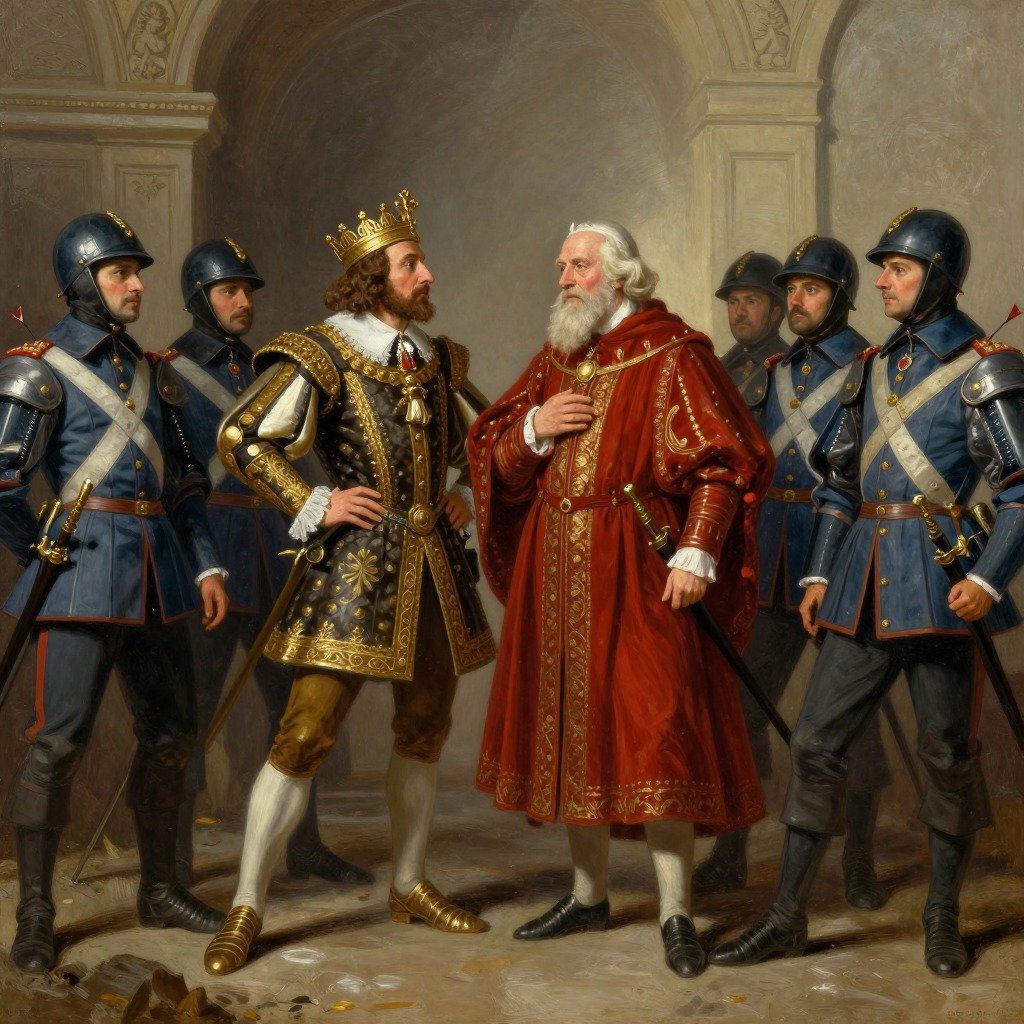
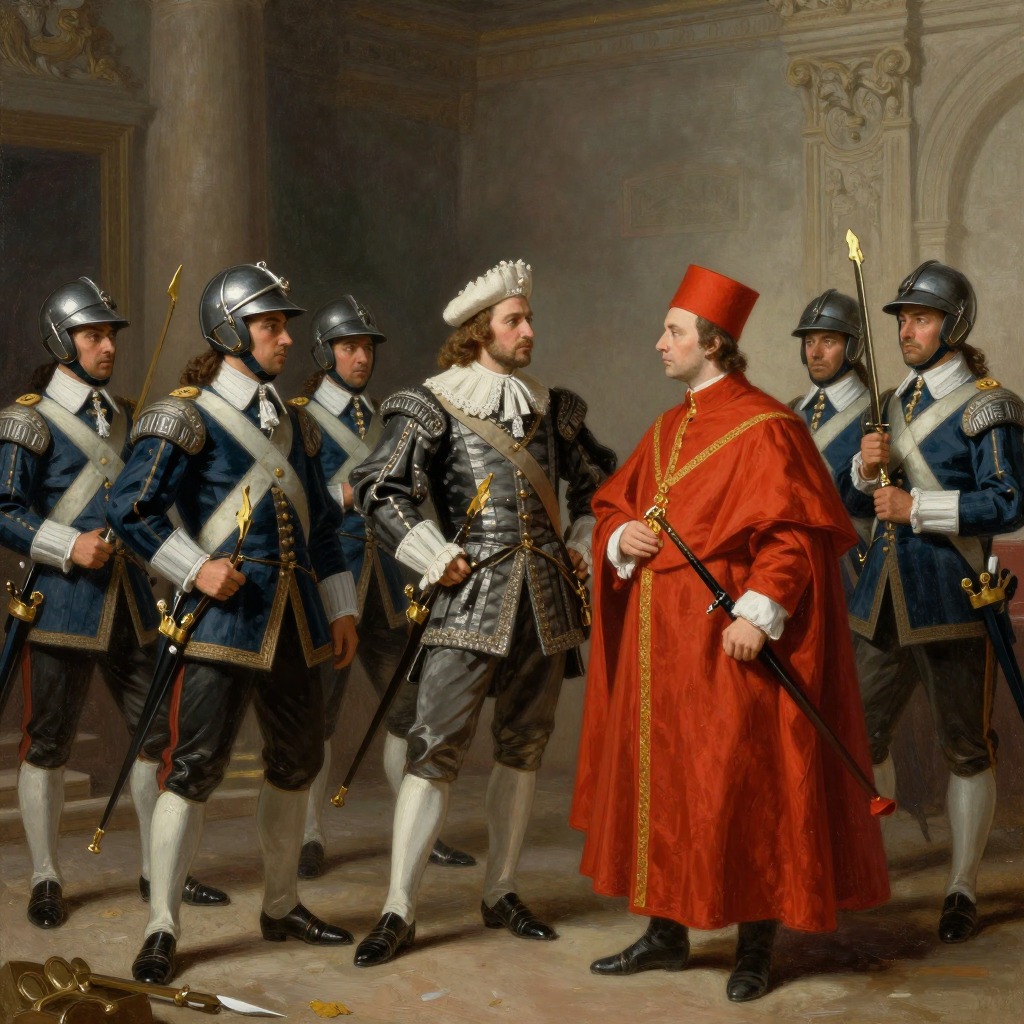
Duc de la Tremouille
The Duc de la Tremouille is a figure of considerable standing in the world of The Three Musketeers, a Protestant nobleman whose personal integrity and political neutrality place him in a unique position during the escalating conflict between the King's Musketeers and the Cardinal's Guards. Though he seldom appears at court, his word carries decisive weight when the king himself demands an impartial account of a violent confrontation. His role, though brief, is pivotal: he is the man whose truthful testimony before Louis XIII exonerates Athos and exposes the fault of his own household, thereby defusing a crisis that threatened the lives of the four friends.
Identity and Background
The Duc de la Tremouille is a Protestant, a fact that distances him from the Catholic king's inner circle. He is described as a man of courage and honor, and his social relations are generally unbiased, as he belongs to no particular party. This neutrality is noted by Monsieur de Treville, who observes that the duke "seeing the king seldom, was of no party" and therefore "did not, in general, carry any bias into his social relations." Despite his noble rank, he is not a frequent presence at court; the king himself remarks that it has been nearly three years since he last saw him, and that he never sees the duke unless he sends for him. This independence from courtly intrigue makes him a rare figure of impartiality.
Role in the Conflict and the Confrontation
The duke becomes embroiled in the conflict when a brawl erupts between the King's Musketeers and the Cardinal's Guards, culminating in an attack on his own hotel. The Musketeers, led by Athos, Porthos, Aramis, and d'Artagnan, pursue the Guardsmen into the duke's residence, and the duke's people make a sortie against them. In the aftermath, the duke is prejudiced by his esquire, a relative of the wounded Guardsman Bernajoux, and initially blames the Musketeers. He sends a letter of complaint to Monsieur de Treville, who then visits him in person to resolve the dispute. Treville proposes a reasonable solution: they should go to the wounded Bernajoux and adjure him, in the name of God, to speak the truth. The duke, finding this proposal reasonable, agrees. When they interrogate Bernajoux, who is placed between life and death, he describes the affair exactly as it happened, confirming that the fault lay with his own people. The duke, upon hearing this, immediately offers his apologies to Treville, acknowledging that the Musketeers were not to blame.
Testimony Before the King
The duke's honesty is put to its most crucial test when he is summoned before King Louis XIII. The cardinal has already poisoned the king's mind against the Musketeers, accusing them of rioting and attempting to burn the duke's hotel. The king, furious, demands to know the truth. Treville, confident in the duke's integrity, stakes his own position on the duke's testimony. The duke, having returned late to his hotel the previous evening, is brought before the king the following morning. He tells the king the truth: that the fault lay with his own people, and that he is ready to offer his excuses. This testimony completely reverses the king's anger, turning it away from the Musketeers and toward the cardinal's misinformation. The king, hearing the duke's words from behind an open door, is pleased and tells Treville to inform the duke that he wishes to be considered his friend.
Significance and Narrative Role
The Duc de la Tremouille's primary narrative function is to serve as an instrument of justice and truth. In a world where the cardinal's machinations and the king's volatile temper constantly threaten the heroes, the duke's unwavering honesty provides a rare moment of clarity. He is a character who, despite his political and religious differences from the king, is trusted by the monarch to tell the truth. His testimony not only saves Athos from imprisonment but also humiliates the cardinal, who is forced to watch his carefully constructed accusations collapse. The duke's role underscores a key theme of the novel: that honor and truth, when spoken by a man of integrity, can prevail over political scheming. He is a flat character, defined by a single, unwavering trait—his loyalty to the truth—but that trait is essential to the plot's resolution at a critical juncture.