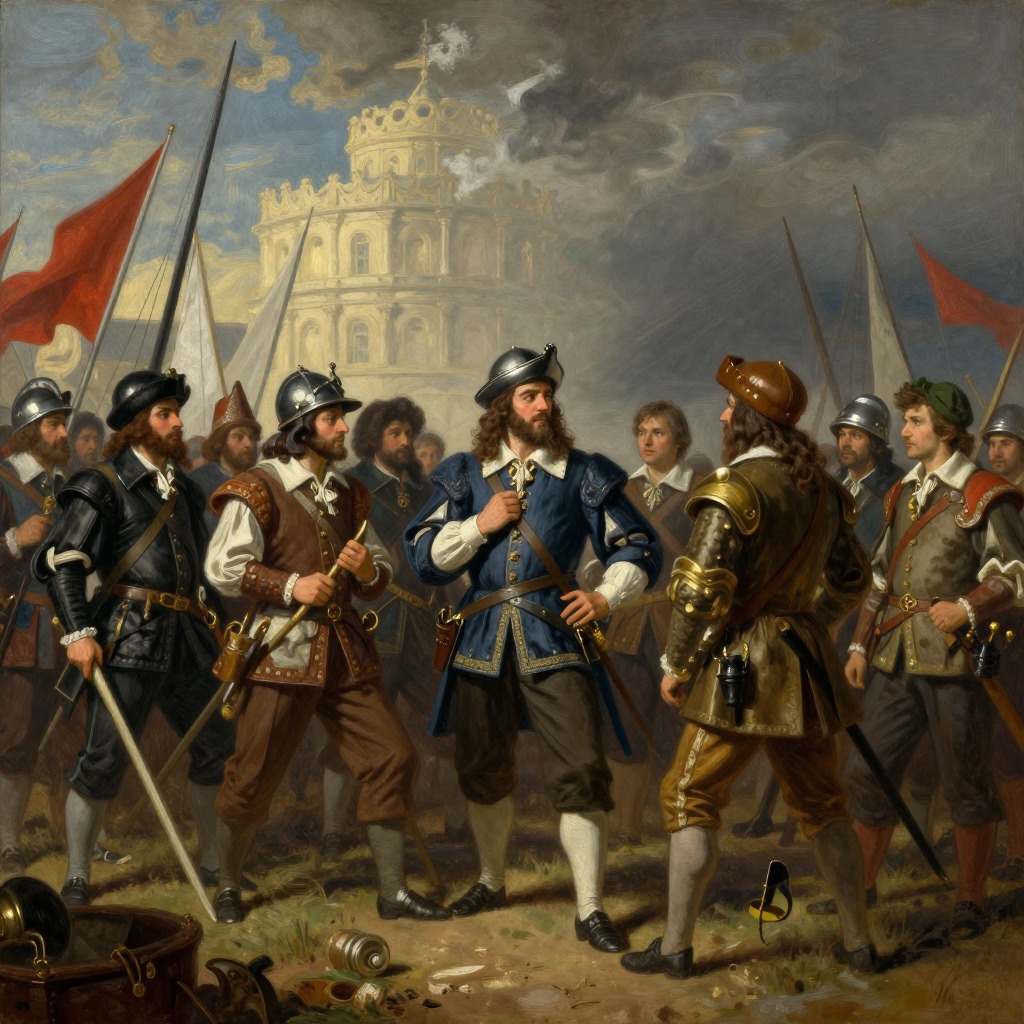
Grimaud
Grimaud, the valet of Athos, is one of the most distinctive and memorable secondary characters in The Three Musketeers. His defining trait—a near-total silence imposed by his master—transforms him from a mere servant into a living symbol of Athos's own reserve, discipline, and buried pain. Through his mute gestures, his occasional lapses into speech, and his absolute loyalty, Grimaud becomes an essential instrument in the adventures of the four inseparables, often providing crucial intelligence or comic relief at precisely the right moment.
Identity and Background
Grimaud is introduced as a valet whom Athos has trained in a thoroughly peculiar fashion. He is described as "very taciturn" , a quality that reflects his master's own reticence. Athos, who scarcely speaks himself, has accustomed Grimaud to obey him upon a simple gesture or a simple movement of his lips; he never speaks to him except under the most extraordinary occasions . This system of communication is so ingrained that Grimaud, who fears his master as he does fire, sometimes misunderstands a gesture and executes the precise contrary of the order intended. On these rare occasions, Athos, without putting himself in a passion, thrashes Grimaud—and on those days, he speaks a little . This dynamic establishes Grimaud not as a mere servant but as a carefully calibrated instrument of Athos's will, whose very silence is a form of eloquence.
Role in the Adventures
Grimaud's silent competence makes him invaluable during the four friends' most perilous missions. During the journey to England, when the four friends split up to avoid detection, Grimaud is one of the lackeys who accompanies the Musketeers, armed and ready . At the inn in Amiens, after Athos is captured, Grimaud takes care of the horses while Planchet stands guard . Later, during Athos's self-imprisonment in the cellar of the inn at Amiens, Grimaud joins him, fully armed, and the two barricade themselves inside, with Grimaud loading his musketoon . When they finally emerge, Grimaud is described as "moistened before and behind with a greasy liquid which the host recognized as his best olive oil," a testament to the chaotic aftermath of their siege .
Grimaud's most celebrated moment of initiative occurs during the Bastion Saint-Gervais episode. While the four friends are breakfasting and discussing their plans, Grimaud, acting as sentinel, spots the approach of Cardinal Richelieu and his escort. Breaking his usual silence, he cries out "Officer!" , alerting the Musketeers and allowing them to compose themselves before the cardinal's arrival. This single word, a violation of his master's strict rule, is a measure of the gravity of the situation. Athos, though he reprimands him, later rewards him by making him eat the incriminating letter from Marie Michon and then giving him a glass of wine (E06522-E06524).
Relationship with Athos
The bond between Athos and Grimaud is one of profound, wordless understanding. Athos's instructions are often given by a simple sign or a movement of the lips, and Grimaud interprets them with a mixture of fear and devotion . This system is so effective that Athos can command Grimaud to perform complex tasks without a single spoken word. For instance, when Athos wants to send a message, he makes a sign to Grimaud, who understands perfectly and sets off . This silent communication is a mark of their deep, almost symbiotic relationship. Athos's trust in Grimaud is absolute; he entrusts him with the most sensitive tasks, such as guarding the door during the council of the Musketeers and later, during the pursuit of Milady, sending him as one of the scouts to Armentieres .
Change and Ending
Grimaud's trajectory mirrors that of his master. After the siege of La Rochelle, when Athos quits the service in 1633 under the pretext of having inherited a small property in Roussillon, Grimaud follows him . This final act of loyalty confirms that his entire existence is bound to Athos. Throughout the novel, Grimaud evolves from a mere comic figure—a silent servant who is sometimes beaten for his mistakes—into a trusted and essential member of the Musketeers' inner circle. His silence, once a source of humor, becomes a mark of his reliability and his complete absorption into Athos's world.
Thematic Significance
Grimaud embodies the theme of absolute loyalty and the power of non-verbal communication. In a novel filled with eloquent speeches and dramatic declarations, Grimaud's silence is a powerful counterpoint. He is a living example of the adage "actions speak louder than words." His presence also highlights the class structure of the era, where servants are often invisible yet indispensable. Grimaud's silent competence and unwavering devotion make him a foil to the more talkative and sometimes unreliable lackeys of the other Musketeers, and his ultimate fate—following Athos into retirement—underscores the enduring nature of the bond between a gentleman and his most trusted servant.