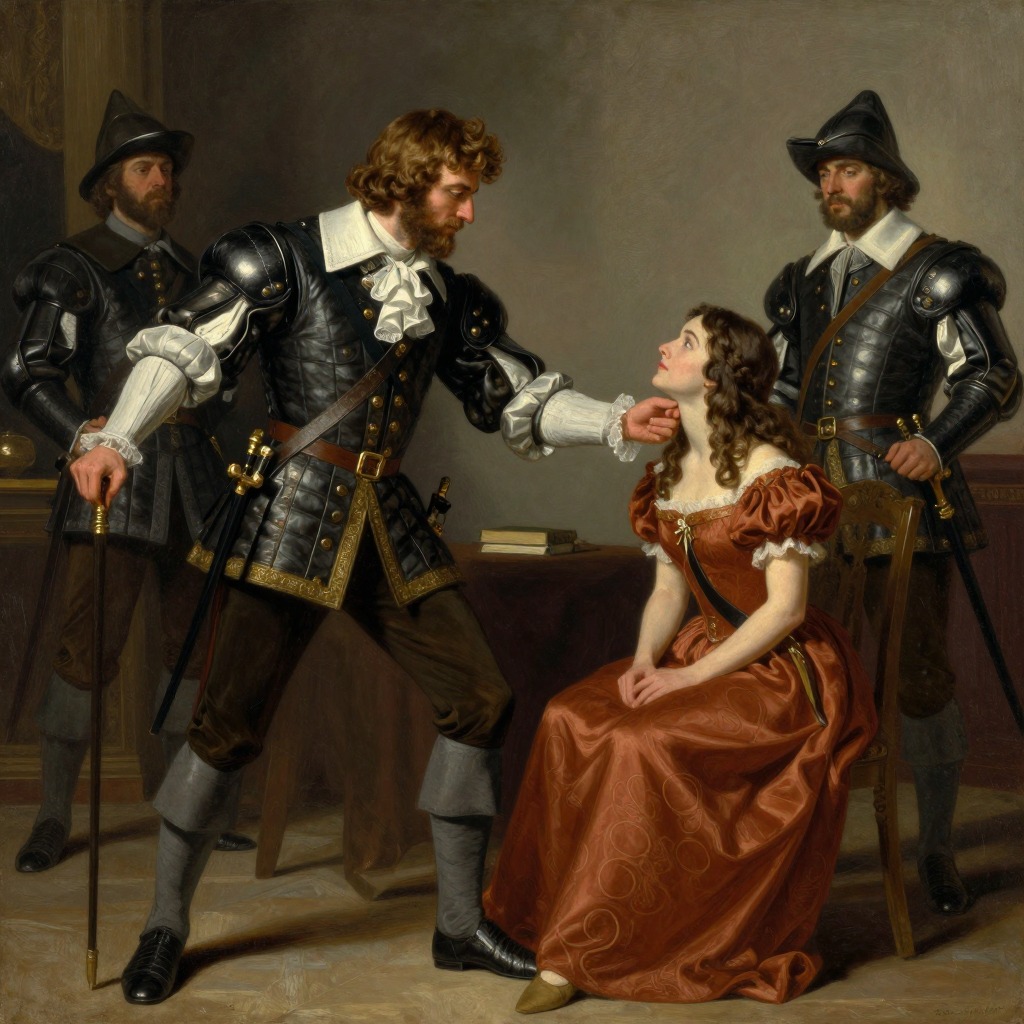
Mousqueton
Mousqueton, the Norman valet of Porthos, is one of the most resourceful and devoted servants in Alexandre Dumas's The Three Musketeers. Originally named Boniface, he was rechristened by his master, who found the new name infinitely more sonorous. Mousqueton's practical skills—poaching, wine-lassoing, and foraging—repeatedly save his master from hunger and embarrassment, while his loyalty, born of a violent family history, makes him a formidable ally in the Musketeers' adventures. He is a figure of comic ingenuity and grim competence, a servant whose talents far exceed his station.
Identity and Background
Mousqueton was a Norman, whose pacific birth name of Boniface his master changed into the infinitely more sonorous name of Mousqueton. He entered Porthos's service upon condition that he should only be clothed and lodged, though in a handsome manner, but he claimed two hours a day to himself, consecrated to an employment which would provide for his other wants. Porthos agreed to the bargain, and the thing suited him wonderfully well. He had doublets cut out of his old clothes and cast-off cloaks for Mousqueton, and thanks to a very intelligent tailor, who made his clothes look as good as new by turning them, and whose wife was suspected of wishing to make Porthos descend from his aristocratic habits, Mousqueton made a very good figure when attending on his master.
Mousqueton's father was a man of mixed religious beliefs who, during the wars between Catholics and Huguenots, adopted a faith that permitted him to be sometimes Catholic, sometimes a Huguenot. He would walk with his fowling piece on his shoulder, and when he saw a Catholic coming alone, the Protestant religion immediately prevailed in his mind; he would lower his gun and commence a conversation that almost always ended by the traveler's abandoning his purse to save his life. When he saw a Huguenot coming, he felt himself filled with such ardent Catholic zeal that he could not understand how, a quarter of an hour before, he had been able to have any doubts upon the superiority of the Catholic religion. One day, this worthy man was surprised in a lonely road between a Huguenot and a Catholic, with both of whom he had before had business, and who both knew him again; they united against him and hanged him on a tree. Mousqueton and his brother, who were drinking in a nearby cabaret, heard the boast of the killers. They let them tell their story out, then, as the killers took different directions, Mousqueton's brother hid himself on the road of the Catholic, and Mousqueton on that of the Huguenot. Two hours later, all was over; they had done the business of both, admiring the foresight of their poor father, who had taken the precaution to bring each of them up in a different religion.
Role and Skills
Mousqueton's most celebrated skill was his ability to provision his master through unconventional means. When Porthos was laid up with a strained knee at the inn at Chantilly, Mousqueton foraged for food. He laid snares in the runs near the wood of Monsieur le Prince and slipped lines into his Highness's fish ponds, so that the sick man never wanted for partridges, rabbits, carp, or eels. He also developed a unique method of obtaining wine: having learned from a Spanish lackey who had been to Mexico how to throw a lasso, he practiced the exercise until he could catch the neck of a bottle at thirty paces. He then used this skill to steal wine from the innkeeper's cellar through a ventilating hole, knowing exactly which part of the cellar held the best wine. When Porthos was in debt to the innkeeper, Mousqueton took all he wanted without asking, putting the host under his feet.
Mousqueton was also a participant in the great adventures of the four friends. He was among the lackeys who were armed with pistols and musketoons for the journey to England, and he was wounded in the ambush at Crevecoeur, receiving a ball which lodged in the fleshy part that prolongs the lower portion of the loins. He fell from his horse, not because he was severely wounded, but because, not being able to see the wound, he judged it to be more serious than it really was. His horse rejoined the others and galloped by the side of his companions.
Relationships and Loyalty
Mousqueton's relationship with Porthos was one of devoted service, though it was not without its strains. When Porthos was in financial difficulty, Mousqueton was the one who had to bear the brunt of the innkeeper's demands. He was also the one who, after the disastrous dinner at the procurator's house, was sent to return the inferior horse and mule that Madame Coquenard had provided, driving them to the procurator's door and fastening them to the knocker. Despite these trials, Mousqueton remained loyal, and his master, in turn, was concerned for his welfare. When Mousqueton was wounded, Porthos had to have the surgeon twice a day, and the surgeon charged double on account of that foolish Mousqueton having allowed himself a ball in a part which people generally only show to an apothecary.
Mousqueton was also part of the larger network of servants who served the four friends. He was present at the council of the Musketeers when they planned their campaign, and he was among the lackeys who were sent to guard the doors and windows during the trial and execution of Milady. He was one of the two lackeys who dragged Milady to the bank of the river, and he trembled in all his members when she whispered to him, offering a thousand pistoles to assist her escape. Athos, hearing this, ordered the lackeys to be changed, and Planchet and Bazin took their places.
Change and Ending
After the siege of La Rochelle, Porthos left the service and married Madame Coquenard, whose coffer contained eight hundred thousand livres. Mousqueton, in turn, had a magnificent livery and enjoyed the satisfaction of which he had been ambitious all his life—that of standing behind a gilded carriage. His story ends in a state of comfortable prosperity, a fitting reward for his years of ingenious and devoted service.