d'Artagnan
d'Artagnan, the protagonist of Alexandre Dumas's The Three Musketeers, is a young, ambitious Gascon gentleman whose journey from a provincial outsider to a lieutenant in the king's Musketeers forms the novel's central arc. His character is defined by a volatile mix of fiery courage, shrewd intelligence, and a deep, often impulsive, capacity for love and loyalty, which together propel him through a series of adventures that entangle him with the highest powers of France and England, culminating in a personal tragedy that forges his maturity.
Identity and Background
Introduced on the first Monday of April 1625 in the market town of Meung, d'Artagnan is an eighteen-year-old from Bearn, described as a "Don Quixote of eighteen" without his armor. He has a long, brown face, high cheekbones, a hooked nose, and an intelligent, open eye. His father, M. d'Artagnan the elder, a former servant of Henry IV, gives him three gifts: fifteen crowns, a yellow Bearn pony, and a letter of recommendation to Monsieur de Treville, captain of the king's Musketeers. The father's parting advice is to "endure nothing from anyone except Monsieur the Cardinal and the king" and to "fight on all occasions," as duels are forbidden, making courage twice as valuable. His mother adds a recipe for a miraculous balsam. d'Artagnan's initial poverty is underscored by his selling the yellow pony for three crowns upon arriving in Paris, and he takes a modest garret in the Rue des Fossoyeurs, near the Luxembourg.
Life and Plot Trajectory
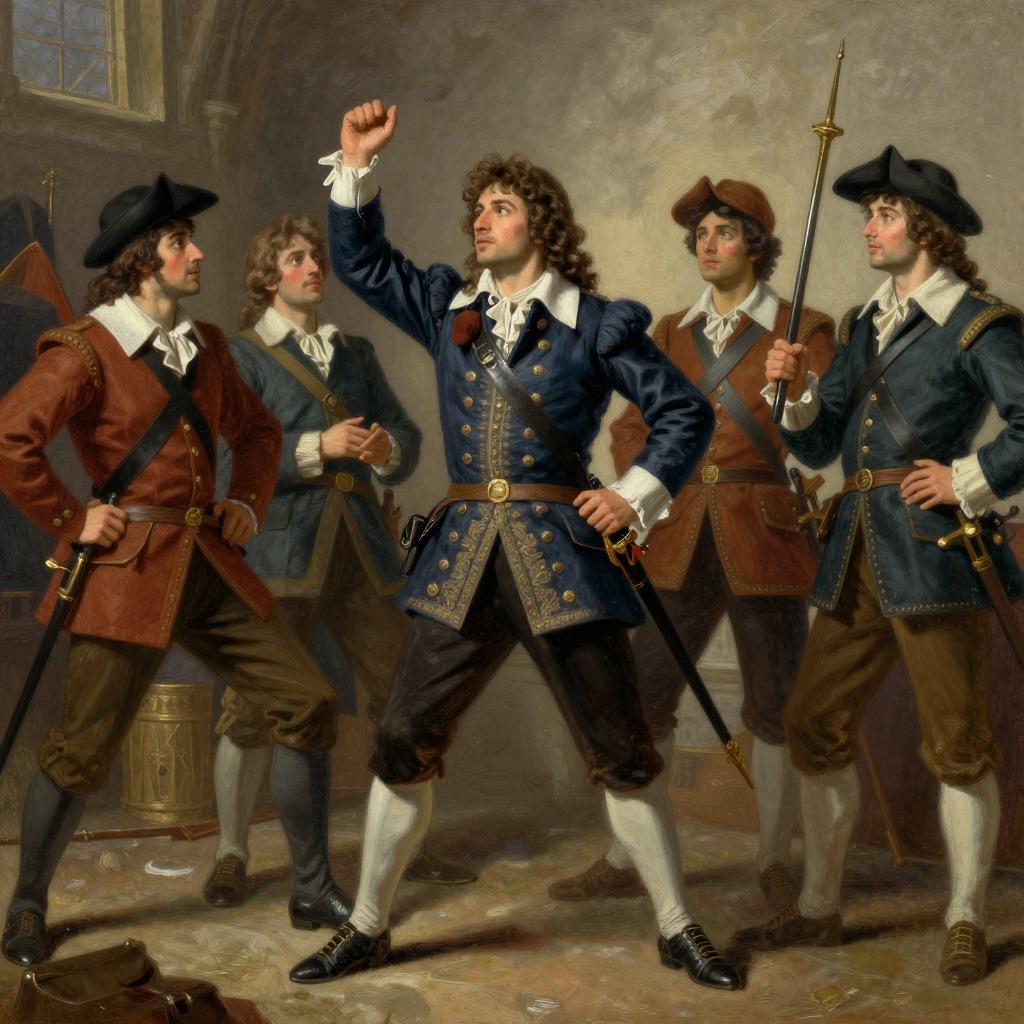
d'Artagnan's life in Paris is a rapid ascent from a naive cadet to a celebrated hero. His first day in the capital is a series of blunders: he offends Athos, Porthos, and Aramis in separate incidents, accidentally challenging all three to duels. This leads to the famous confrontation at the Carmes-Deschaux, where the four are interrupted by Cardinal Richelieu's Guards. d'Artagnan chooses to fight alongside the Musketeers, declaring, "I have not the uniform, but I have the spirit," and wounds Jussac, the Guards' leader. This act of solidarity forges the legendary bond between the four men, who adopt the motto "All for one, one for all." His subsequent career is a whirlwind of missions: he recovers the queen's diamond studs from the Duke of Buckingham in London, a journey fraught with ambushes and a duel with the Comte de Wardes; he rescues Constance Bonacieux from a cardinalist trap; and he survives a poisoning attempt orchestrated by Milady. His exploits culminate in the siege of La Rochelle, where he and his friends hold the Bastion Saint-Gervais against the enemy, an act that earns him the admiration of the cardinal and, ultimately, a lieutenant's commission in the Musketeers.
Key Actions and Objectives
d'Artagnan's primary objective is to become a Musketeer, a goal he achieves through a series of audacious actions. He is driven by a desire for glory, fortune, and love. His key actions include: fighting alongside the Musketeers against the cardinal's Guards, which wins him their friendship; traveling to England to retrieve the queen's diamond studs, a mission that cements his favor with Queen Anne of Austria; rescuing Constance Bonacieux from the cardinal's agents, which deepens his love for her; and repeatedly outmaneuvering Milady, his nemesis, whose schemes he thwarts at every turn. He also demonstrates a pragmatic side, selling the queen's diamond for seven thousand livres to fund his friends' equipment. His final, defining action is his pursuit of Milady after she poisons Constance, leading to her trial and execution, an act of vengeance that solidifies his transition from a carefree youth to a man marked by loss.
Relationships and Conflict
d'Artagnan's relationships are the engine of the plot. His friendship with Athos, Porthos, and Aramis is the novel's emotional core, a bond of absolute loyalty that survives danger, poverty, and personal secrets. His love for Constance Bonacieux is a pure, driving force, but it is also the source of his greatest vulnerability, as Milady uses it to destroy her. His conflict with Milady is the novel's central antagonism; she is a "demon" who seeks his death for uncovering her secret—the fleur-de-lis brand on her shoulder. This conflict escalates from personal enmity to a matter of state, as Milady is an agent of Cardinal Richelieu. d'Artagnan also navigates a complex relationship with the cardinal, who alternately threatens and tempts him, offering a commission in his own guards. d'Artagnan's refusal, out of loyalty to his friends and the king, marks a key moment of moral choice.
Change and Ending
d'Artagnan undergoes a profound transformation from a brash, impulsive youth to a mature, battle-hardened leader. The death of Constance, poisoned by Milady, is the crucible of this change. It strips him of his youthful idealism and replaces it with a cold, determined desire for justice. He participates in Milady's trial and execution, an act that is both a personal vengeance and a grim duty. In the novel's conclusion, he is offered a lieutenant's commission in the Musketeers by Cardinal Richelieu, who recognizes his worth. His three friends, each for their own reasons, refuse the commission, insisting that d'Artagnan is the most worthy. He accepts, becoming the leader of the very corps he had admired from afar. The epilogue notes that he later fought Rochefort three times, wounding him each time, before they reconciled. He is left with his new rank and the bitter memory of his lost love, a bittersweet resolution to his journey.
Narrative Role and Evaluation
d'Artagnan serves as the novel's central consciousness and driving force. His perspective guides the reader through the complex world of 17th-century French court intrigue, and his actions set the plot in motion. He is a classic picaresque hero, a young man of low birth who rises through wit and courage. His character is a blend of the idealistic and the pragmatic; he is capable of both grand gestures of loyalty and calculated acts of deception, such as his impersonation of the Comte de Wardes to seduce Milady. Dumas portrays him with a mixture of affection and irony, celebrating his Gascon pride and bravery while acknowledging his youthful folly. His ultimate success is not just a personal triumph but a vindication of the values of friendship, honor, and loyalty that he and his friends embody, making him one of literature's most enduring and beloved heroes.