Berthold
Berthold is a minor but revealing figure within the court's hierarchy, a law student who serves as the examining judge's trusted assistant and who embodies the court's predatory, informal power over those within its orbit. He appears in two key scenes: first in the court offices, where he carries off the court usher's wife on the judge's orders, and later in Titorelli's studio, where his presence underscores the court's pervasive reach into even the artist's attic workspace. Though he speaks little, his actions—and the reactions he provokes—expose the court's reliance on personal influence, sexual coercion, and the degradation of both its employees and the accused.
Identity and Role
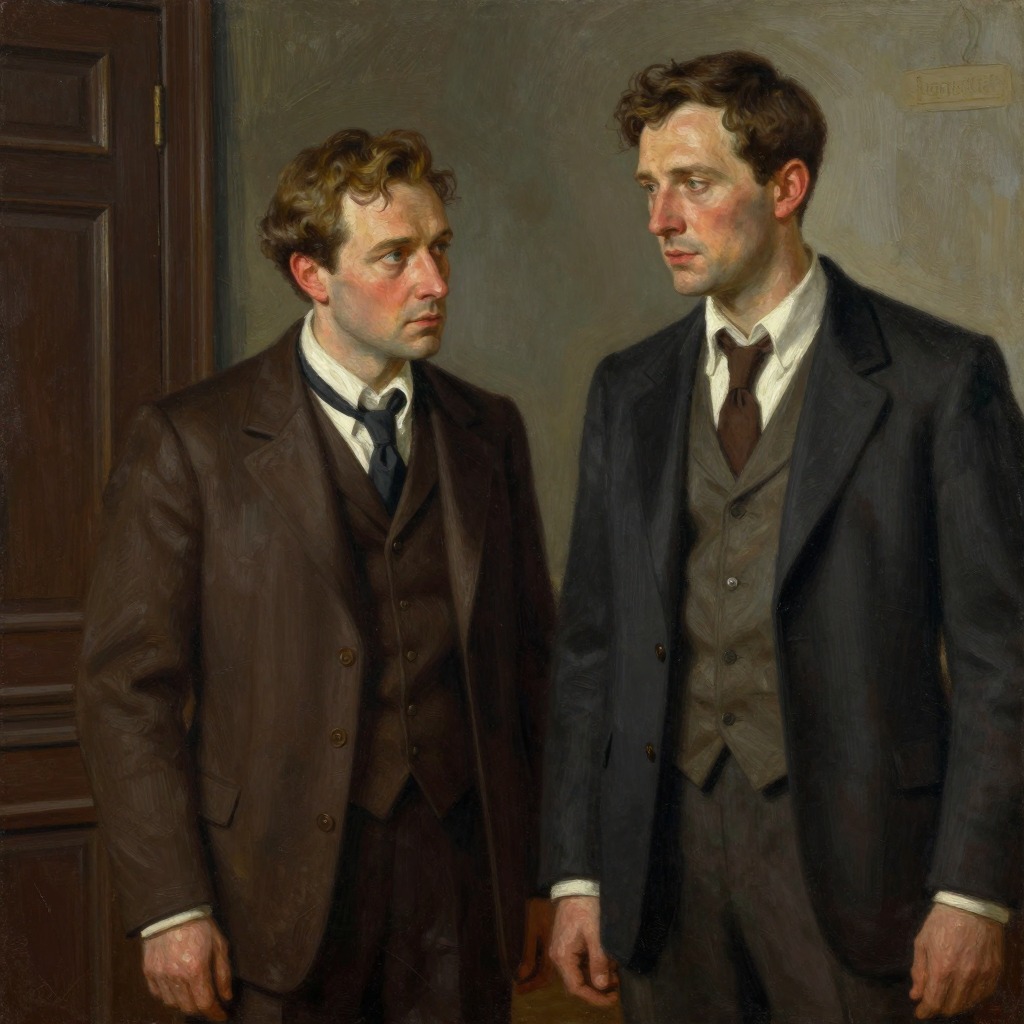
Berthold is introduced as a young man, short, with legs that are not quite straight, and a short, thin, red beard which he continually fingers in an attempt to appear dignified. He is a student of the unfamiliar discipline of jurisprudence, and the court usher's wife describes him as someone who will almost certainly be very powerful later on. He is the examining judge's most trusted associate, the one sent to carry messages and, more significantly, to fetch the usher's wife for the judge's pleasure. The usher himself confirms this hierarchy, noting that the student has been carrying off his wife for himself and now does so for the judge as well. Berthold's position is one of delegated authority: he acts on the judge's orders but also exploits the situation for his own gratification, a pattern that reveals the court's tolerance of personal corruption among its junior members.
Key Actions and Relationships
Berthold's most consequential action occurs in the court offices, where he physically carries the court usher's wife away from K. and up a narrow flight of wooden steps leading to the attic. He lifts her onto one arm with a strength unexpected from his slight frame, runs with her to the door, and strokes and squeezes her arm with his free hand, provoking K. to attempt an intervention. The woman, however, tells K. it is no use, as the examining judge has sent for her, and she begs K. not to interfere, saying it would be the end of her. Berthold's relationship with the woman is one of coercive pursuit: she tells K. that the student has been chasing after her for a long time, that she has no protection from him, and that even her husband has had to get used to it to keep his job. The usher, in a moment of bitter fantasy, tells K. he dreams of crushing Berthold against the wall, his arms stretched out, his crooked legs twisted, blood squirting all around. Berthold's presence in Titorelli's studio is more peripheral but equally telling: he is the judge who comes through the door by the bed, for whom Titorelli has given a key so he can wait in the studio when the painter is not home, and who wakes Titorelli by climbing over his bed in the morning. This detail reinforces the student's intimacy with the court's inner workings and his casual disregard for boundaries.
Thematic Significance
Berthold functions as a synecdoche for the court's method of operation: it works through personal connections, informal coercion, and the exploitation of those in dependent positions. His physical deformity—the crooked legs—and his theatrical dignity (the red beard he fingers to seem important) mark him as a grotesque figure, yet one who wields real power over the lives of others. The court usher's wife, despite her complaints, is drawn to him; she tells K. that the student is always after her and that she cannot resist him. This ambivalence mirrors the court's own hold over the accused, who are simultaneously repelled and fascinated by its authority. Berthold's role as the examining judge's proxy also illustrates the court's delegation of its most sordid tasks to junior functionaries, allowing the higher officials to remain invisible while their subordinates carry out the work of intimidation and control. In this, he is a minor but essential cog in the machine that grinds down Josef K.