Willem
Willem is one of the two police officers who arrest Josef K. at the beginning of the novel, a coarse and corrupt junior functionary whose casual abuse of power and subsequent punishment illustrate the arbitrary, self-perpetuating logic of the Court.
Identity and Introduction
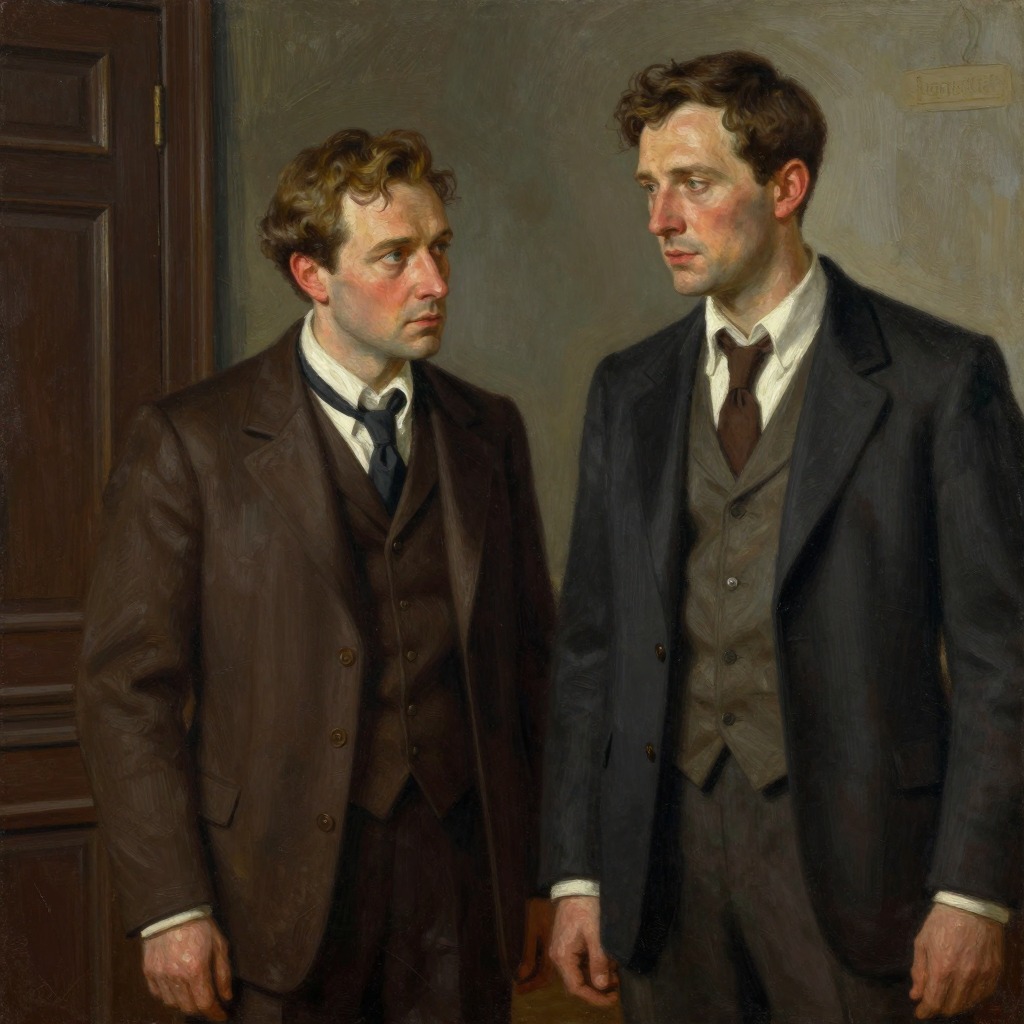
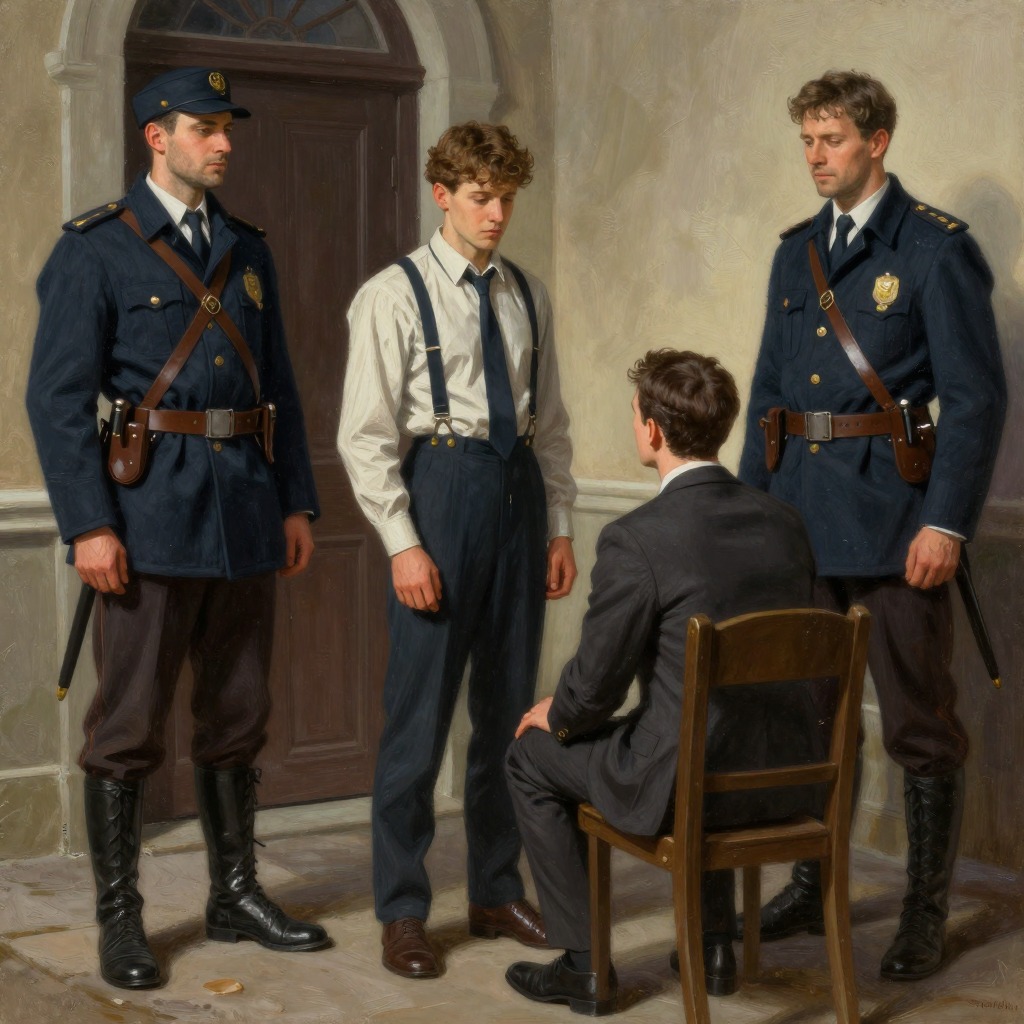
Willem is the larger of the two arresting officers, described as having a friendly-looking belly that sticks out, but a dry, bony face with a strong nose twisted to one side, a mismatch that makes him seem untrustworthy. He and his colleague Franz arrive at Mrs. Grubach's lodging house on the morning of K.'s thirtieth birthday. Willem is the more talkative and assertive of the pair; he is the one who explains to K. that he is under arrest, that the proceedings are underway, and that he will learn everything in good time. He also tells K. that the Court does not go looking for guilt among the public—"it's the guilt that draws them out, like it says in the law." Willem presents himself as a low-ranking officer who knows only the lowest grades of the authorities, yet he speaks with the certainty of someone who believes the system is infallible.
Corrupt Behavior and Abuse of Power
From the moment of the arrest, Willem and Franz exploit their position for personal gain. They examine K.'s nightshirt and tell him he will have to wear a lower-quality one, but that they will keep his underclothes and return them if his case turns out well—implying they intend to steal them. They warn K. that items left in the storeroom tend to go missing or get sold off, and that the money paid for them is not what they are offered but what is "slipped on the side." Willem then offers to fetch K. breakfast from the café across the road—if K. has the money to pay for it. When K. refuses, Willem and Franz proceed to eat K.'s own breakfast in front of him. The whip-man later confirms that Willem has grown fat precisely because he is in the habit of eating the breakfasts of everyone he arrests.
Role in the Arrest and the First Hearing
Willem supervises K.'s dressing, insisting that K. must wear a black coat, and sends Franz to announce to the supervisor that K. is getting ready. During the first cross-examination, K. publicly denounces Willem and Franz as "unprincipled riff-raff" who tried to bribe him, trick him into giving them his clothes, and demanded money for breakfast after eating his own. K. tells the assembly that the policemen talked at him until he was sick of it. Willem's behavior is thus presented as typical of the Court's lower functionaries—corrupt, self-serving, and contemptible.
The Whipping and Its Aftermath
Weeks later, K. discovers Willem and Franz in a junk room at the bank, about to be flogged by a whip-man because K. had complained about them to the examining judge. Willem, now stripped to the waist, pleads with K., explaining that he has a family to feed and that the theft of clothes is a tradition among the police. He insists that K. did not actually request their punishment, but the whip-man declares the punishment "just and unavoidable." Willem tries to argue that his career is ruined, but the whip-man mocks his fat belly, saying the first strokes of the cane will just get lost in it. K. attempts to bribe the whip-man to let them go, but the flogging proceeds. Franz screams horribly, and K. shoves him to stop the noise, then slams the door. The next day, K. opens the junk room again and finds the scene exactly as before—the whip-man, the candle, and the two policemen still undressed, wailing and calling out "Mr. K.!" K. slams the door and runs away, almost in tears. The whipping scene recurs, suggesting that the punishment is endless and inescapable, a permanent fixture of the Court's machinery.
Narrative Role and Significance
Willem is a flat character, built around a single idea: the corrupt, self-justifying minor official who embodies the Court's moral decay. He is not a villain in any grand sense but a petty functionary who has internalized the system's logic and uses it for his own advantage. His fate—endless flogging for behavior that the Court itself permits—demonstrates that the Court punishes its own servants arbitrarily, and that no one, not even its agents, is safe from its machinery. Willem's presence in the novel establishes the tone of the arrest: absurd, humiliating, and governed by rules that are never explained but always enforced.