Jim Hawkins
Jim Hawkins is the first-person narrator and central protagonist of Treasure Island, the boy whose perspective shapes the entire narrative. He begins as the son of an innkeeper at the Admiral Benbow Inn, but through a series of escalating adventures—discovering a dead pirate's treasure map, sailing on the Hispaniola, overhearing a mutiny plot, and single-handedly recapturing the ship—he transforms into a decisive and courageous young man. His narration, written at the request of Squire Trelawney, Dr. Livesey, and the other gentlemen, frames the story as a retrospective account, keeping back only the bearings of the island because treasure still lies unclaimed. Jim's growth from a frightened child to a capable hero is the novel's central arc, and his moral choices, particularly his complex relationship with Long John Silver, give the adventure its ethical depth.
Identity and Introduction
Jim Hawkins introduces himself as the narrator of the whole affair, taking up his pen in the year of grace 17__ and going back to the time when his father kept the Admiral Benbow inn. He is a boy of the English coast, familiar with the sea but not yet a sailor, and his early life is marked by the arrival of the brown old seaman with the sabre cut—Billy Bones—who takes up lodging under his father's roof. Jim's role in the household is practical: he helps his mother run the inn, lays the breakfast-table, and serves rum to the guests. His first significant duty, however, comes when the captain takes him aside and promises him a silver fourpenny on the first of every month if he will keep his "weather-eye open for a seafaring man with one leg." This arrangement makes Jim a sharer in the captain's alarms and fills his dreams with nightmares of the one-legged man, whom he imagines in a thousand forms, with the leg cut off at the knee or the hip, or as a monstrous creature with a single leg in the middle of his body. The monthly fourpenny piece, paid with reluctance and often only after the captain blows through his nose and stares him down, becomes Jim's first wage and his first lesson in dealing with dangerous men.
Life and Plot Trajectory
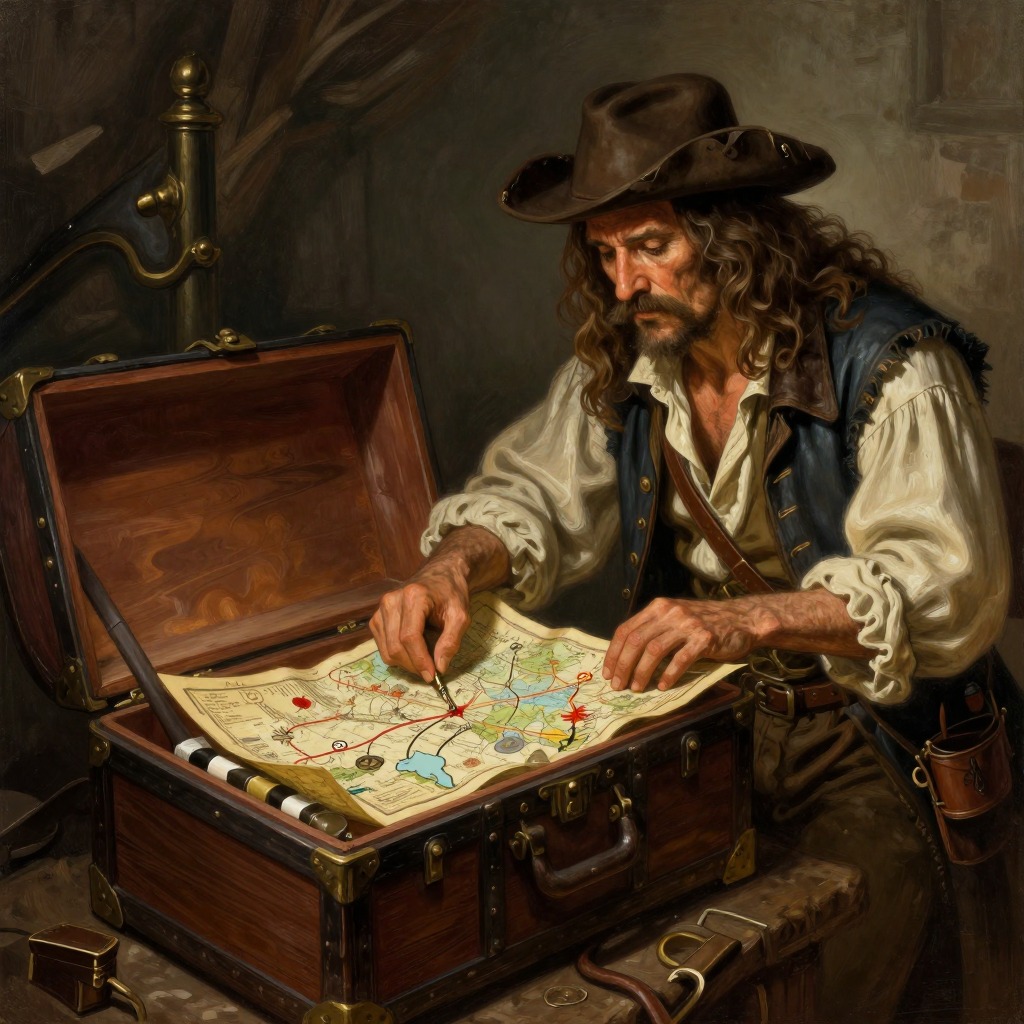
Jim's life changes irrevocably with the death of Billy Bones and the discovery of the treasure map. After the captain is struck dead by apoplexy, Jim and his mother return to the inn to claim the money owed to them, and Jim takes the oilskin packet containing the map, an act that sets the entire adventure in motion. He carries the packet to Dr. Livesey and Squire Trelawney, who recognize it as the key to Flint's buried treasure, and Jim is immediately drawn into the expedition. The squire declares that Hawkins shall come as cabin-boy, and Dr. Livesey vouches for him, saying he will be a credit to the undertaking. Jim lives at the hall under the charge of old Redruth, the gamekeeper, almost a prisoner but full of sea-dreams, brooding by the hour over the map and approaching the island in his fancy from every possible direction. When the time comes to leave, he says good-bye to his mother and the cove where he has lived since birth, and his first attack of tears comes at the sight of the clumsy stranger who is to stay in his place beside her. On the voyage, Jim's curiosity leads him into the apple barrel, where he overhears Long John Silver's plot to mutiny, a discovery that saves the lives of the honest men aboard. His subsequent adventures—going ashore, witnessing Silver murder Tom, meeting Ben Gunn, and later cutting the Hispaniola adrift and boarding her alone—mark his progression from passive observer to active agent.
Key Actions and Objectives
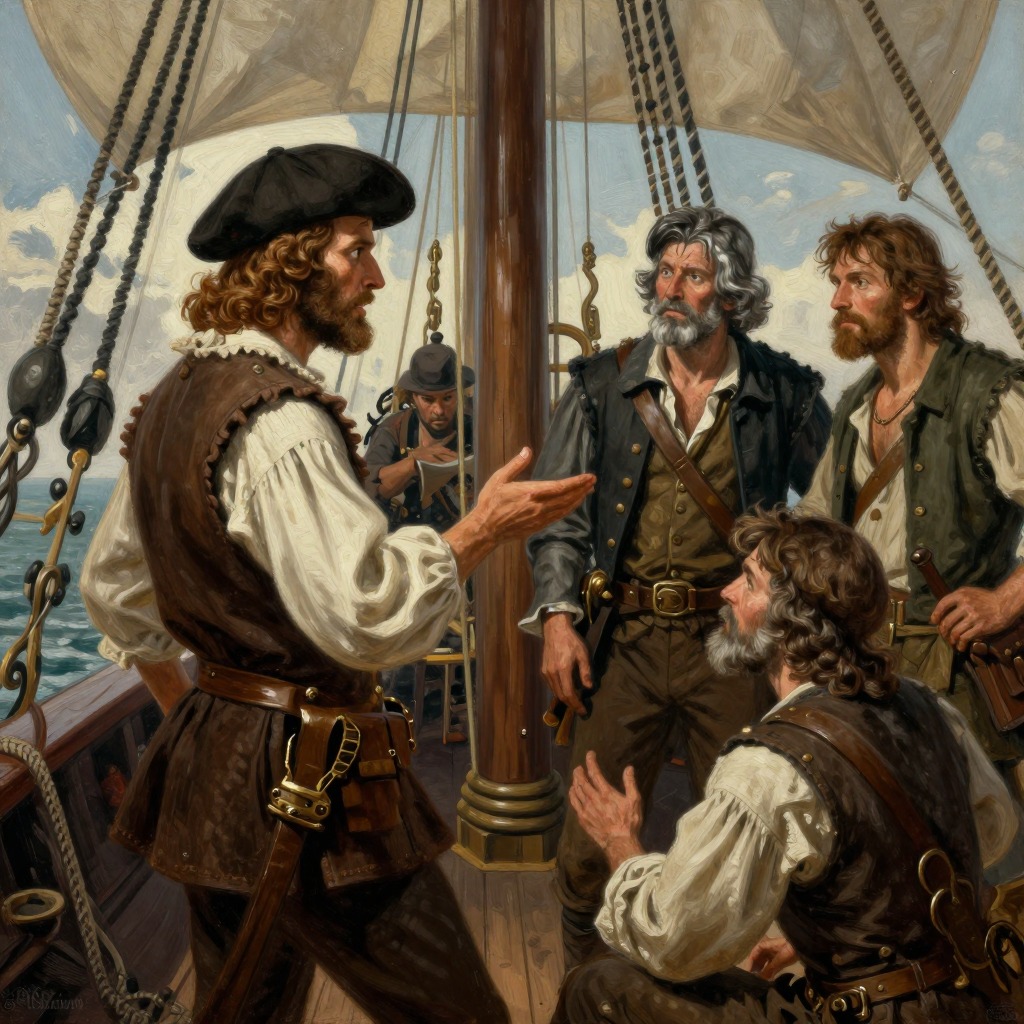
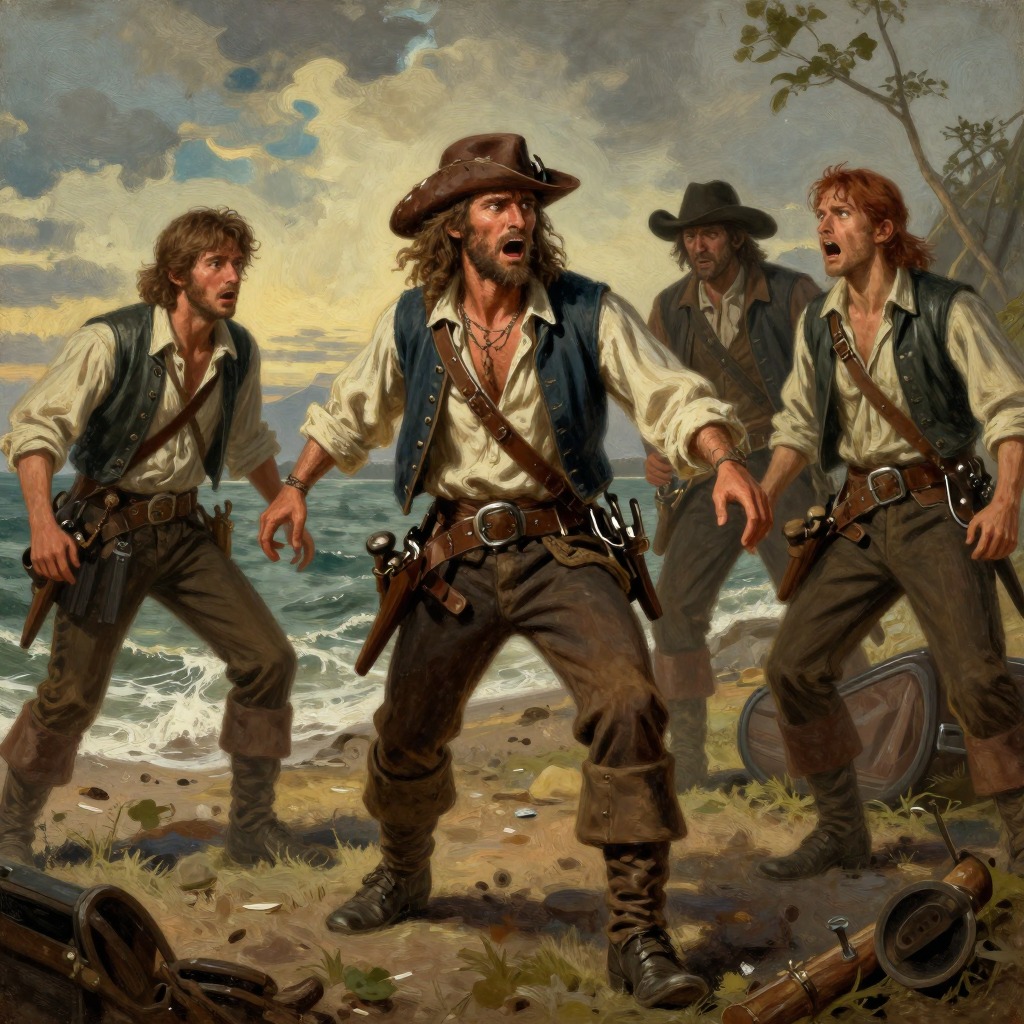
Jim's key actions are defined by a series of bold, often impulsive decisions that repeatedly turn the tide in favor of the loyal party. His first major act is hiding in the apple barrel and overhearing Silver's council of war, where he learns that the lives of all the honest men aboard depend upon him alone. He reports every word to the captain, the squire, and the doctor, who drink his health and praise his luck and courage. His second great act is going ashore with the mutineers, a "mad notion" that leads him to witness Silver's murder of Tom and to meet Ben Gunn, the marooned pirate who has already found and moved the treasure. Jim's most daring exploit, however, is his sea adventure: he takes Ben Gunn's coracle, cuts the Hispaniola adrift from her anchor, and boards the ship alone, where he finds the two watchmen dead or dying from a drunken quarrel. He strikes the Jolly Roger, takes possession of the ship, and engages in a deadly duel with Israel Hands, who tries to kill him with a dirk. Jim's objectives throughout are to save his friends and secure the ship, and he pursues them with a mixture of childish impulsiveness and growing competence, even as he acknowledges his own follies—leaving the stockade with only two sound men to guard it, and later finding himself captured by the mutineers.
Relationships and Conflict
Jim's relationships are defined by his position as a boy among men, both loyal and treacherous. With Long John Silver, he shares a complex bond that oscillates between fear, admiration, and mutual dependence. Silver flatters Jim from their first meeting at the Spy-glass Tavern, calling him "as smart as paint" and treating him with unwearied kindness, and Jim initially believes him to be the best of men. After overhearing the mutiny plot, Jim is horrified by Silver's cruelty and duplicity, yet when he is captured by the mutineers, Silver protects him, saving his life from the angry crew and forming a bargain: Jim will save Silver from the gallows, and Silver will save Jim from the pirates. Jim's relationship with Dr. Livesey is one of trust and guidance; the doctor praises his courage, scolds him for his desertion, and ultimately works to save him. With the squire, Jim is a favored protégé, and with Captain Smollett, a boy who earns grudging respect. His conflicts are primarily with the mutineers, especially Israel Hands, whom he kills in self-defense, and with his own conscience, as he repeatedly blames himself for leaving his friends in danger.
Change and Ending
Jim's transformation is complete by the novel's end. He returns to the stockade to find the mutineers in possession, is captured, and uses his wits to survive, even boasting to Silver that he was the one who cut the ship adrift and killed the men aboard her. After the treasure is recovered and the mutineers are defeated, Jim helps transport the gold to the Hispaniola, packing the minted money into bread-bags and sorting the diverse coinage with pleasure. He is present when Silver escapes, and he reflects that they were all pleased to be so cheaply quit of him. The novel closes with Jim's account of the aftermath: the treasure is shared, Captain Smollett retires from the sea, Gray becomes a mate and part owner of a ship, and Ben Gunn spends his thousand pounds in nineteen days. Jim himself, now the narrator of the whole story, declares that the bar silver and the arms still lie where Flint buried them, and that oxen and wain-ropes would not bring him back to that accursed island. His worst dreams are of the surf booming about its coasts and the sharp voice of Captain Flint the parrot still ringing in his ears: "Pieces of eight! Pieces of eight!"
Narrative Role and Evaluation
Jim Hawkins's role as narrator is essential to the novel's structure and effect. His first-person retrospective account, written at the request of the gentlemen, gives the story an intimate, personal quality, and his youth and inexperience make him a natural lens for the reader's own wonder and fear. His narration is marked by vivid sensory detail—the smell of tar and salt, the sight of the island's grey woods and wild stone spires, the sound of the surf booming half a mile away—and by a growing self-awareness that mirrors his moral development. Jim's perspective also shapes the reader's judgment of the other characters, particularly Silver, whose charm and menace are filtered through Jim's alternating admiration and horror. The novel's episodic structure, with its shifts between Jim's narration and Dr. Livesey's, allows Jim to be both participant and observer, and his final reflections on the cost of the treasure—the lives of seventeen men from the Hispaniola, and the blood and sorrow that went into its amassing—give the adventure a somber, moral weight. Jim Hawkins is thus not merely the hero of the tale but its conscience, the boy who grows into a man by facing danger, making choices, and learning to live with their consequences.