Ned Land
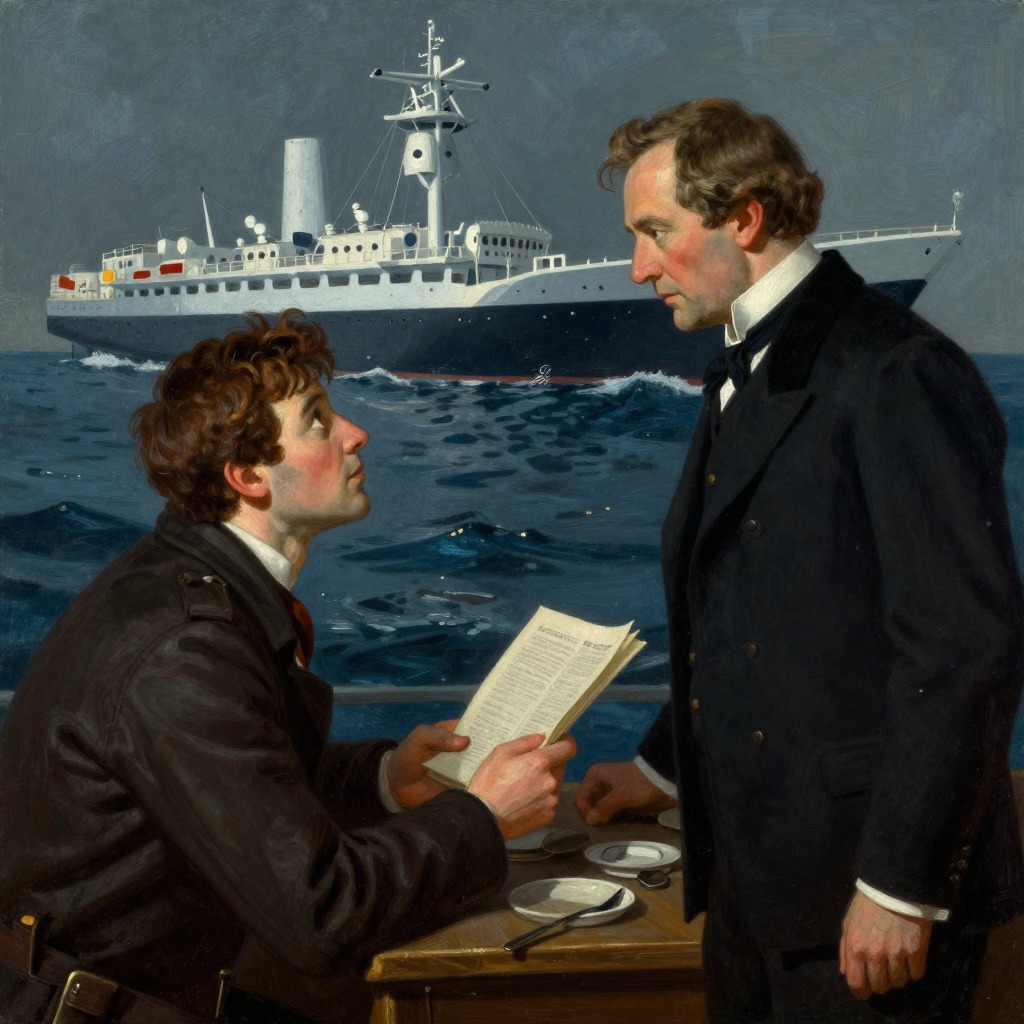
Ned Land, a Canadian harpooner of legendary prowess, is introduced as a man whose very being is defined by action and freedom. At about forty years old and over six feet tall, he is powerfully built, with a serious manner and a gaze of remarkable intensity. Commander Farragut of the Abraham Lincoln wisely hires him, recognizing that his eye and throwing arm are worth the entire crew. Ned Land is a man of few words but immense physical presence, a creature of constant appetites who embodies man as heroic animal. His skepticism about the "monster" is immediate and unshakable; he flatly denies that any whale, no matter how large, could puncture a steamer's sheet-iron plates, and he remains the lone dissenter on board the frigate, refusing to share the general conviction. This stubbornness, however, is matched by a deep, unspoken loyalty that will later define his actions.
Life and Plot Trajectory
Ned Land's journey is one of escalating confinement and resistance. After the Abraham Lincoln's collision with the Nautilus, he is thrown overboard and, with characteristic resourcefulness, is the first to realize that the supposed monster is actually a machine made of boilerplate steel. Captured and imprisoned, he immediately begins plotting escape. His initial fury at their captivity is barely contained; he threatens to break out, to fight, to kill. He is the embodiment of the will to freedom, constantly at odds with the scientific curiosity that keeps Professor Aronnax and Conseil compliant. His mood swings between sullen silence and explosive rage, and his desperation grows with each passing week. The monotony of life on board, the lack of red meat, and the absence of any hope of escape drive him to the brink of despair. He becomes less sociable, almost sullen, and his eyes flicker with dark fire whenever he encounters Captain Nemo. The Canadian's entire being is concentrated on one goal: to regain his liberty, even if it means risking his life.
Key Actions and Objectives
Ned Land's primary objective is escape, and every action he takes is subordinated to this goal. He is the one who first sights the "monster" from the Abraham Lincoln, and later, it is his harpoon that strikes the Nautilus, an act that inadvertently leads to their capture. He is a master of his trade, as demonstrated when he harpoons two whales with a right-and-left shot off the Falkland Islands. His skills are not limited to whaling; he is a capable hunter, a skilled navigator of the skiff, and a man of immense physical courage. He is the one who, during the shark attack at the Ceylon pearl fisheries, rushes forward with his harpoon to save Captain Nemo, an act that earns him a rare moment of gratitude from the captain. He is also the driving force behind the final, desperate escape attempt, meticulously planning the seizure of the skiff and the flight from the Nautilus. His actions are always direct, forceful, and aimed at breaking the bonds of his imprisonment.
Relationships and Conflict
Ned Land's relationship with Captain Nemo is one of fundamental, irreconcilable conflict. Nemo represents law, order, and a self-imposed exile from humanity; Ned Land represents raw, untamed freedom. Their clashes are inevitable. Nemo's prohibition on hunting whales for sport infuriates Ned, who sees it as a denial of his very identity. The Canadian's hatred for the captain is palpable, and he is the only one on board who dares to openly defy him. In contrast, his relationship with Professor Aronnax is one of grudging respect and growing friendship. Aronnax, a fellow French speaker, becomes a confidant, and Ned often seeks his counsel. Conseil, the stoic classifier, serves as a foil to Ned's passionate nature, their debates on fish classification providing moments of levity. The bond between the three men is forged in shared danger, and it is Ned and Conseil who ultimately save Aronnax's life during the asphyxiation crisis in the Antarctic ice, sacrificing their own air for him.
Change and Ending
Ned Land's character undergoes a subtle but significant transformation. While he never abandons his desire for freedom, his initial, almost animalistic rage is tempered by the shared experiences and dangers of the voyage. He learns to cooperate with Aronnax and Conseil, and his respect for the professor's scientific passion grows. The harpooner's final act is not one of blind fury but of calculated, desperate courage. He leads the escape from the Nautilus, and in the chaos of the Maelstrom, he is the one who urges them to hold on, to screw the nuts back down, to fight for survival. When the skiff is finally torn from the submarine, he is thrown into the vortex alongside his companions. The novel ends with the three men safe in a fisherman's hut on the Lofoten Islands, having survived the whirlpool. Ned Land's fate is left open; he has achieved his freedom, but the cost and the manner of its achievement remain a mystery.
Narrative Role and Evaluation
Ned Land serves as the novel's primary source of dramatic tension and human conflict. He is the embodiment of the will to freedom, a force that constantly challenges Captain Nemo's absolute authority and the scientific detachment of Professor Aronnax. His presence prevents the narrative from becoming a mere travelogue, injecting a constant undercurrent of danger and the possibility of rebellion. He is a flat character in the sense that his core motivation—the desire for freedom—remains constant, but he is also capable of surprising the reader with his loyalty and courage. His skepticism about the monster and his practical, earthbound perspective provide a necessary counterpoint to the novel's more fantastical elements. Ultimately, Ned Land is the human heart of the story, a man whose simple, powerful desires for liberty, good food, and his homeland make him the most relatable and compelling figure in the crew.