
Alice's Adventures in Wonderland
Basic Facts
Alice's Adventures in Wonderland (often shortened to Alice in Wonderland) is a beloved children's novel by the English author and mathematician Lewis Carroll (pen name of Charles Lutwidge Dodgson). First published in November 1865 by Macmillan, the book features 42 wood-engraved illustrations by John Tenniel. It is a prime example of the literary nonsense genre, blending fantasy, wordplay, and absurdity. The story follows a young girl named Alice who falls down a rabbit hole into a bizarre underground world filled with anthropomorphic creatures and illogical events.
Plot Summary
On a lazy afternoon, Alice sits beside her sister on a riverbank when she spots a White Rabbit wearing a waistcoat and muttering about being late. She follows him down a rabbit hole and enters a long hall with many locked doors. After drinking a potion labeled "DRINK ME," she shrinks; then eating a cake marked "EAT ME" makes her grow giant. She encounters a series of strange characters: a Caterpillar who smokes a hookah and gives cryptic advice, a Cheshire Cat with a disappearing grin, a Mad Hatter and a March Hare having an endless tea party, and a Queen of Hearts who constantly orders executions. Alice attends a trial where the Knave of Hearts is accused of stealing tarts, and as the Queen threatens her, she wakes up back on the riverbank, realizing it was all a dream.
Themes and Background
The novel explores themes of identity, growth, and the absurdity of adult logic. Through Alice's constant size changes and her struggles to make sense of Wonderland's nonsensical rules, Carroll critiques the rigid social conventions of Victorian England. The book is filled with mathematical puzzles, logical paradoxes, and linguistic puns, reflecting Carroll's expertise as a mathematician and logician. The story originated during a boating trip on July 4, 1862, when Carroll entertained the Liddell sisters—Lorina, Alice, and Edith—with an impromptu tale. Alice Liddell, the real girl, begged him to write it down, and after several revisions, the manuscript was published in 1865.
Influence and Legacy
Alice's Adventures in Wonderland was an immediate success and has never gone out of print. It has been translated into over 100 languages and adapted into countless films, plays, ballets, and video games. Its characters—the White Rabbit, the Cheshire Cat, the Mad Hatter—have become cultural icons. The book has influenced writers such as Frank Baum, Dr. Seuss, and John Lennon, and continues to inspire artists, psychologists, and philosophers. Its blend of whimsy, satire, and intellectual depth ensures its place as a timeless masterpiece of children's literature.
About the Author
Early Life
Lewis Carroll was the pen name of Charles Lutwidge Dodgson, born on January 27, 1832, in Daresbury, Cheshire, England. He was the third of eleven children and the eldest son of Charles Dodgson, a conservative clergyman, and Frances Jane Lutwidge. His father, a former Oxford scholar, nurtured his mathematical talents, while his mother fostered his interest in religion and literature. Carroll showed early brilliance, reading John Bunyan's The Pilgrim's Progress at age seven. He stuttered but was highly creative, entertaining his siblings with homemade magazines and plays. In 1843, the family moved to Croft-on-Tees in North Yorkshire, where they lived for 25 years.
Education and Career
Carroll was initially educated at home, then attended Richmond Grammar School and later Rugby School. In 1850, he entered Christ Church, Oxford, where he excelled in mathematics and classics. He graduated in 1854 and became a mathematics lecturer at Christ Church, a position he held until 1881. He was also ordained as a deacon in the Anglican Church but never pursued full priesthood. Carroll was a prolific mathematician and logician, publishing works on geometry, algebra, and logic games. He never married and spent most of his life in Oxford.
Literary and Photographic Work
Under the pseudonym Lewis Carroll, he published Alice's Adventures in Wonderland in 1865, inspired by a story he told to the Liddell sisters during a boat trip on July 4, 1862. The sequel, Through the Looking-Glass, followed in 1871. He also wrote the narrative poem The Hunting of the Snark (1876) and many other poems and puzzles. Carroll was a notable photographer, especially of children, and his portraits remain highly regarded. His work in photography, mathematics, and literature showcases his multifaceted genius.
Death and Legacy
Carroll died of bronchitis on January 14, 1898, at his sisters' home in Guildford, Surrey, at age 65. He was buried at Mount Cemetery in Guildford. His books have never been out of print and have been translated into over 100 languages. Carroll's influence extends far beyond children's literature: his use of nonsense, paradox, and wordplay has inspired authors like James Joyce, Jorge Luis Borges, and filmmakers like Tim Burton. He is remembered as a master of fantasy and logic, whose works continue to delight and perplex readers of all ages.
StoryFlow
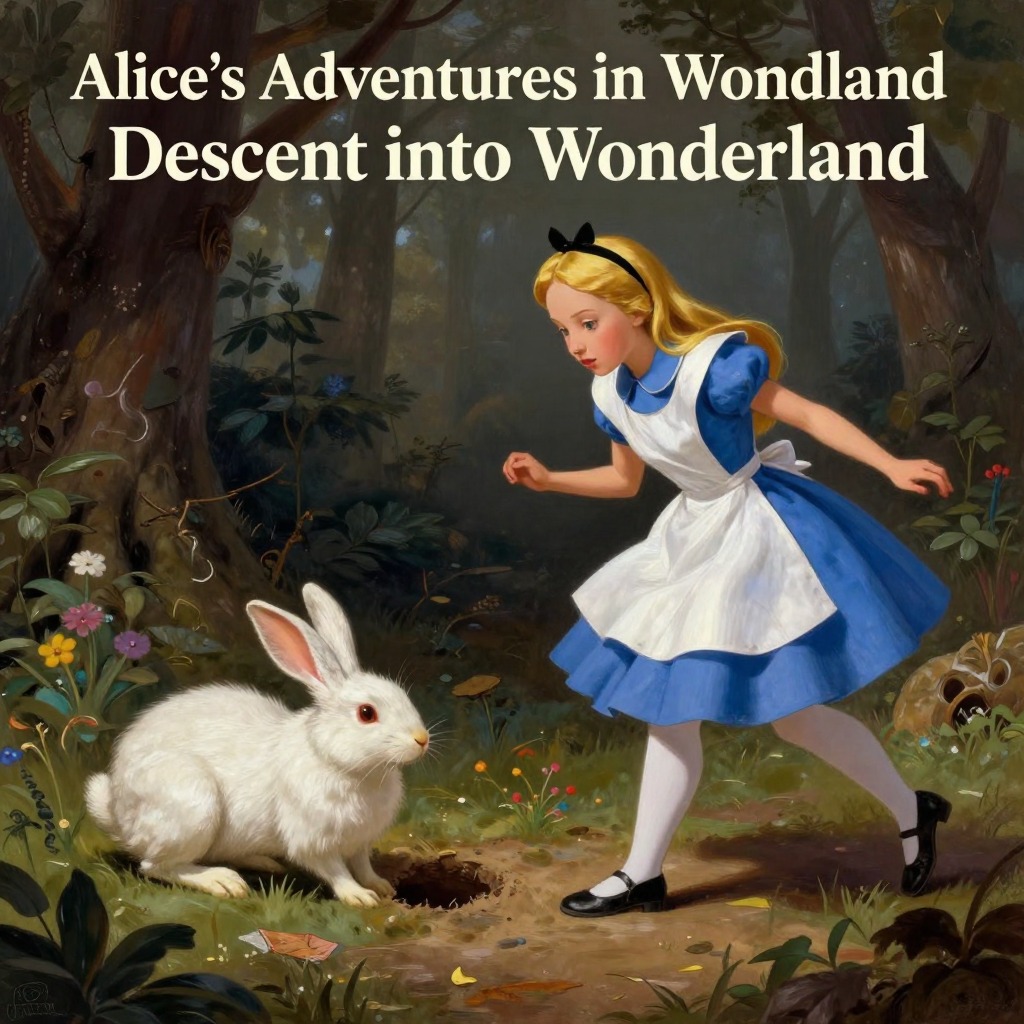
Alice's Descent into Wonderland
Alice chases a White Rabbit down a rabbit-hole and undergoes a series of bewildering size changes, setting the stage for her journey through a surreal world.
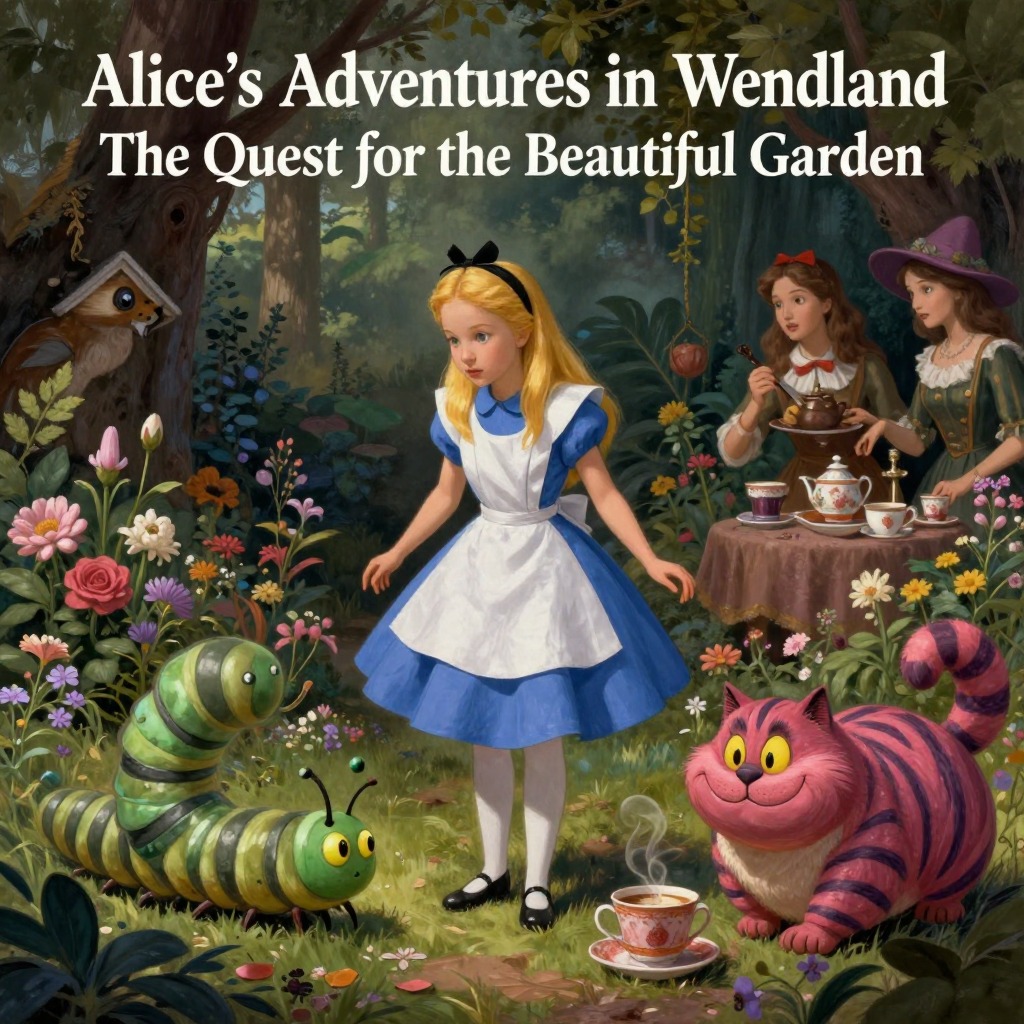
The Quest for the Beautiful Garden
Alice's persistent desire to enter the lovely garden drives her through encounters with the Caterpillar, the Cheshire Cat, and the Mad Tea-Party, as she struggles to control her size.
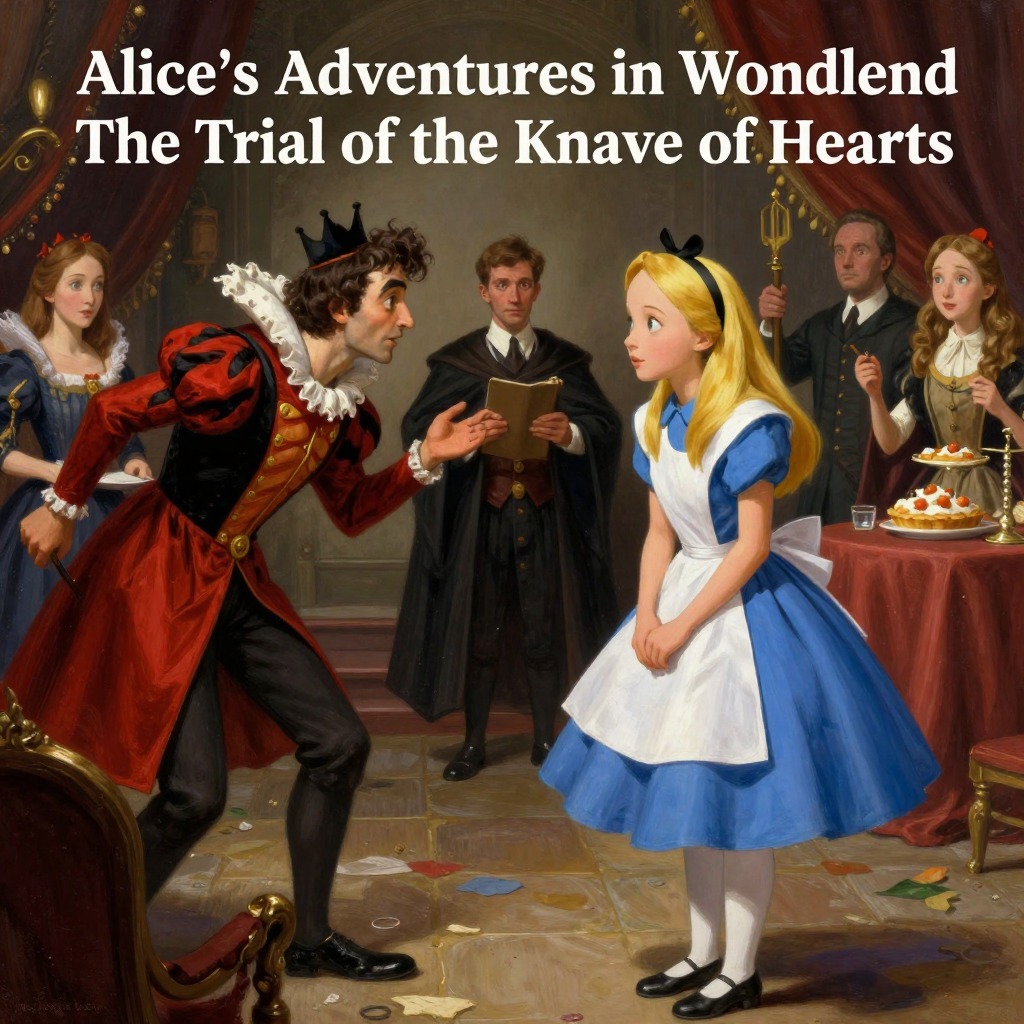
The Trial of the Knave of Hearts
The chaotic trial of the Knave of Hearts for stealing tarts exposes the absurdity of Wonderland's justice system, culminating in Alice's confrontation with the Queen.
