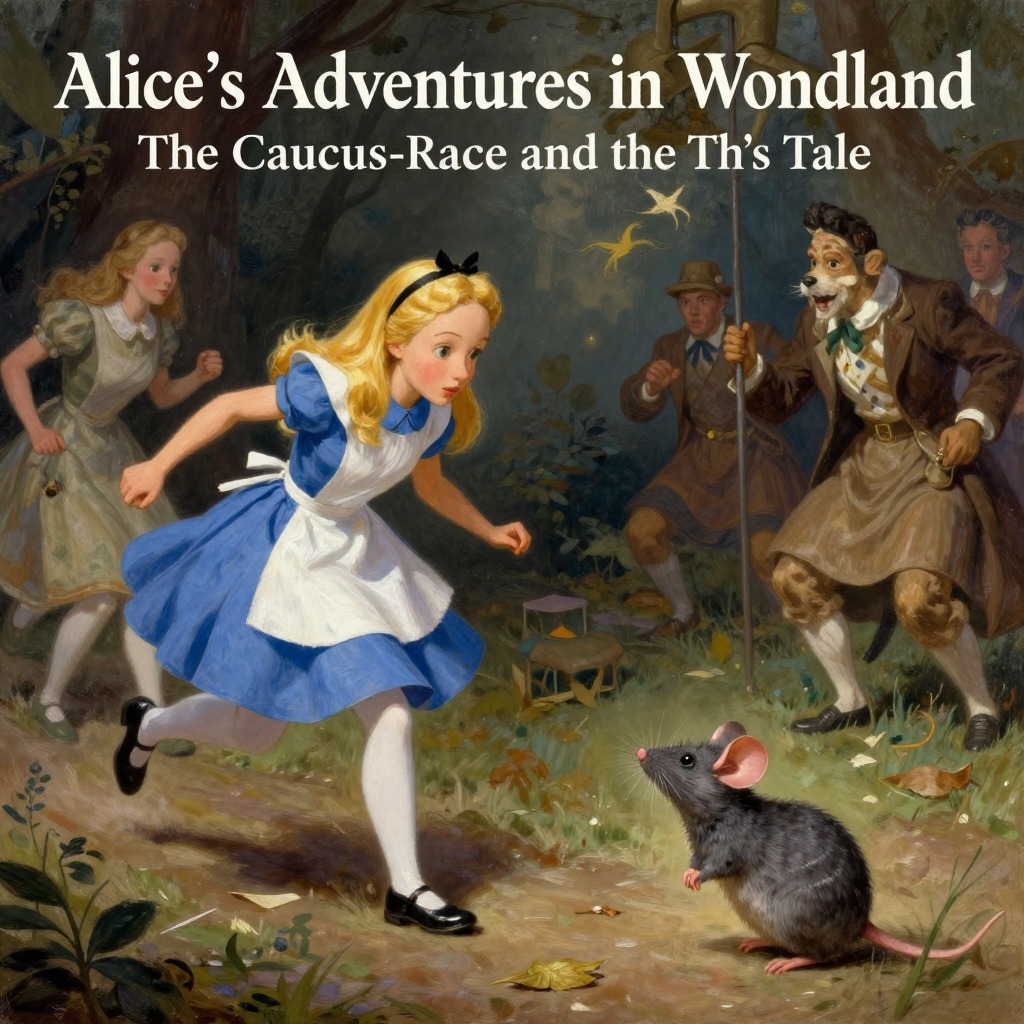
A Caucus-Race and a Long Tale
The Caucus-Race and the Mouse's Tale constitute the first collective social encounter Alice experiences in Wonderland, an episode that crystallizes the arbitrary, self-defeating logic of the creatures she has fallen among. After swimming in the pool of her own tears, Alice leads a bedraggled party of birds and animals—including a Duck, a Dodo, a Lory, an Eaglet, and a Mouse—to the shore, where they assemble, dripping wet, cross, and uncomfortable. The immediate problem is how to get dry, and the solution they devise, the Caucus-Race, becomes a perfect emblem of Wonderland's procedural absurdity: a race with no fixed start, no finish line, and no winner, yet one that produces a ceremonial distribution of prizes and a solemn declaration that "Everybody has won, and all must have prizes." The Mouse then offers to tell its history, a "long and a sad tale" that Alice mishears as a "long tail," and the narrative that follows is printed as a poem shaped like a mouse's tail—a visual pun that Alice fails to attend to, provoking the Mouse's anger and its abrupt departure. The episode ends with Alice's mention of her cat Dinah, which scatters the remaining creatures in fear, leaving her alone once more.
The Caucus-Race: A Ritual of Absurd Procedure
The Dodo proposes the Caucus-Race as "the best thing to get us dry," and the race itself is a masterpiece of arbitrary design. First, the Dodo marks out a race-course in a sort of circle, declaring that "the exact shape doesn't matter." Then all the party are placed along the course, here and there, and they begin running when they like and leave off when they like, so that it is not easy to know when the race is over. After half an hour or so, when they are quite dry, the Dodo suddenly calls out "The race is over!" and the panting crowd asks, "But who has won?" The Dodo sits for a long time with one finger pressed upon its forehead—the position in which one usually sees Shakespeare in pictures—and at last announces, "Everybody has won, and all must have prizes." This declaration, which would be meaningless in any ordinary competition, is accepted without question by the assembly. Alice, as the only human present, is designated the prize-giver; she pulls out a box of comfits from her pocket and hands them round, exactly one apiece. The Mouse then insists that Alice herself must have a prize, and the Dodo solemnly presents her with a thimble, saying "We beg your acceptance of this elegant thimble," after which the party cheers. Alice thinks the whole thing very absurd, but they all look so grave that she does not dare to laugh. The Caucus-Race thus establishes a pattern that will recur throughout Wonderland: a procedure that is internally consistent yet utterly detached from any external standard of sense, and that is enforced by the solemnity of its participants rather than by any rational foundation.
The Mouse's Tale: A Visual Pun and a Failed Narration
After the race, the party sits down in a ring and begs the Mouse to tell them something more. Alice reminds the Mouse of its promise to tell its history and why it hates cats and dogs, adding in a whisper "C and D" for fear of offending it again. The Mouse sighs and says, "Mine is a long and a sad tale!" Alice, looking down with wonder at the Mouse's tail, replies, "It is a long tail, certainly; but why do you call it sad?" The narrative that follows is printed as a poem shaped like a mouse's tail—a concrete visual pun that Alice, puzzling over the shape, fails to attend to. The poem tells of a meeting between "Fury" and a mouse, in which Fury proposes a trial with himself as judge and jury, and condemns the mouse to death. Alice, distracted by the tail shape, misses the content entirely, and when the Mouse stops and asks severely, "You are not attending! What are you thinking of?" she can only reply, "you had got to the fifth bend, I think?" The Mouse, furious, declares that it had not, and when Alice offers to help undo a "knot" (mishearing "not"), the Mouse walks away, saying "You insult me by talking such nonsense!" Alice pleads, "But you're so easily offended, you know!" but the Mouse only growls and shakes its head impatiently. The Lory sighs, "What a pity it wouldn't stay!" and an Old Crab tells her daughter, "Let this be a lesson to you never to lose your temper!"—a moral that the Young Crab rejects snappishly. The Mouse's Tale thus becomes a failed act of communication: a story that is literally shaped to be seen rather than heard, and that is rejected by its audience because she is looking at the wrong thing.
Dinah's Disruption: The Social Fragility of Wonderland
Alice, left alone after the Mouse's departure, wishes aloud for her cat Dinah, saying "She'd soon fetch it back!" The Lory asks who Dinah is, and Alice eagerly explains that Dinah is "such a capital one for catching mice" and that "she'll eat a little bird as soon as look at it!" This speech causes a remarkable sensation among the party. Some of the birds hurry off at once; an old Magpie wraps itself up carefully, remarking, "I really must be getting home; the night-air doesn't suit my throat!" and a Canary calls out in a trembling voice to its children, "Come away, my dears! It's high time you were all in bed!" On various pretexts they all move off, and Alice is soon left alone. She says to herself in a melancholy tone, "I wish I hadn't mentioned Dinah! Nobody seems to like her, down here, and I'm sure she's the best cat in the world!" and begins to cry again, feeling very lonely and low-spirited. The episode thus ends as it began: with Alice alone, having inadvertently driven away the only company she had, by speaking the truth about her own world. The Caucus-Race and the Mouse's Tale together establish the social logic of Wonderland as one in which arbitrary rules are solemnly observed, verbal puns are taken as literal truths, and the mere mention of a predator from the world above can shatter a fragile community. Alice's loneliness, her failure to attend to the right thing, and her inability to navigate the creatures' touchy sensibilities all mark her as an outsider who must learn—or fail to learn—the rules of this new world.