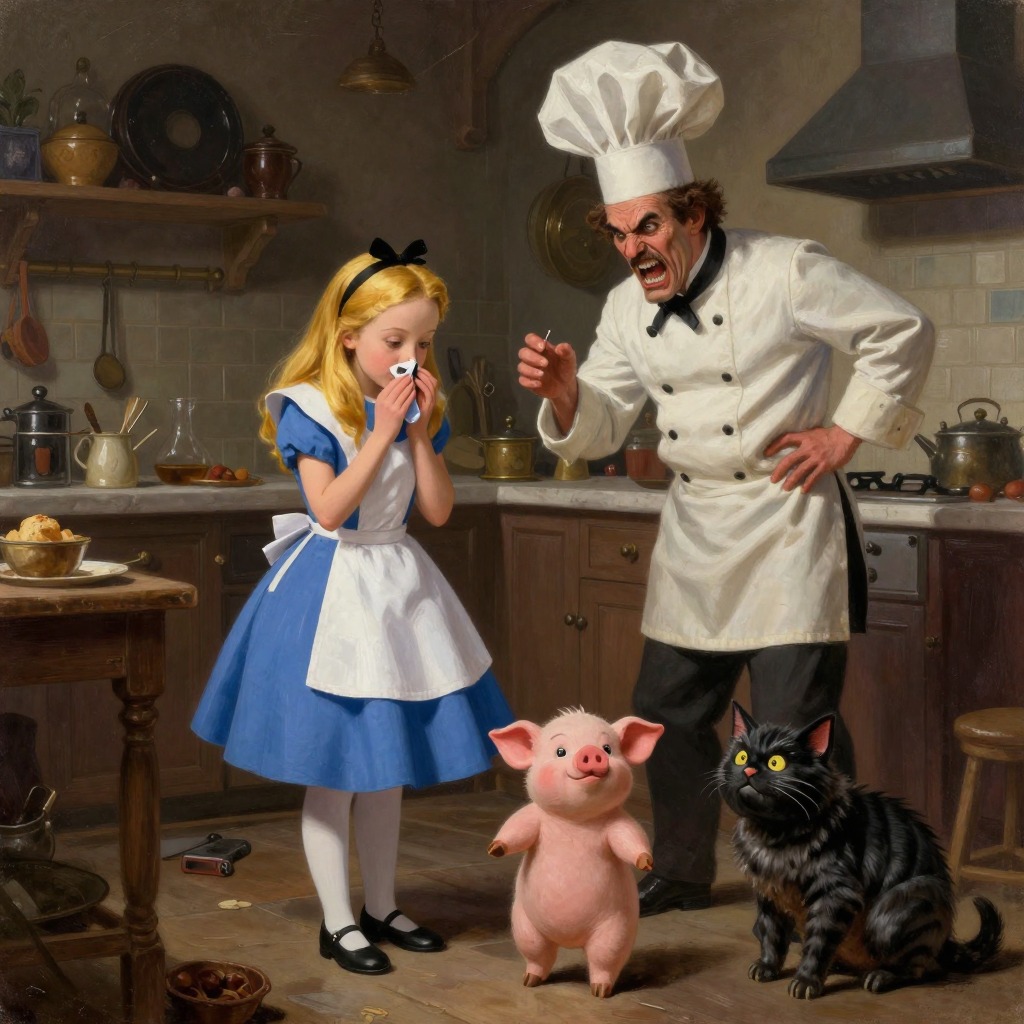
Cook
The Cook appears only twice in Alice's Adventures in Wonderland, but each appearance is marked by a distinctive, aggressive physicality and a complete indifference to the norms of domestic order or legal procedure. She is first encountered in the Duchess's kitchen, a space so thick with pepper that everyone except the Cook and the Cheshire Cat is sneezing uncontrollably, and later surfaces as a witness in the trial of the Knave of Hearts, where her terse, uncooperative testimony contributes to the courtroom's collapse into farce.
Identity and Introduction
The Cook is introduced in Chapter VI, "Pig and Pepper," as a figure bent over a large cauldron of soup in a kitchen filled with smoke. She is the only person in the room who does not sneeze, despite the pepper-laden air that makes even the Duchess sneeze occasionally and keeps the baby howling and sneezing without pause. The Cook's defining action is not her cooking but her throwing: she takes the cauldron off the fire and immediately begins hurling everything within reach at the Duchess and the baby. The fire-irons come first, followed by a shower of saucepans, plates, and dishes. The Duchess takes no notice even when hit, and the baby is already howling so much that it is impossible to tell whether the blows hurt it. When the Duchess leaves to prepare for croquet with the Queen, the Cook throws a frying-pan after her, just missing. This relentless, indiscriminate violence establishes the Cook as a force of pure, unthinking aggression within the domestic sphere.
Role in the Kitchen Scene
The Cook's pepper-heavy soup is the catalyst for the scene's central chaos. Alice observes that there is "certainly too much pepper in that soup," and the entire kitchen—except for the Cook and the grinning cat—is convulsed by sneezing. The Duchess herself sings a lullaby that celebrates beating the child when he sneezes, and the Cook joins in the chorus of "Wow! wow! wow!" while continuing to throw objects. The Cook's actions are not directed by malice toward any particular target; she throws at both the Duchess and the baby with equal vigor, and the Duchess's only response is a hoarse growl that "if everybody minded their own business, the world would go round a deal faster than it does." The Cook's behavior thus embodies a kind of mechanical, unreflective violence that is simply part of the kitchen's normal operation. Alice, horrified, jumps up and down in an agony of terror when a large saucepan nearly carries off the baby's nose, but the Cook continues stirring the soup as if nothing has happened.
Appearance at the Trial
The Cook reappears in Chapter XI, "Who Stole the Tarts?," as the second witness called in the trial of the Knave of Hearts. She carries the pepper-box in her hand, and Alice recognizes her even before she enters the court by the way the people near the door begin sneezing all at once. When the King asks her to give her evidence, the Cook simply replies "Shan't." The King, flustered, is told by the White Rabbit that he must cross-examine her himself. He asks what tarts are made of, and the Cook answers "Pepper, mostly." This single, absurd answer—tarts are not made of pepper—is her entire testimony. A sleepy voice from the Dormouse adds "Treacle," and the Queen immediately orders the Dormouse suppressed, creating a commotion during which the Cook disappears. Her refusal to cooperate and her nonsensical evidence mirror the kitchen scene's logic: she is a figure who disrupts order simply by being present, and her pepper-box, like her pepper in the soup, spreads discomfort and confusion wherever she goes.
Thematic Significance
The Cook serves as a concentrated emblem of the arbitrary, physical violence that pervades Wonderland. Her pepper is not merely a seasoning but a substance that causes involuntary bodily reactions—sneezing, howling, and general discomfort—and her throwing of objects is a form of aggression that is met with complete indifference by the Duchess and with horror by Alice. The Cook's later appearance at the trial, where her pepper-box again triggers sneezing and her testimony is a single defiant word, reinforces the idea that Wonderland's institutions—whether domestic or judicial—are governed not by reason but by caprice and brute force. She is a flat character in Forster's sense, built around a single idea: the cook as a source of chaotic, unthinking violence. Yet within that flatness, she is unforgettable, a figure whose pepper and pots and pans leave a lasting impression of a world where even the most ordinary domestic tasks are conducted with a kind of savage absurdity.