Everything's got a moral
The Duchess's declaration that "Everything's got a moral, if only you can find it" functions as a central, recurring rule in Wonderland, a principle that satirizes the Victorian obsession with didacticism and the arbitrary imposition of meaning. The rule is first fully articulated during Alice's second meeting with the Duchess, after the Duchess has been fetched from prison to settle the dispute over the Cheshire Cat's head. As they walk arm-in-arm, the Duchess, in a markedly pleasant temper, applies her moralizing to every remark Alice makes, demonstrating the rule's relentless and often nonsensical application.
Origin and Articulation
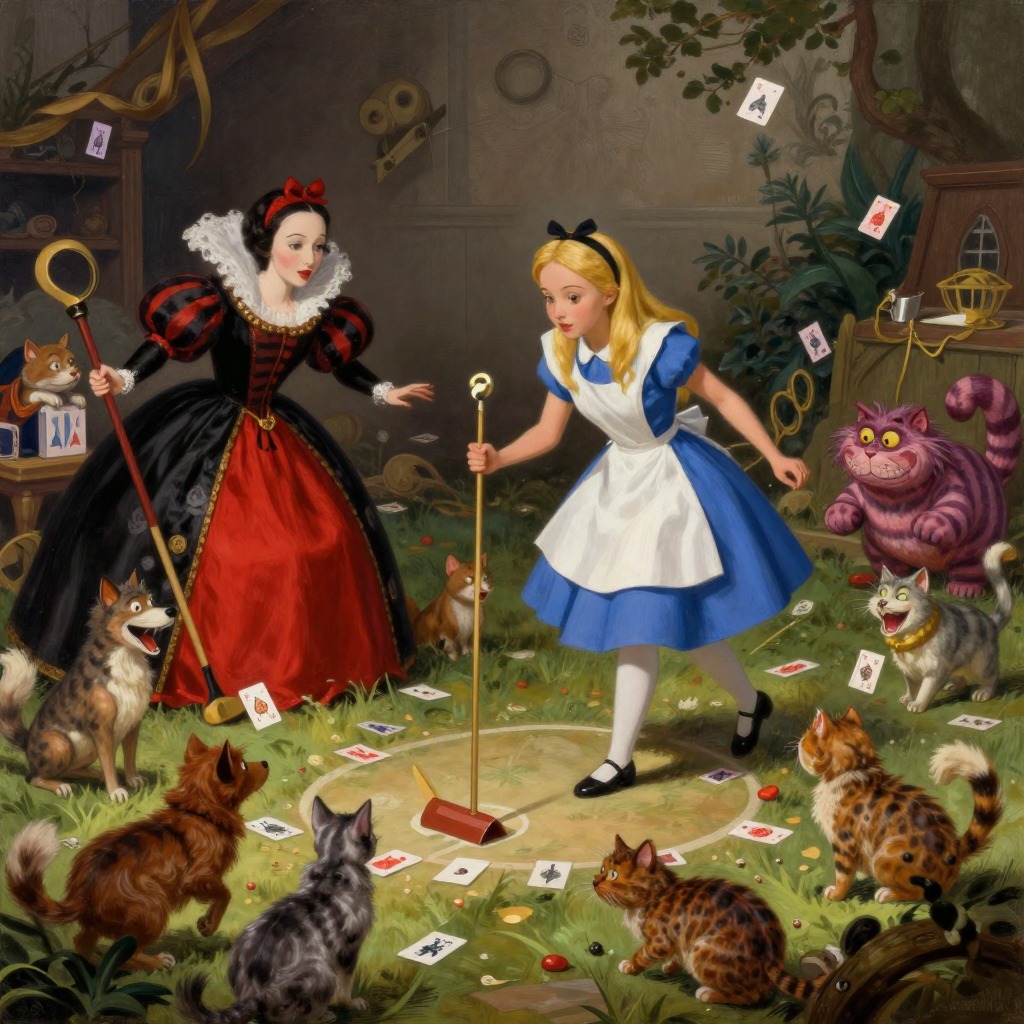
The rule is introduced not as a formal decree but as a conversational habit of the Duchess. When Alice ventures that a particular observation might not have a moral, the Duchess retorts, "Tut, tut, child! Everything's got a moral, if only you can find it." She then proceeds to attach a moral to each of Alice's statements, from the progress of the croquet game ("the moral of that is—'Oh, 'tis love, 'tis love, that makes the world go round!'") to the nature of mustard ("the moral of that is—'The more there is of mine, the less there is of yours'"). The Duchess's moralizing is so compulsive that she even begins to formulate a moral about pigs having the right to fly, only to be interrupted by the Queen of Hearts. The rule is thus established as a personal doctrine of the Duchess, one she applies with unwavering confidence regardless of relevance.
Application and Absurdity
The Duchess's application of the rule reveals its inherent absurdity. She derives morals from the most trivial and unrelated subjects, such as the biting properties of flamingoes and mustard ("Birds of a feather flock together") and the nature of mustard as a mineral ("Be what you would seem to be"). Her most convoluted moral—"Never imagine yourself not to be otherwise than what it might appear to others that what you were or might have been was not otherwise than what you had been would have appeared to them to be otherwise"—is so tangled that Alice admits she cannot follow it. This demonstrates that the rule, rather than providing clarity, generates confusion and meaningless complexity. The Duchess's own behavior, however, contradicts her moralizing: she is quick to agree with everything Alice says, suggesting that the morals are not derived from genuine insight but are merely rhetorical ornaments.
Contrast with Alice's World
The rule "Everything's got a moral" stands in stark contrast to the world Alice comes from, where books without pictures or conversations are deemed useless, and where simple rules like "if you drink much from a bottle marked 'poison,' it is almost certain to disagree with you" are practical and clear. In Wonderland, the Duchess's rule inverts this logic: instead of providing useful guidance, it imposes arbitrary meaning on every event, making the world more confusing rather than more understandable. Alice's own approach to the world is one of direct experience and logical questioning, as when she challenges the King's invented "Rule Forty-two" or declares the trial's proceedings "Stuff and nonsense!" The Duchess's rule, by contrast, represents a form of intellectual tyranny, where every action must be justified by a moral, no matter how far-fetched.
Thematic Significance
The rule "Everything's got a moral" is a key element in Carroll's satire of Victorian moralism and the educational systems that sought to extract a lesson from every experience. The Duchess, with her sharp chin and aggressive affection, embodies the overbearing adult who insists on finding meaning where none exists. The rule's ultimate failure to provide genuine insight—its morals are either platitudes, non-sequiturs, or incomprehensible—mirrors the broader absurdity of Wonderland, where language and logic are constantly subverted. Alice's final rejection of the Queen's authority ("Who cares for you? You're nothing but a pack of cards!") and her awakening from the dream suggest that the rule, like the rest of Wonderland's arbitrary systems, cannot withstand the clear-eyed perspective of a child who refuses to accept nonsense as truth. The rule thus serves as a comic but pointed critique of the impulse to moralize, a reminder that not everything in life—or in a dream—needs to have a lesson attached.