March Hare
The March Hare is one of the most memorable inhabitants of Wonderland, a creature defined by his participation in an endless, chaotic tea party and his embodiment of the story's central theme of madness. Introduced by the Cheshire Cat as one of the two mad residents of the area, the March Hare, along with the Hatter, presides over a tea table set perpetually at six o'clock, a frozen moment in time that structures their entire existence. He is a character who, through his actions and words, systematically dismantles the logic of ordinary conversation and social etiquette, revealing the arbitrary and often nonsensical nature of the rules that govern the waking world.
Identity and Introduction
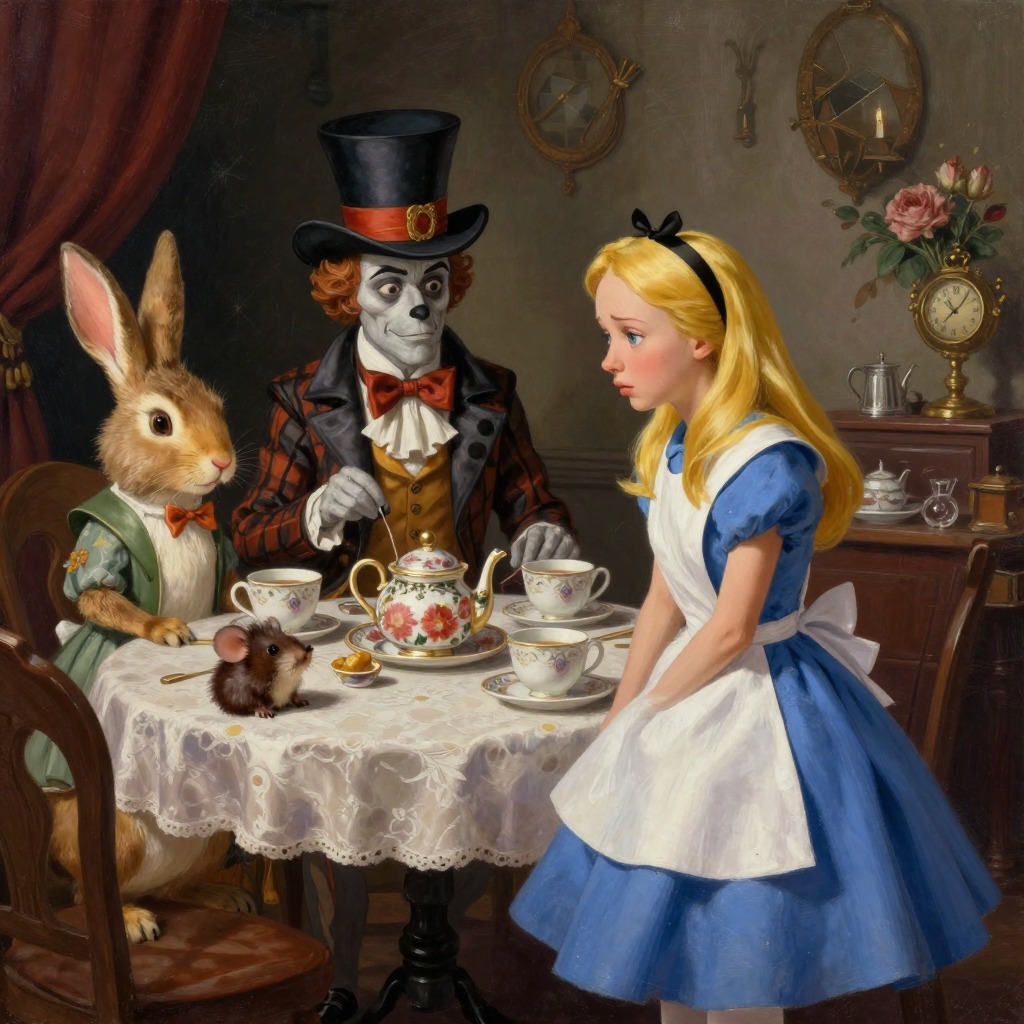
The March Hare is first mentioned by the Cheshire Cat, who tells Alice that he lives in one direction from their meeting point, while the Hatter lives in the other. The Cat warns Alice that both are mad, a statement that proves to be an understatement. When Alice first encounters the March Hare, he is seated at a large table under a tree outside his house, having tea with the Hatter and a fast-asleep Dormouse. The three are crowded together at one corner of the table, and their immediate, hostile cry of "No room! No room!" upon seeing Alice sets the tone for the encounter. The March Hare's house itself is a reflection of his character, with chimneys shaped like ears and a roof thatched with fur, marking him as a creature of whimsical, animalistic design.
The Mad Tea-Party
The tea party is the March Hare's primary domain, a scene of relentless, circular logic and social inversion. He offers Alice wine that does not exist, then criticizes her for sitting down without an invitation at a table laid for many. When the Hatter poses the riddle "Why is a raven like a writing-desk?", the March Hare joins in the subsequent wordplay, contributing the non-sequitur that "I like what I get" is the same as "I get what I like." His most notable contribution to the party's absurdity involves his watch, which tells the day of the month but not the hour. The March Hare explains that the watch is two days wrong because he used the best butter to fix it, a remedy that the Hatter insists was ruined by crumbs from a bread-knife. To demonstrate his faith in the butter, the March Hare dips the watch into his cup of tea. The March Hare is also the one who, when the conversation lags, demands that the Dormouse tell a story, and he actively participates in the physical comedy of pinching the Dormouse to keep it awake. The party is a perfect illustration of the story's absurdist logic, where time is a person who can be offended, and the only way to cope with a stopped clock is to move endlessly around a table, never washing the dishes.
Relationships and Conflict
The March Hare's primary relationship is with the Hatter, his partner in the eternal tea party. They function as a duo, finishing each other's sentences and reinforcing each other's illogical arguments. Their dynamic is one of mutual, if irritable, dependence, as seen when the Hatter blames the March Hare for the watch's malfunction, and the March Hare meekly defends his choice of butter. The March Hare also has a relationship with the Dormouse, whom he and the Hatter use as a cushion and a source of entertainment, pinching it to force it to tell stories. With Alice, the March Hare is consistently rude and dismissive, challenging her every attempt at polite conversation. He is a figure of pure antagonism to her desire for order and sense, embodying the very chaos she must navigate. His role in the trial of the Knave of Hearts is minimal but telling: he follows the Hatter into the court, arm-in-arm with the Dormouse, and when asked when the Hatter began his tea, he provides the date "Fifteenth," contributing to the general confusion of the proceedings.
Change and Ending
The March Hare undergoes no personal transformation or arc. He is a static character, a fixed point of madness in the fluid world of Wonderland. His function is to be a constant, unchanging source of absurdity. He does not learn, grow, or change; he simply is. At the end of the tea party, Alice leaves in disgust, and the March Hare, along with the Hatter, makes no attempt to stop her, instead trying to put the Dormouse into the teapot. He reappears only as a witness in the trial, where his testimony is as nonsensical as his tea-party conversation. His final appearance is in the sister's dream, where the rattle of teacups from his never-ending meal is one of the sounds that fills the air, cementing his role as a permanent fixture of Wonderland's chaotic landscape.
Thematic Significance
The March Hare is a key vehicle for the novel's exploration of madness, logic, and the arbitrary nature of social rules. His behavior, along with the Hatter's, directly challenges Alice's (and the reader's) assumptions about how the world should work. The tea party, with its endless, circular conversation and its rejection of basic politeness, is a microcosm of Wonderland's entire operating system: a place where cause and effect are severed, and where the only constant is the absurd. The March Hare's madness is not a flaw but a fundamental characteristic of his world, a world that the Cheshire Cat famously declares is populated entirely by mad creatures. Through the March Hare, Carroll satirizes the rigid etiquette and logical positivism of Victorian society, suggesting that the rules of the real world are just as arbitrary and nonsensical as those of Wonderland.