Mock Turtle
The Mock Turtle is one of the most sorrowful and oddly endearing inhabitants of Wonderland, a creature whose very name is a pun on the soup made from a mock turtle (a calf's head prepared to resemble turtle meat). He appears in the latter half of Alice's adventures, introduced by the Queen of Hearts as a figure who will tell his history, and his presence deepens the book's exploration of identity, memory, and the absurdity of institutional learning. Sitting on a little ledge of rock, sighing as if his heart would break, the Mock Turtle presents a portrait of perpetual grief that is both comic and poignant, and his long, rambling account of his education in the sea is one of the most sustained examples of Carroll's playful subversion of language and logic.
Identity and Introduction
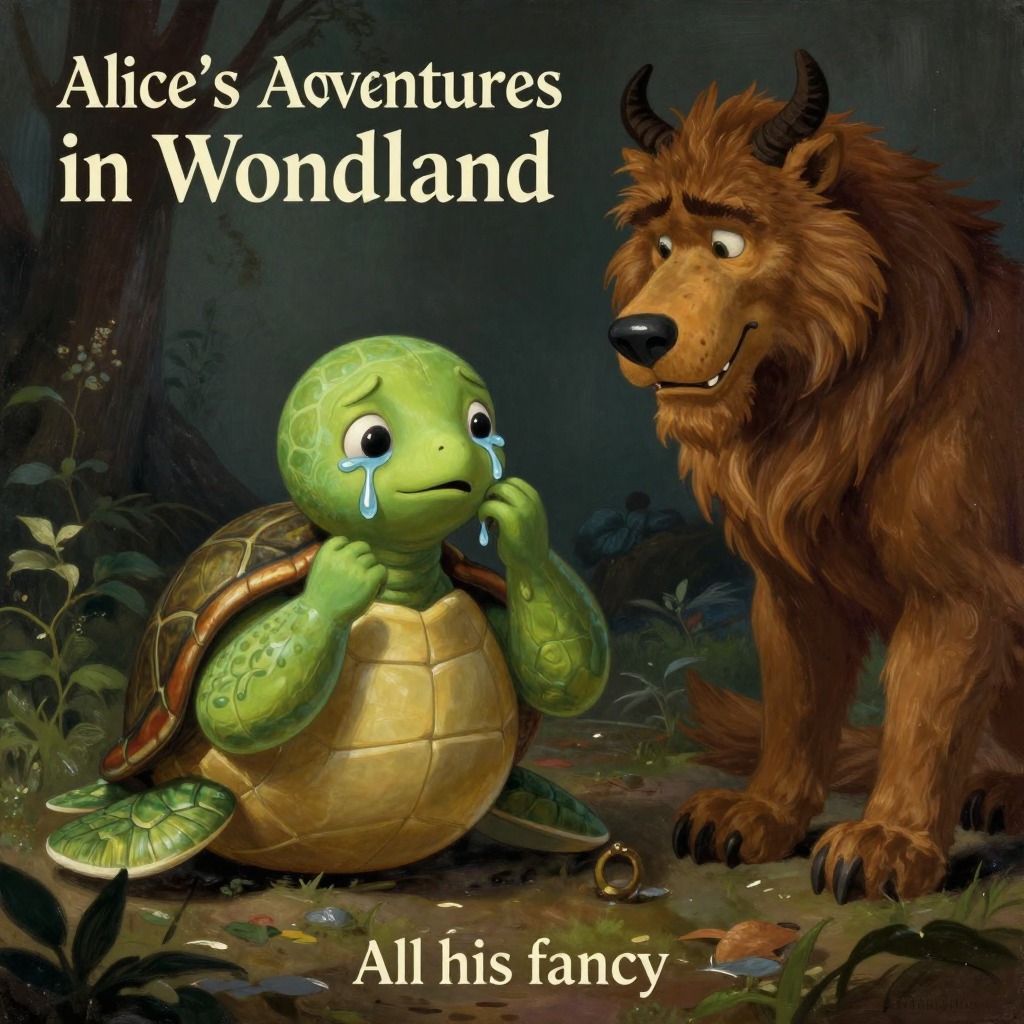
The Mock Turtle is first mentioned by the Queen of Hearts, who asks Alice if she has seen him yet and explains that he is "the thing Mock Turtle Soup is made from." When Alice and the Gryphon approach him, he is sitting "sad and lonely on a little ledge of rock," and Alice can hear him sighing "as if his heart would break." She pities him deeply, but the Gryphon dismisses his sorrow as "all his fancy," claiming he "hasn't got no sorrow." The Mock Turtle looks at them with "large eyes full of tears" but says nothing at first, establishing him as a creature defined by an exaggerated, almost theatrical melancholy. His physical description is minimal, but his behavior—the constant sobbing, the deep sighs, the slow, hollow speech—creates a vivid impression of a being trapped in a state of perpetual mourning for a past that may never have existed.
The Sea-School Education
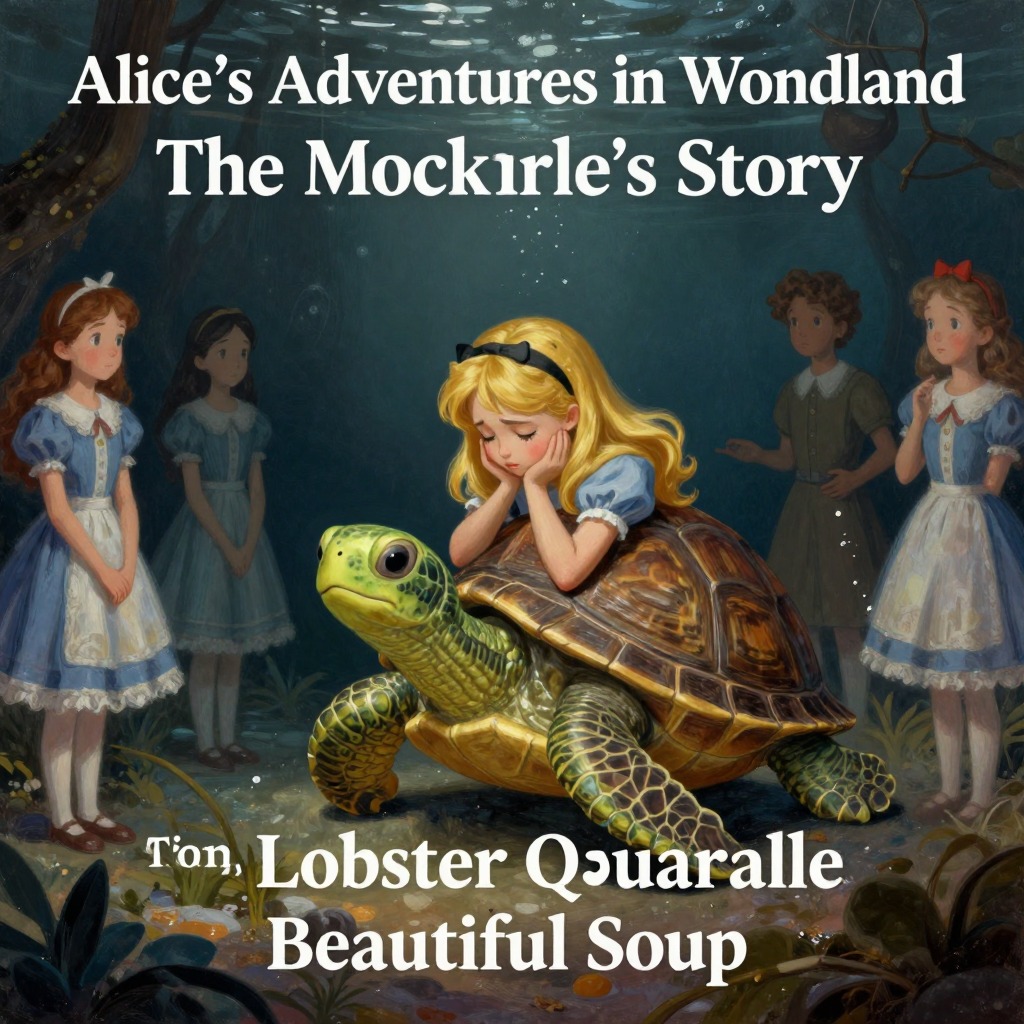
The Mock Turtle's central narrative is his account of his education in the sea, which he delivers in a deep, hollow tone. He explains that he was once a real turtle and that he and his fellow students went to school in the sea, where the master was an old turtle they called Tortoise "because he taught us." This pun—on "taught us" and "tortoise"—is the first of many linguistic jokes that structure his story. He describes the curriculum with great earnestness: the regular course included "Reeling and Writhing, of course, to begin with," followed by the branches of Arithmetic: "Ambition, Distraction, Uglification, and Derision." When Alice expresses ignorance of "Uglification," the Gryphon scolds her, and the Mock Turtle adds further subjects: "Mystery, ancient and modern, with Seaography: then Drawling—the Drawling-master was an old conger-eel, that used to come once a week: he taught us Drawling, Stretching, and Fainting in Coils." The Gryphon mentions a Classics master, an old crab who taught "Laughing and Grief." The Mock Turtle explains that lessons were ten hours the first day, nine the next, and so on, because "they lessen from day to day"—a pun that Alice finds to be "quite a new idea." This entire sequence is a brilliant parody of Victorian education, transforming its subjects into absurd, physically suggestive activities that mock the rigidity and pretension of formal schooling.
The Lobster Quadrille and Songs
After the lesson discussion, the Mock Turtle and the Gryphon perform the Lobster Quadrille, a dance they describe with great enthusiasm. The Mock Turtle sings a song, "Will you walk a little faster?", which tells of a whiting and a snail being urged to join a dance with lobsters and porpoises. The song's refrain, "Will you, won't you, will you, won't you, will you join the dance?", becomes a hypnotic, almost coercive invitation. The Mock Turtle also sings "Beautiful Soup," a mournful, drawn-out ode to soup that he performs with tears running down his cheeks, his voice choked with sobs. The Gryphon calls for a chorus, but before the Mock Turtle can repeat it, a cry of "The trial's beginning!" interrupts them, and the Gryphon hurries Alice away, leaving the Mock Turtle's song unfinished, its melancholy words—"Soo—oop of the e—e—evening, Beautiful, beautiful Soup!"—fading in the distance. These performances cement the Mock Turtle's role as a figure of pure, absurd sentimentality, whose grief is both genuine and utterly ridiculous.
Relationships and Narrative Role
The Mock Turtle's primary relationship is with the Gryphon, who acts as a kind of impatient, slightly bullying companion. The Gryphon interrupts him, corrects him, and urges him to "drive on," yet they also dance together and share a mutual nostalgia for their school days. The Mock Turtle is deeply sensitive to Alice's interruptions and questions, taking offense easily, as when he angrily corrects her for asking why they called the master Tortoise. He is also a figure of authority in his own mind, insisting on the superiority of his education and demanding that Alice explain her own adventures. His narrative role is to provide a sustained, self-contained episode of pure linguistic and logical play, a counterpoint to the more chaotic and threatening encounters with the Queen of Hearts. He represents a kind of arrested development, forever weeping for a lost past that is itself a fabrication, and his story underscores the book's theme that identity and knowledge are unstable constructs, subject to the whims of language and memory.
Change and Ending
The Mock Turtle undergoes no significant change during his encounter with Alice. He remains fixed in his sorrow, his nostalgia, and his absurd self-importance. When Alice is called away to the trial, he is left behind, still singing his song, his fate unknown. He does not appear in the trial scene or in the final dream sequence, except as a distant, sobbing presence in Alice's sister's vision of Wonderland. His story is a self-contained loop, a performance of grief that has no resolution. This lack of change is itself significant: the Mock Turtle is a character defined by stasis, a living embodiment of a pun, and his function is to be a vehicle for Carroll's wordplay and satire, not to undergo a narrative arc. His final, fading song is a perfect emblem of his character—beautiful, absurd, and ultimately inconsequential, a melancholy echo in a world that is always moving on to the next absurdity.