The verses
The verses are a set of twenty-four lines of doggerel that appear, during the climactic trial of the Knave of Hearts, as a mysterious piece of evidence. The White Rabbit, acting as herald, produces a paper that has just been picked up, which he initially mistakes for a letter but then reveals to be a set of verses. The poem is unsigned and bears no direction on the outside, a fact the White Rabbit calls "the queerest thing about it." Its sudden introduction, at a moment when the King is about to call for a verdict, shifts the trial's focus from the known accusation—that the Knave stole the Queen of Hearts' tarts—to a bewildering exercise in interpretation. The verses become the story's final, most concentrated puzzle, a piece of language that resists any single, stable meaning and exposes the arbitrary nature of the court's authority.
Content and Structure
The poem is composed of six four-line stanzas, written in a breathless, first-person voice that shifts between pronouns—"I," "she," "he," "they," "you," "we," "us," "it"—without ever fixing their referents. It begins with a report of gossip: "They told me you had been to her, / And mentioned me to him." The speaker claims to have been given a good character but is said to be unable to swim. Subsequent stanzas describe the exchange of unnamed objects ("I gave her one, they gave him two, / You gave us three or more"), a secret that must be kept from "all the rest," and an obstacle that came "between / Him, and ourselves, and it." The poem's syntax is deliberately convoluted, its pronouns floating free of any antecedent, and its narrative—if it can be called one—concerns a love triangle, a theft, or a conspiracy, but never settles into a coherent story. The final stanza insists on secrecy: "Don't let him know she liked them best, / For this must ever be / A secret, kept from all the rest, / Between yourself and me."
Introduction as Evidence
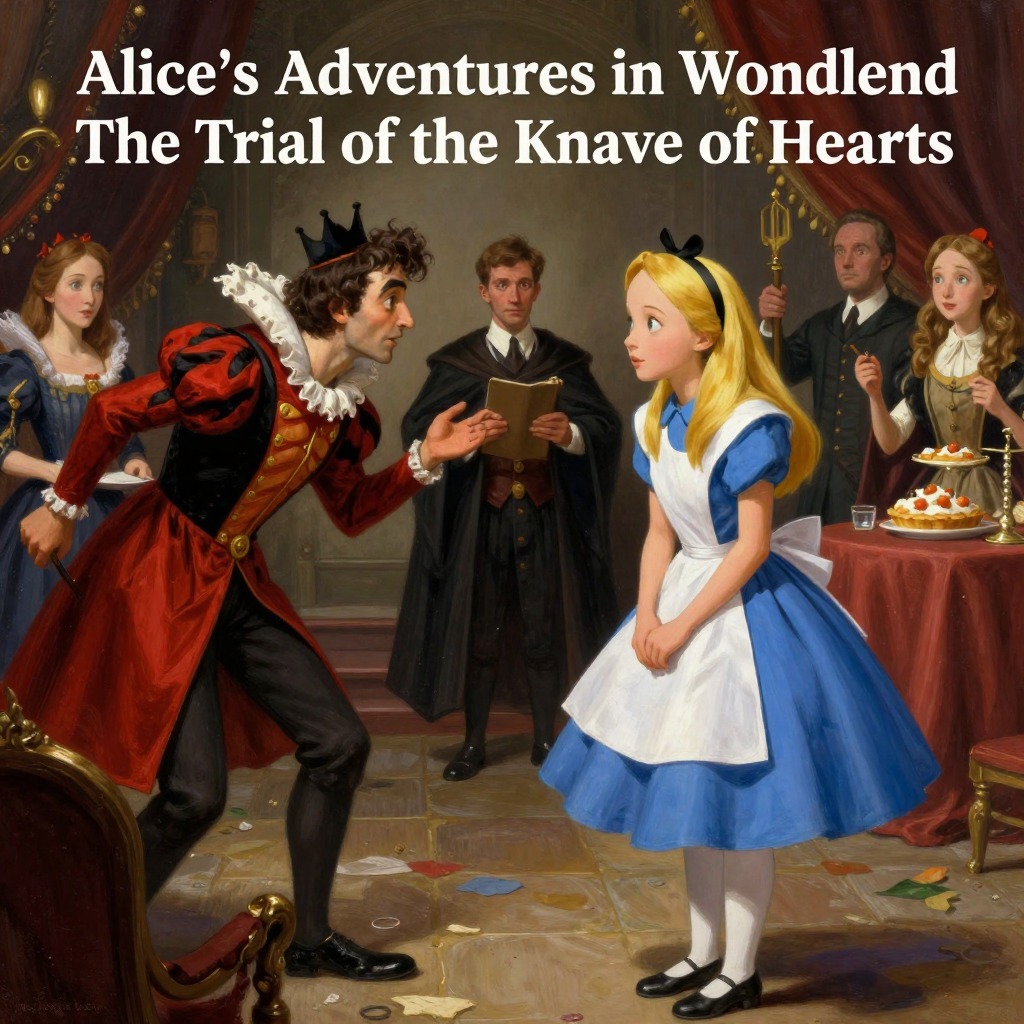
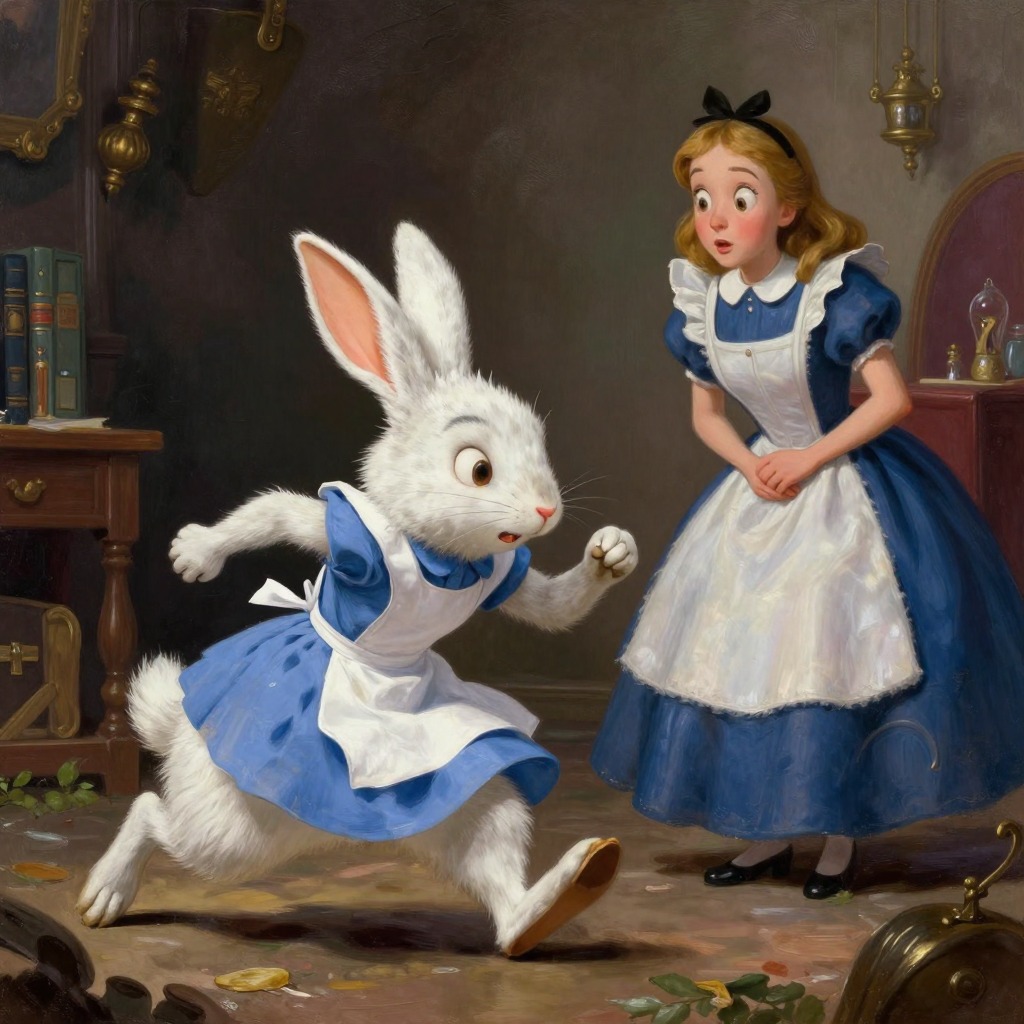
The verses are introduced at a critical juncture in the trial. The King, having just invoked Rule Forty-two to try to expel Alice from the court, is about to instruct the jury to consider their verdict when the White Rabbit interrupts, jumping up in a great hurry to announce that "this paper has just been picked up." The Queen asks what is in it, and the White Rabbit admits he has not opened it yet, speculating that it seems to be a letter written by the prisoner to somebody. The King immediately assumes it must have been written to someone, "unless it was written to nobody, which isn't usual, you know." When the paper is unfolded, it turns out to be a set of verses, not a letter. The Knave of Hearts protests that he did not write it and that they cannot prove he did, as there is no name signed at the end. The King, however, inverts this logic, declaring that the absence of a signature only makes the matter worse: "You must have meant some mischief, or else you'd have signed your name like an honest man." This reasoning draws a general clapping of hands, the first really clever thing the King has said that day, and the Queen declares it proves the Knave's guilt.
Interpretation and Meaninglessness
The verses provoke a fierce debate about interpretation. Alice, who has grown so large in the last few minutes that she is no longer afraid to interrupt, declares that if any one of the jury can explain the poem, she will give him sixpence, adding, "I don't believe there's an atom of meaning in it." The jury dutifully writes this down on their slates. The King, however, sees meaning where Alice sees none, and he begins to parse the poem line by line, applying each phrase to the case at hand. He seizes on the line "said I could not swim" and asks the Knave if he can swim; the Knave shakes his head sadly, and the King declares, "All right, so far." He then interprets "I gave her one, they gave him two" as a reference to the tarts, and when Alice points out that the next line says "they all returned from him to you," the King triumphantly points to the tarts still sitting on the table, claiming, "Nothing can be clearer than that." He then turns to the line "before she had this fit" and asks the Queen if she ever had fits; she furiously denies it, throwing an inkstand at the Lizard. The King, realizing the words do not fit the Queen, declares, "It's a pun!" in an offended tone, and everybody laughs. The poem thus functions as a Rorschach test for the court's authority: the King finds in it whatever he needs to confirm the Knave's guilt, while Alice sees only nonsense. The verses themselves remain stubbornly opaque, their meaning never resolved.
Narrative and Thematic Significance
The verses serve as the final, most concentrated expression of Wonderland's resistance to stable meaning. Throughout the story, Alice has encountered poems that come out wrong, riddles without answers, and conversations that loop back on themselves. The verses at the trial are the culmination of this pattern: a piece of language that is introduced as crucial evidence but that, upon examination, yields no clear information. The poem's floating pronouns and absent referents mirror the instability of identity that Alice herself has experienced throughout her adventures—her repeated question "Who in the world am I?" finds its echo in a text that cannot say who is speaking, who is being addressed, or what is being discussed. The King's desperate attempt to force the poem into a confession, and Alice's counter-assertion that it has no meaning at all, stage a conflict between authoritarian interpretation and skeptical reading. The verses are never explained, and the trial never reaches a verdict; instead, the Queen demands "Sentence first—verdict afterwards," and Alice's final rebellion—shouting that the court is "nothing but a pack of cards!"—brings the dream to an end. The verses thus remain as an open question, a piece of evidence that proves nothing except the impossibility of proving anything in a world where language has come unmoored from reference.