the rabbit-hole
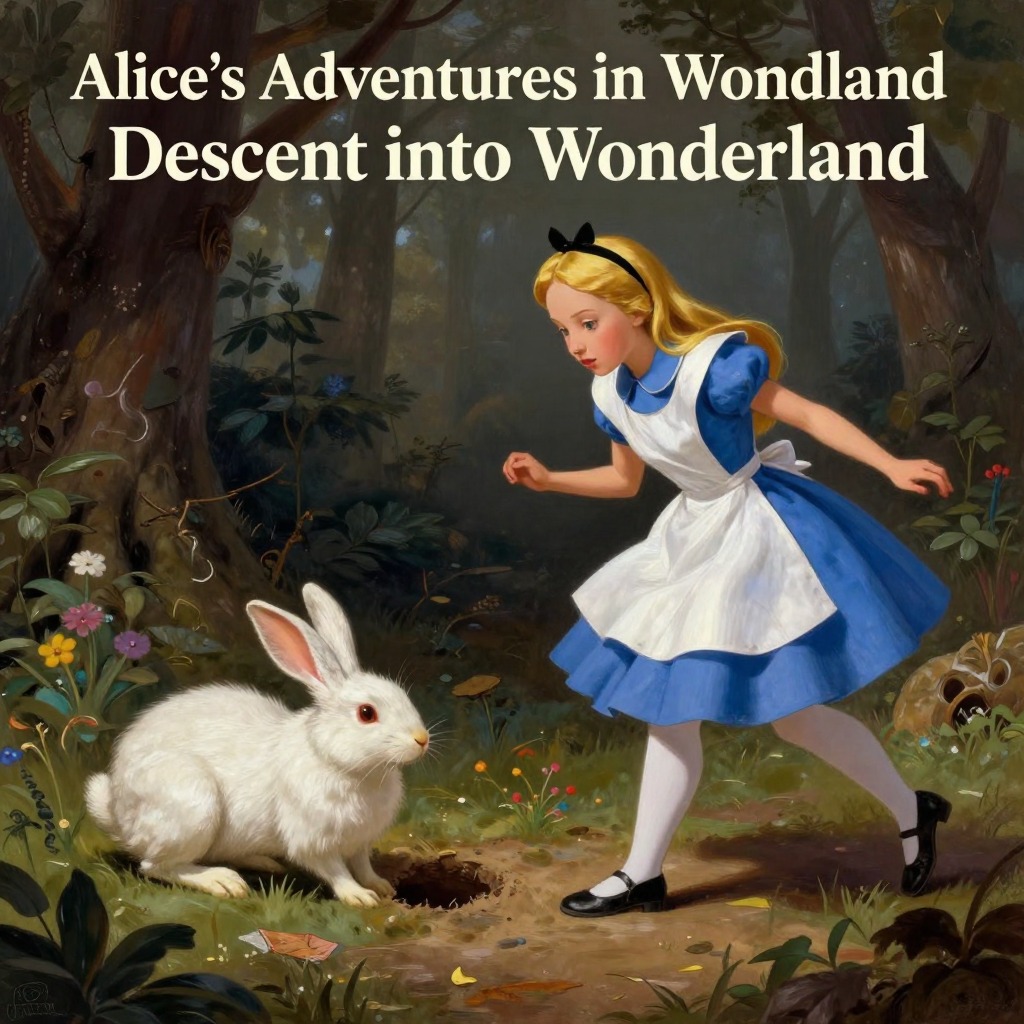
The rabbit-hole is the entry point to Wonderland and the catalyst for Alice's entire adventure. It first appears when a White Rabbit with pink eyes, wearing a waistcoat and consulting a pocket watch, runs past Alice and pops down a large hole under a hedge. Burning with curiosity, Alice follows without a moment's hesitation, never once considering how she might get out again. This single act of impulsive pursuit separates her from the mundane world of her sister's book—which had no pictures or conversations—and plunges her into a domain where the laws of nature and logic are suspended.
Physical Description and Descent
The rabbit-hole begins as a tunnel running straight on for some way before dipping suddenly down into a very deep well. The fall is so prolonged that Alice has plenty of time to look about her; she notices that the sides of the well are lined with cupboards and bookshelves, with maps and pictures hung upon pegs. As she falls, she takes down a jar labeled "ORANGE MARMALADE" only to find it empty, and she carefully places it into a cupboard rather than drop it for fear of killing someone below. The descent is marked by Alice's internal monologue: she wonders how many miles she has fallen, speculates about reaching the centre of the earth, and muses on the Antipathies (her mispronunciation of Antipodes). She grows sleepy and begins to dream of walking hand in hand with her cat Dinah, asking whether cats eat bats, until she lands with a thump on a heap of sticks and dry leaves.
Portal to Wonderland
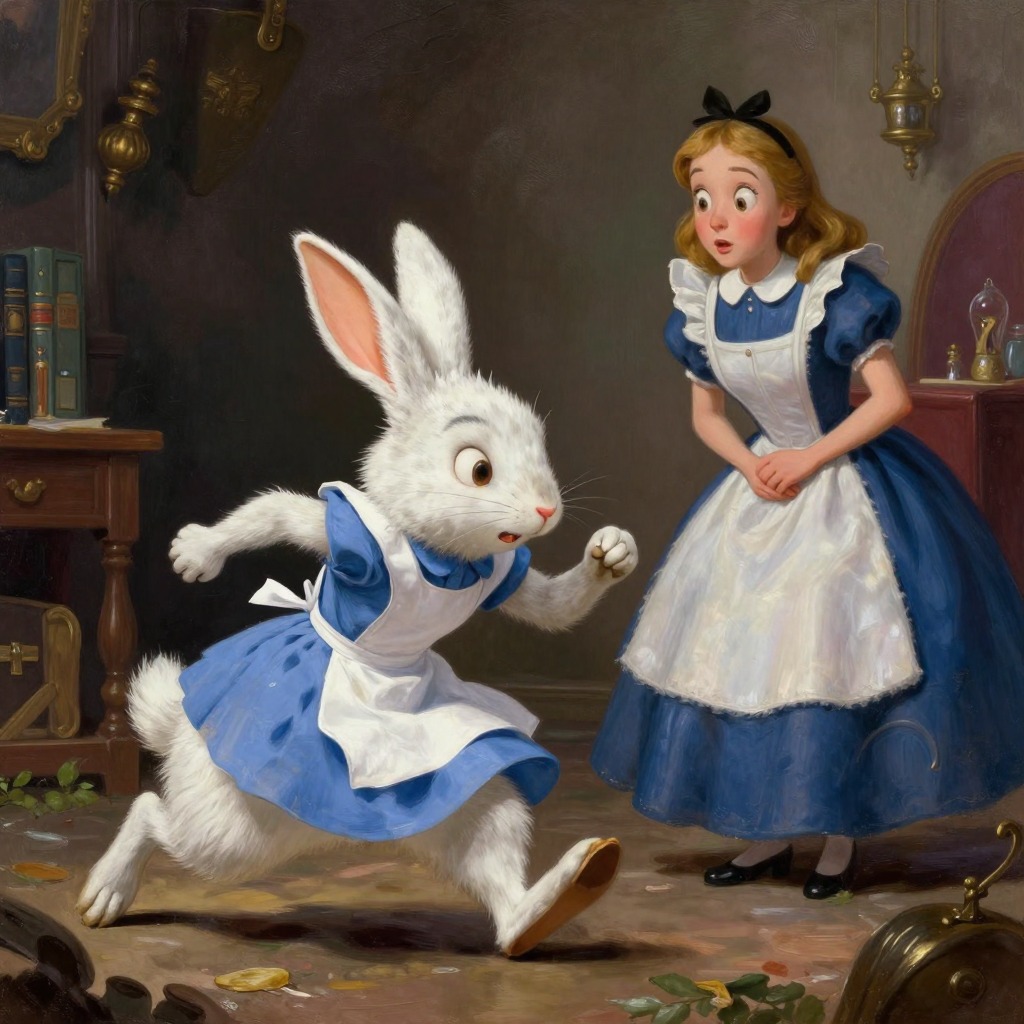
Once the fall is over, Alice finds herself in a long, low hall lit by a row of lamps, with doors all around that are locked. This hall is the immediate aftermath of the rabbit-hole, and it is here that she discovers the tiny golden key, the little door leading to a beautiful garden, and the bottles and cakes that cause her dramatic changes in size. The rabbit-hole thus leads not only to a physical space but to a series of trials involving identity, scale, and language. Later, when Alice is trapped in the White Rabbit's house after growing too large, she reflects that it was much pleasanter at home, and she almost wishes she had not gone down that rabbit-hole—yet she also acknowledges that it is rather curious, this sort of life, and realizes she is now in the middle of a fairy-tale.
Symbolic and Thematic Significance
The rabbit-hole functions as a threshold between the predictable, rule-bound world of the Victorian nursery and the chaotic, dreamlike logic of Wonderland. It is the point of no return after which Alice's sense of self becomes unstable: she grows and shrinks, forgets her lessons, and is repeatedly asked "Who are you?" by creatures like the Caterpillar. The hole itself is never seen again after the initial descent, but its consequences reverberate through every subsequent episode. In the end, when Alice wakes up on the bank with her head in her sister's lap, her sister reflects on the dream and imagines how Alice, as a grown woman, will one day tell the tale to other children, keeping the simple and loving heart of her childhood. The rabbit-hole thus becomes the origin of a story that bridges childhood wonder and adult memory.
Connection to the Dream Framework
The entire adventure is framed as a dream: Alice falls asleep by the riverbank, dreams of the rabbit-hole and all that follows, and wakes to her sister's voice saying "Wake up, Alice dear! What a long sleep you've had!" The rabbit-hole is therefore the first element of the dream narrative, the point at which the ordinary world dissolves into the extraordinary. Its sudden appearance—a rabbit with a watch, a hole under a hedge—is the trigger that transforms a dull afternoon into a journey through a landscape of absurdity, where even the Duchess's pepper-laden kitchen and the baby that turns into a pig are part of a single, coherent dream logic. The rabbit-hole, though never revisited, remains the foundational image of Wonderland itself: a descent into the unknown that changes everything.