the shore
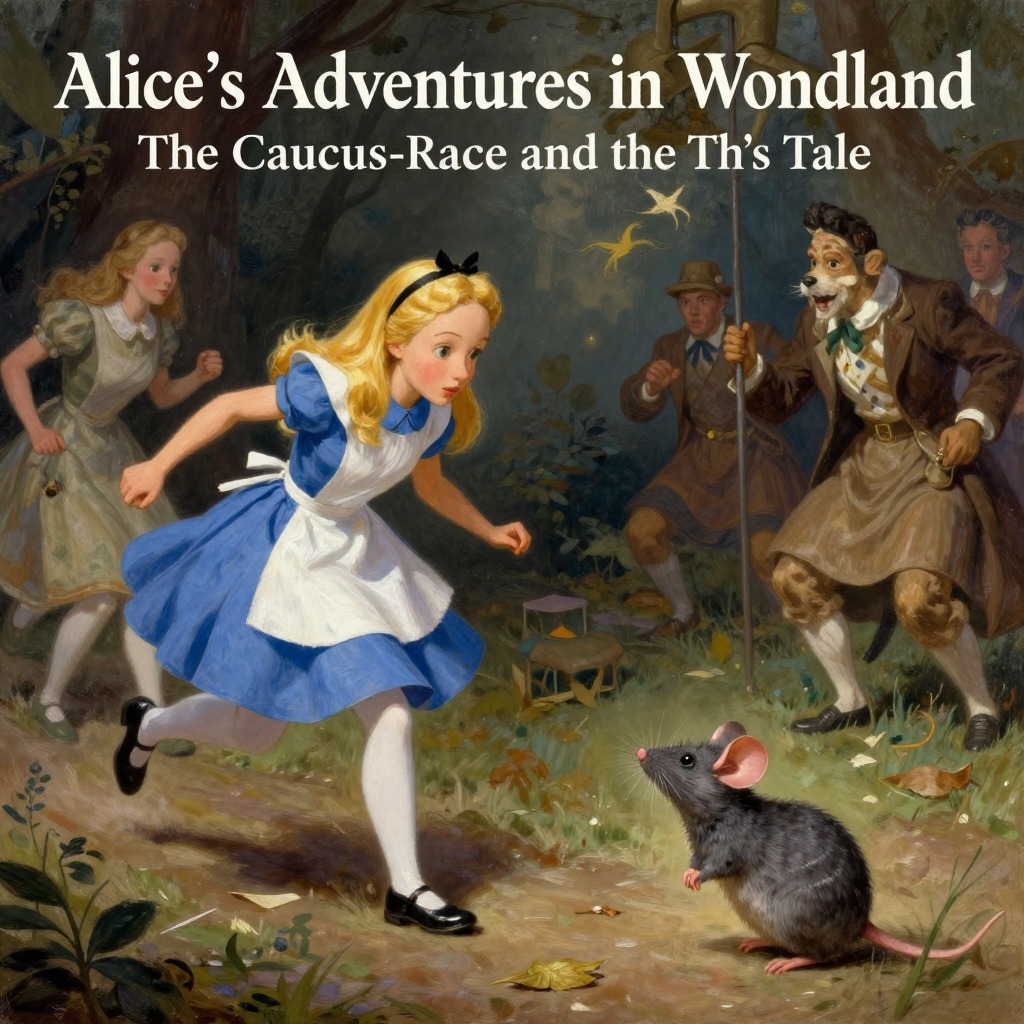
The shore is the first piece of solid ground Alice reaches after nearly drowning in her own tears, and it becomes the stage for Wonderland's most concentrated parody of social organization. It is here that the dripping, cross, and uncomfortable party of birds and animals assembles, and the Mouse, who seems to be a person of authority among them, calls them to sit down in a large ring. The Dodo then proposes a Caucus-race as the best way to get dry, and the race is run in a sort of circle, with no starting signal and no fixed end, until the Dodo suddenly declares it over. The Dodo then announces that everybody has won and all must have prizes, and Alice is forced to hand out comfits from her pocket and accept a thimble as her own prize. The shore thus hosts a ritual that satirizes democratic process, competitive sport, and reward systems all at once, reducing them to arbitrary, self-congratulatory nonsense.
The Shore as a Boundary Between Worlds
The shore functions as a liminal space between the aqueous chaos of the pool of tears and the dry, rule-bound absurdity of the land. Alice first reaches it after swimming with the Mouse, Duck, Dodo, Lory, Eaglet, and other creatures, and it is the place where the Mouse promises to tell his history, explaining why he hates cats and dogs. Later, the shore reappears as the setting for the Lobster Quadrille, the dance described by the Mock Turtle and Gryphon. In their account, the dancers first form into two lines along the sea-shore, clear the jelly-fish out of the way, advance twice with a lobster as a partner, change lobsters, retire in the same order, throw the lobsters as far out to sea as they can, swim after them, turn a somersault in the sea, change lobsters again, and then return to land. The shore is thus the starting and ending point of a dance that enacts a constant crossing between sea and land, a movement that mirrors Alice's own repeated transitions between sizes and states.
The Shore in the Duchess's Kitchen and the Pig-Baby Episode
The shore is also invoked indirectly through the pepper-laden atmosphere of the Duchess's kitchen. Alice observes that there is certainly too much pepper in the soup, and the air is so thick that even the Duchess sneezes occasionally, while the baby sneezes and howls without a moment's pause. The only creatures that do not sneeze are the cook and the Cheshire Cat, which sits on the hearth grinning. When Alice later carries the baby outside, it grunts, its nose becomes a snout, its eyes grow extremely small, and it turns unmistakably into a pig. Alice sets the little creature down and feels relieved to see it trot away quietly into the wood. The shore is not physically present in this scene, but the pepper that fills the kitchen—a substance that makes people hot-tempered, as Alice later reflects—creates a sensory environment as oppressive and disorienting as the salt water of the pool. Alice's own theory, that pepper makes people hot-tempered, vinegar makes them sour, camomile makes them bitter, and barley-sugar makes children sweet-tempered, is a comic attempt to impose a moral-physical rule on the chaos she has experienced, and it is on the shore that she first began to formulate such rules.
The Shore in the Mock Turtle's Story and the Gryphon's Company
The shore is the setting for the Mock Turtle's melancholy narrative. The Gryphon leads Alice to the Mock Turtle, who is sitting sad and lonely on a little ledge of rock, sighing as if his heart would break. The Gryphon dismisses the sorrow as all his fancy, claiming that they never executes nobody. The Mock Turtle then tells his history, describing how he was once a real Turtle and went to school in the sea, where the master was an old Turtle they called Tortoise because he taught them. The curriculum included Reeling and Writhing, Ambition, Distraction, Uglification, and Derision, as well as Mystery, ancient and modern, with Seaography, and Drawling taught by an old conger-eel. The shore is the place where these sea-creatures come to tell their stories, a threshold between the underwater world of their education and the land where Alice can listen. It is also where the Gryphon and Mock Turtle perform the Lobster Quadrille, dancing solemnly round and round Alice, treading on her toes, while the Mock Turtle sings about a whiting and a snail, a porpoise close behind, and the lobsters and turtles all advancing on the shingle.
The Shore in Alice's Sister's Dream
The shore reappears in the final chapter as part of Alice's sister's dream. After Alice wakes and runs off to tea, her sister sits with her head on her hand, watching the setting sun, and dreams of little Alice and all her wonderful Adventures. In this dream, the long grass rustles as the White Rabbit hurries by, the frightened Mouse splashes through the neighbouring pool, and the rattling teacups of the March Hare and his friends are heard. The sister half believes herself in Wonderland, though she knows that if she opens her eyes, the grass will be only rustling in the wind, the pool rippling to the waving of the reeds, the rattling teacups changing to tinkling sheep-bells, and the Queen's shrill cries to the voice of the shepherd boy. The shore is not named directly in this passage, but the pool and the grass are the same landscape that Alice first encountered when she emerged from the pool of tears. The sister's dream transforms the shore from a site of absurdity into a memory of childhood wonder, a place that will be preserved in the simple and loving heart of the grown woman as she gathers other little children and tells them strange tales.