Bugger Wars
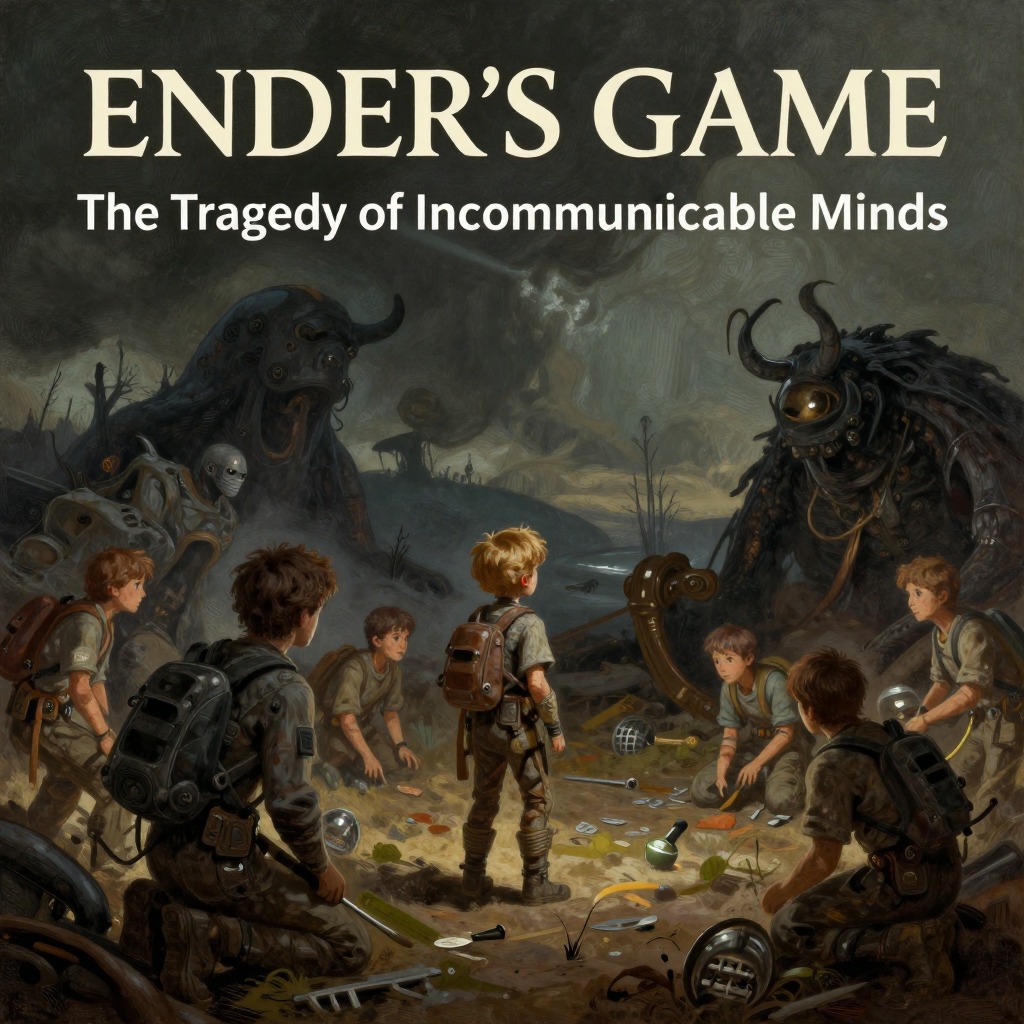
The Bugger Wars represent the central, existential conflict of the human species against an alien intelligence, shaping the political, military, and social structures of the world for nearly a century. The wars are defined by three distinct invasions, each escalating in scale and consequence, and they culminate in a secret, decades-long human counter-offensive that ends with the genocide of the Bugger race. The conflict is fundamentally rooted in a failure of communication, as the Buggers possess a hive-mind consciousness that renders them incapable of understanding or even perceiving human language and individual thought, leading to mutual incomprehension and catastrophic violence.
Causes and Nature of the Conflict
The Bugger Wars began not with a declaration of war, but with a catastrophic failure of communication. The Buggers are a hive-mind species, communicating instantaneously and directly, mind to mind, without the need for language, writing, or signals. This fundamental difference meant that when they encountered humanity, they had no framework to recognize human attempts at communication. As Colonel Graff explains, "They don't have a language at all. We used every means we could think of to communicate with them, but they don't even have the machinery to know we're signaling." The Buggers, in turn, may have been trying to think to humanity, unable to understand why there was no response. This mutual incomprehension made it impossible to determine the other's intentions, leading to the inevitable conclusion: "If the other fellow can't tell you his story, you can never be sure he isn't trying to kill you." The First Invasion was exploratory, but the Second Invasion was a colonization attempt, bringing a queen to populate Earth. The Buggers, viewing the loss of individual workers as inconsequential—like clipping one's nails—did not perceive their actions as murder. Only the killing of a queen, which closes off a genetic path, was considered murder in their society. This fundamental difference in perception of life and death fueled the conflict, as humanity, with its individualistic consciousness, could not forgive the slaughter of its people.
The Course of the Wars
The First Invasion was a brutal exploratory attack that caught humanity unprepared. The Second Invasion was a more organized colonial effort, featuring a massive bugger fleet that was ultimately defeated by the brilliant, desperate tactics of Mazer Rackham. Rackham's victory was a turning point, but it was not a final one. In the eighty years following the Second Invasion, humanity, having learned from the Buggers' instantaneous communication, developed the ansible, a device that allowed faster-than-light communication. This technology enabled the International Fleet to launch a secret, preemptive Third Invasion. Instead of waiting for the Buggers to attack again, humanity sent a vast armada of starships to the Bugger homeworlds, a journey that took decades. The fleet was already in transit, approaching the Bugger systems, while the public on Earth was kept in the dark, believing the fleet was still in defensive positions. The Third Invasion was not a defensive war but a calculated, species-wide offensive aimed at total annihilation.
The Final Battle and Genocide
The final battle of the Bugger Wars was fought not by an adult general, but by a child, Ender Wiggin, who was tricked into believing he was playing a series of advanced simulations. For months, Ender commanded the real human fleet, winning battle after battle against the Bugger forces. The final engagement took place at the Bugger homeworld, where all the queens from all their colonies had gathered. Ender, facing an enemy force that outnumbered him a thousand to one, made the decision to use the Molecular Detachment Device (Dr. Device) directly against the planet itself. The weapon caused a chain reaction that destroyed the entire planet and every Bugger ship in the vicinity. The victory was absolute and final. Ender later learned the truth: "For the past few months you have been the battle commander of our fleets. This was the Third Invasion. There were no games, the battles were real, and the only enemy you fought was the buggers. You won every battle, and today you finally fought them at their home world, where the queen was, all the queens from all their colonies, they all were there and you destroyed them completely." The war ended with the extinction of an entire intelligent species.
Aftermath and Legacy
The immediate aftermath of the war was not peace, but a new conflict among humans, the League War, as the Warsaw Pact and the Hegemony vied for control of the post-war order. Ender himself was hailed as a hero but was also seen as a dangerous political tool, leading to his exile from Earth. The most profound legacy of the Bugger Wars, however, was the discovery of a single, surviving Bugger queen's cocoon, which the Buggers had left for Ender in a place modeled after his own childhood fantasy game. Through a psychic connection, Ender learned the Buggers' true nature: they were not malicious but tragically misunderstood. They had not intended to murder and, upon realizing humanity was sentient, they had ceased their attacks. Ender, burdened by the guilt of genocide, became the "Speaker for the Dead," writing a book from the hive-queen's perspective to tell their story and seek forgiveness. He carried the cocoon with him for the rest of his life, searching for a world where the queen could be safely reborn. The wars thus ended not with a triumphant victory, but with a profound moral reckoning, as the victor dedicated his life to understanding and atoning for the destruction he had wrought.