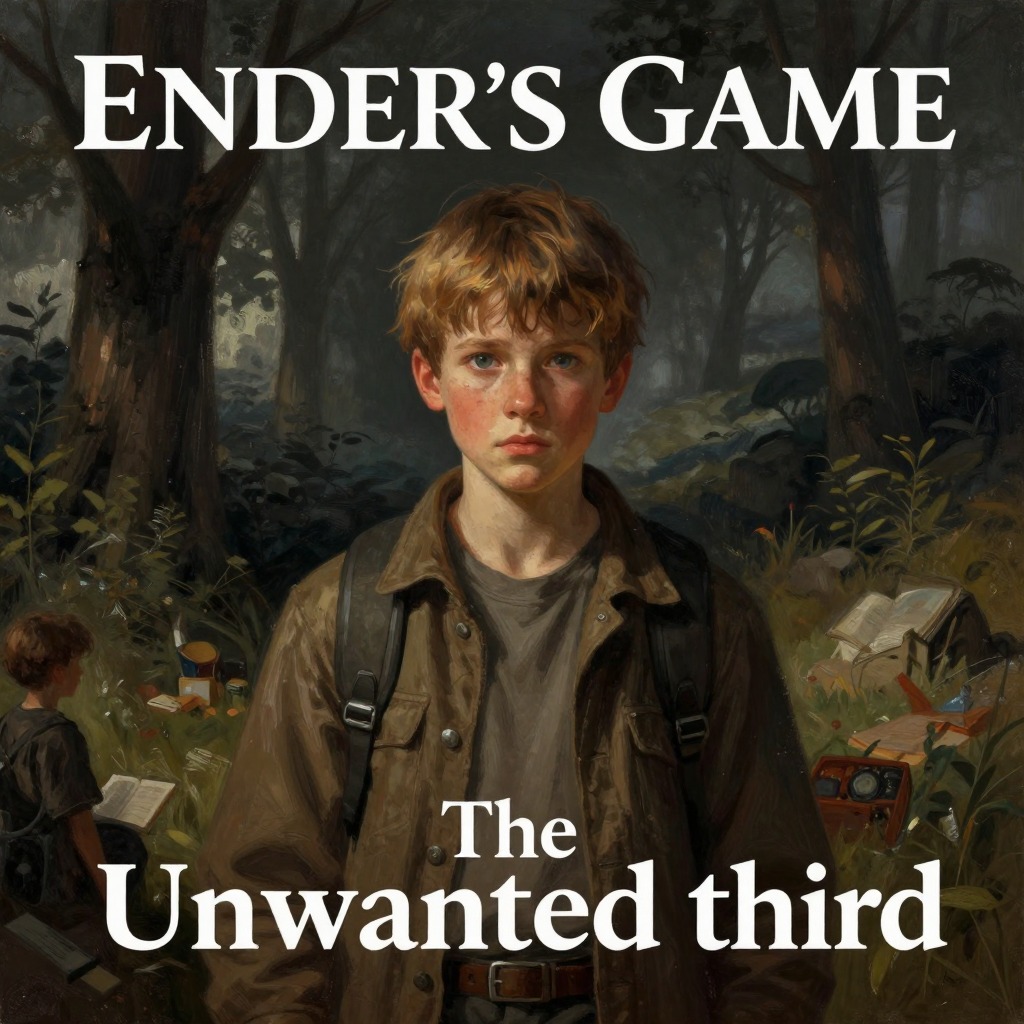
Third
In the world of Ender's Game, a "Third" is a child born as the third offspring of a family, in direct violation of the strict population limitation laws enforced by the International Fleet. Because the human race is preparing for a potential third invasion by the alien Buggers, the government has authorized selective exceptions, allowing certain families to have a third child if the first two have shown exceptional promise. Ender Wiggin is such a child: his older brother Peter and sister Valentine both tested brilliantly, and so the government requisitioned a third child, granting the Wiggin family a legal waiver to conceive him. Yet this waiver marks Ender as a permanent anomaly, a living reminder of a law broken, and the word "Third" becomes a label of shame that follows him from his earliest childhood.
The Stigma of Being a Third
From the moment Ender is old enough to understand, he knows that being a Third sets him apart. His own father, John Paul Wieczorek, had renounced his religion and changed his name to escape the sanctions of a noncompliant family, vowing never to have more than the allotted two children. When Ender is born, he undoes everything his parents have struggled to achieve. As Colonel Graff later explains to Ender, his parents see him as "a badge of pride" for circumventing the law, but also "a badge of cowardice" and "a badge of public shame" because his very existence interferes with their efforts to assimilate into normal society. Ender's brother Peter, who lost his own monitor at age five and was rejected by the Battle School, resents Ender for keeping his monitor a year longer and for being the Third who might succeed where he failed. In Peter's cruel taunts, the word becomes a weapon: "You little bastard, you little Third." Even at school, the other children use it as an insult, calling him "Thirdie" and "turd," and the term is scrawled across his desk as a marching message of derision.
The Monitor and the Test
Ender's status as a Third is intimately tied to the monitor, a device implanted at the back of his neck that allows the International Fleet to see and hear everything he experiences. The monitor is the physical mark of his exceptional status, the reason he is allowed to exist at all. When the monitor is removed, Ender briefly believes he will become "just like everybody else," and that Peter will stop hating him. But the removal is itself the final test: the government wants to see how Ender behaves without the monitor's protection, and his violent response to the bully Stilson—kicking him repeatedly even after he is down—convinces Colonel Graff that Ender has the ruthless instinct needed to command. Graff tells Ender's parents that the Stilson incident was not a charade but a necessary test of motivation, and that Ender's actions, however brutal, proved he could take care of himself. The word "Third" thus becomes the gateway to Battle School, the very stigma that qualifies Ender for the most elite military training in human history.
The Burden of Being a Tool
At Battle School, Ender's status as a Third continues to shape his experience. He is younger and smaller than almost everyone else, and the teachers deliberately isolate him, making him the target of envy and hatred. Graff tells him that he was requisitioned to be "half Peter and half Valentine," combining Peter's ruthless intelligence with Valentine's empathy, and that the government's tests, though imperfect, have identified him as the best hope for humanity. Ender internalizes the weight of this expectation, feeling that he is not a person but a tool, "a weapon" to be aimed at the Buggers. When he finally learns that the battles he has been fighting on the simulator were real, and that he has destroyed the entire Bugger race, he cries out, "I didn't want to kill anybody!" But Graff explains that it had to be a trick, because a commander with enough empathy to understand the enemy could never knowingly commit genocide. Ender's status as a Third, a child born to be used, is thus the very thing that makes him both the perfect weapon and the most tragic victim of the war.
Redefining the Word
Despite the stigma, the word "Third" is reclaimed by Valentine, who understands Ender's burden better than anyone. In her column as Demosthenes, she writes a scathing denunciation of the population limitation laws, arguing that people should be allowed to have as many children as they like and that the surplus population should be sent to other worlds. She concludes with the line, "The most noble title any child can have is Third." This is a direct act of love for Ender, a public declaration that his existence is not a shame but a gift to humanity. The redefinition is also echoed in the novel's structure: Ender's story is told in chapters titled "Third," "Peter," "Graff," and so on, making the word a structural marker of his identity. By the end of the book, Ender has become the Speaker for the Dead, a figure who speaks for the Buggers and for all the dead, and his status as a Third—a child born outside the law—has been transformed into a symbol of the human capacity for both destruction and redemption.