Battle Room
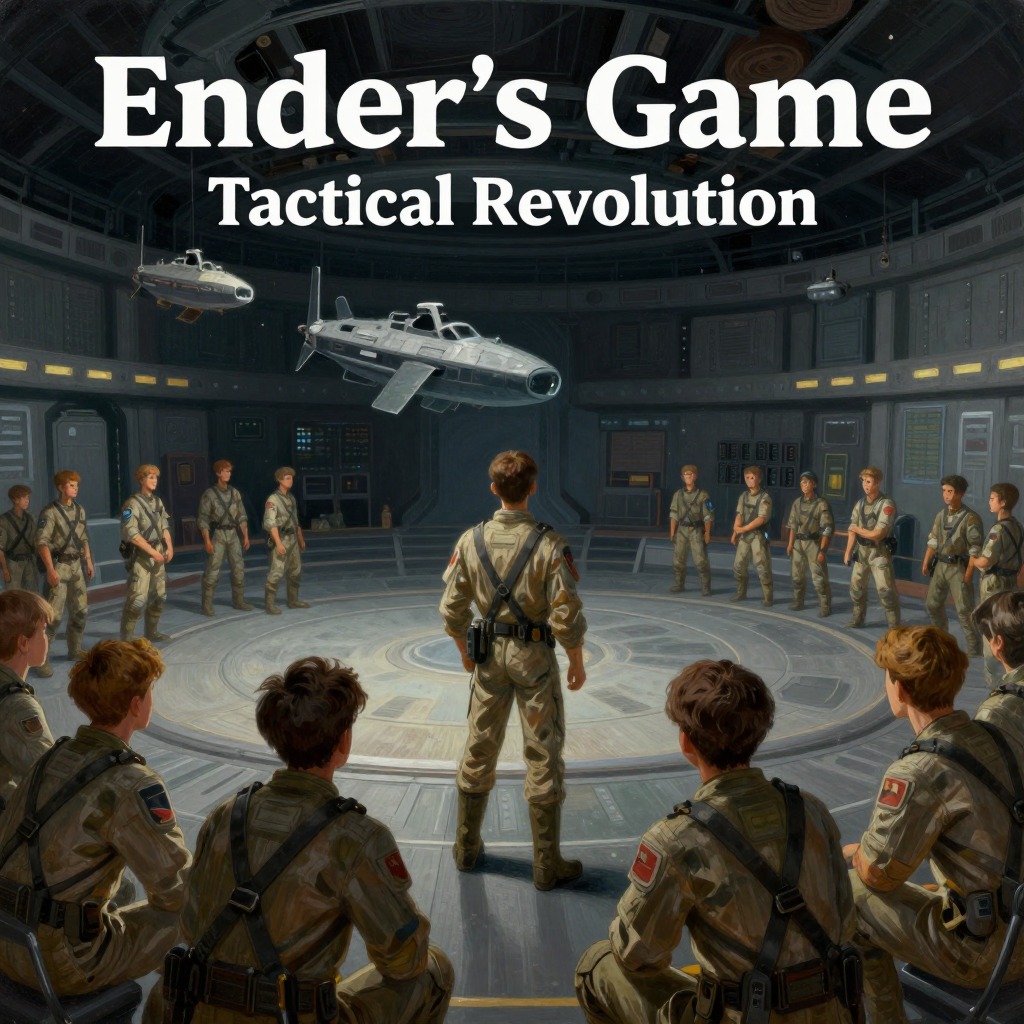
The Battle Room is the zero-gravity training arena at the heart of the Battle School, where children are organized into armies and fight mock battles using flash suits and laser guns. It is the central mechanism for identifying and developing future military commanders, and its design and rules evolve throughout the novel, culminating in the revelation that the 'games' played there were real battles against the Buggers.
Design and Purpose
The Battle Room was conceived by Orson Scott Card as a training environment for three-dimensional warfare. As described in the introduction, the essence of training is to allow error without consequence, and the Battle Room provides an enclosed space where mistakes don't send trainees flying off to Jupiter. It offers a way to practice shooting without risk of injury, with trainees who are 'hit' being disabled temporarily. The environment is changeable, simulating different conditions of warfare—near a ship, in the midst of debris, near tiny asteroids—and it includes some of the confusion of real battle, preventing the play-combat from becoming rigid and formal. The room is a large, empty cube with no gravity, where soldiers wear padded flash suits and carry guns that emit a tight beam of light, freezing any part of the suit they hit. The room's doors are set in the middle of the walls, and the orientation of 'down' is always toward the enemy's gate, a principle Ender famously articulates as 'The enemy's gate is down.'
Early Experiences and Learning
Ender's first experience in the Battle Room is disorienting. He and his fellow Launchies enter clumsily, clinging to handholds along the side, and find that the suits are confining and amplify movement. Ender quickly learns to control his rebounds and to use his legs as a shield, a technique that becomes central to his tactics. He also discovers the guns' two buttons: the red button produces a focused beam that freezes the suit, while the white button acts as a lamp. During this first session, Ender and Alai experiment by shooting each other in the foot, learning that the suit freezes at the point of impact, and they then organize a game where they freeze all the other boys. This early mastery of the room's physics sets Ender apart and foreshadows his later brilliance.
Evolution of Tactics and Rules
The Battle Room is not a static arena; its rules and configurations change to challenge Ender and to reflect the evolving nature of warfare. Initially, battles are fought in a simple open grid with a few 'stars' (obstacles). Ender's first battle, as a member of Salamander Army against Condor Army, reveals the importance of orientation and the enemy's gate being down. He observes that Bonzo's formations are predictable and that the enemy's gate is down, leading him to adopt a feet-first attack position that minimizes his target profile. As Ender becomes a commander, the teachers manipulate the room to test him: they schedule battles with unfair star arrangements, unequal forces, and even two armies at once. In his final Battle School battle, against Griffin and Tiger Armies, Ender wins by ignoring the enemy and moving directly to the enemy's gate, performing the victory ritual even while being destroyed. This act, which the teachers later revise the rules to prevent, demonstrates his willingness to break the game's conventions to achieve victory.
The Simulator and the Third Invasion
The Battle Room's principles are extended in the Command School simulator, which Ender uses to command fleets in what he believes are games. The simulator is a holographic display where Ender controls ships and squadrons, and it is here that he learns to coordinate his old friends from Battle School, including Alai, Bean, and Petra. The simulator's battles become increasingly difficult, with the enemy outnumbering him by a thousand to one in the final exam. In that battle, Ender orders his ships to attack the planet itself, using the Little Doctor to destroy it. Only after the battle does he learn that the simulator was not a game: he had been commanding real fleets in the Third Invasion, and the planet he destroyed was the Bugger homeworld. The Battle Room, therefore, was not just a training ground but a preparation for real warfare, blurring the line between simulation and reality.
Significance and Legacy
The Battle Room is more than a training facility; it is a symbol of the novel's central themes. It represents the gamification of war, where children are manipulated into becoming killers without understanding the consequences. The room's design, with its emphasis on the enemy's gate being down, teaches a ruthless pragmatism that Ender internalizes but later regrets. The Battle Room also serves as a microcosm of the larger conflict, where the 'enemy' is often another army of children, and the teachers are the true adversaries, manipulating the game to produce a perfect commander. Ultimately, the Battle Room's legacy is ambiguous: it produces a hero who saves humanity but at the cost of his innocence and the genocide of an entire species. The room's final echo appears on the Bugger colony world, where Ender finds a playground and a tower built to mimic the End of the World from his mind game, suggesting that the Buggers, too, had been trying to communicate through the very structures that trained him to destroy them.