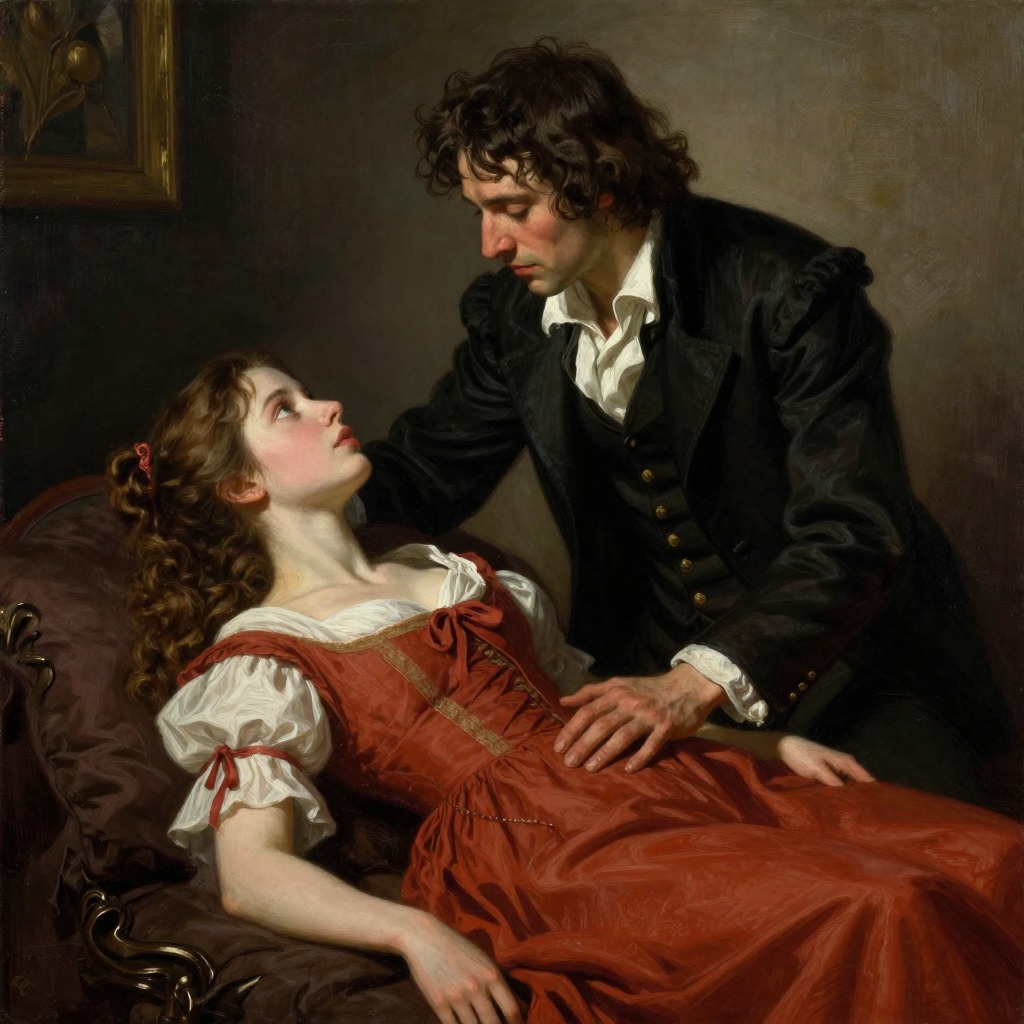
Richis's marriage contract with Baron de Bouyon
Antoine Richis, the second consul of Grasse and by far the wealthiest man in the region, devises a marriage contract with the Baron de Bouyon as a desperate strategic gambit to save his daughter Laure from the serial murderer who has been killing the town's most beautiful virgins. The contract, which Richis hopes to finalize within ten days, represents not only a father's attempt to shield his child but also a calculated business move by a man accustomed to outmaneuvering competitors—yet it ultimately proves powerless against an adversary who operates beyond the reach of conventional reason and social arrangements.
The Strategic Marriage Plan
Richis, a widower in his late thirties, had long planned to marry his sixteen-year-old daughter Laure to the son of the Baron de Bouyon, a nobleman with a good reputation but miserable finances. The original intention was dynastic: Richis wanted to found a family line that would rise to the highest social and political influence, requiring at least two sons—one to take over his vast business holdings in oranges, oil, wheat, hemp, and perfume wholesaling, and another to pursue a legal career leading to the parliament in Aix and eventual ennoblement. The marriage to the Bouyon heir was the first step in this ambitious program.
But the serial murders that claimed twenty-four young girls in and around Grasse transformed this long-term plan into an urgent rescue operation. Richis realized that Laure, with her auburn hair, green eyes, and face so charming that visitors of all ages stood stock-still at the sight of her, was the keystone to the murderer's collection. He concluded that the killer was not a destructive personality but a careful collector assembling the components of absolute beauty, and that Laure was the final, indispensable piece. To thwart this, Richis decided to marry her off immediately, reasoning that a deflowered and preferably pregnant woman would no longer fit the murderer's exclusive gallery.
The Terms and the Rush
Richis's plan was executed with the same ruthless efficiency he applied to business. He ordered his secretary to proceed to Vence to prepare the agreement with the Baron de Bouyon, and he prepared an offer so generous that the baron could not refuse: assumption of debts up to 40,000 livres, a dowry of an equal sum plus diverse land holdings and an oil mill near Maganosc, and a yearly income of 3,000 livres for the young couple. The conditions were stringent: the marriage must take place within ten days, be consummated on the wedding day, and the couple must thereafter take up residence in Vence.
Richis knew he was driving the price excessively high by acting so hastily. Had he waited longer, the baron would have begged for the marriage, given Laure's growing fame and Richis's increasing wealth against Bouyon's mounting financial miseries. But Richis's true opponent was not the baron but the unknown murderer, and speed was everything. He wanted to hold the wedding ceremony in Grasse with great pomp, open to the public, so that even if he could never know his adversary, he would take personal pleasure in knowing that the killer had to watch as his most desired prize was snatched away.
The Failed Escape and Its Consequences
Richis attempted to execute his plan through a diversionary tactic. He staged a public departure from Grasse toward Grenoble, complete with a caravan of twelve mules and servants, but secretly turned south toward the coast, intending to ferry Laure to the fortified Monastery of Saint-Honorat on the Îles de Lérins. From there he would travel to Vence to finalize the marriage contract. But Grenouille, guided by his nose, detected the ruse and tracked the party to the inn at La Napoule. That night, while Richis slept peacefully for the first time in months, Grenouille climbed through the window and murdered Laure, cutting off her hair and wrapping her body in oiled cloths to capture her scent.
When Richis discovered his daughter's naked, shorn body the next morning, the marriage contract became meaningless. The plan that had seemed so clever—so perfectly calculated to outmaneuver an unknown adversary—had failed utterly. Richis's subsequent behavior revealed the depth of his psychological collapse: he sat in Laure's room with her shredded nightgown and hair, unable to weep, filled with disgust at the world and himself. At the execution, rather than seeking vengeance, he fell weeping into Grenouille's arms, called him "my son," and offered to adopt him—a grotesque inversion of the protective father role he had tried to play through the marriage contract.
Narrative and Thematic Significance
The marriage contract with the Baron de Bouyon represents the climax of Richis's rational, analytical approach to a threat that defies rational analysis. Richis, an enlightened thinker who prides himself on seeing through his competitors' intentions, correctly identifies the murderer's systematic method and idealistic motive—he even comes close to understanding that the killer is collecting scents rather than physical beauty. But his solution, a conventional social arrangement designed to render Laure "uncollectible," fails because Grenouille operates outside the social and economic logic that governs Richis's world. The contract thus becomes a symbol of the limits of bourgeois reason when confronted with a force as elemental and amoral as Grenouille's olfactory obsession. Richis's subsequent adoption of Grenouille completes the irony: the father who tried to save his daughter through a marriage contract ends up embracing her murderer as a son, his analytical mind completely overwhelmed by the perfume's irrational power.