17 July 1738
Grenouille's birth
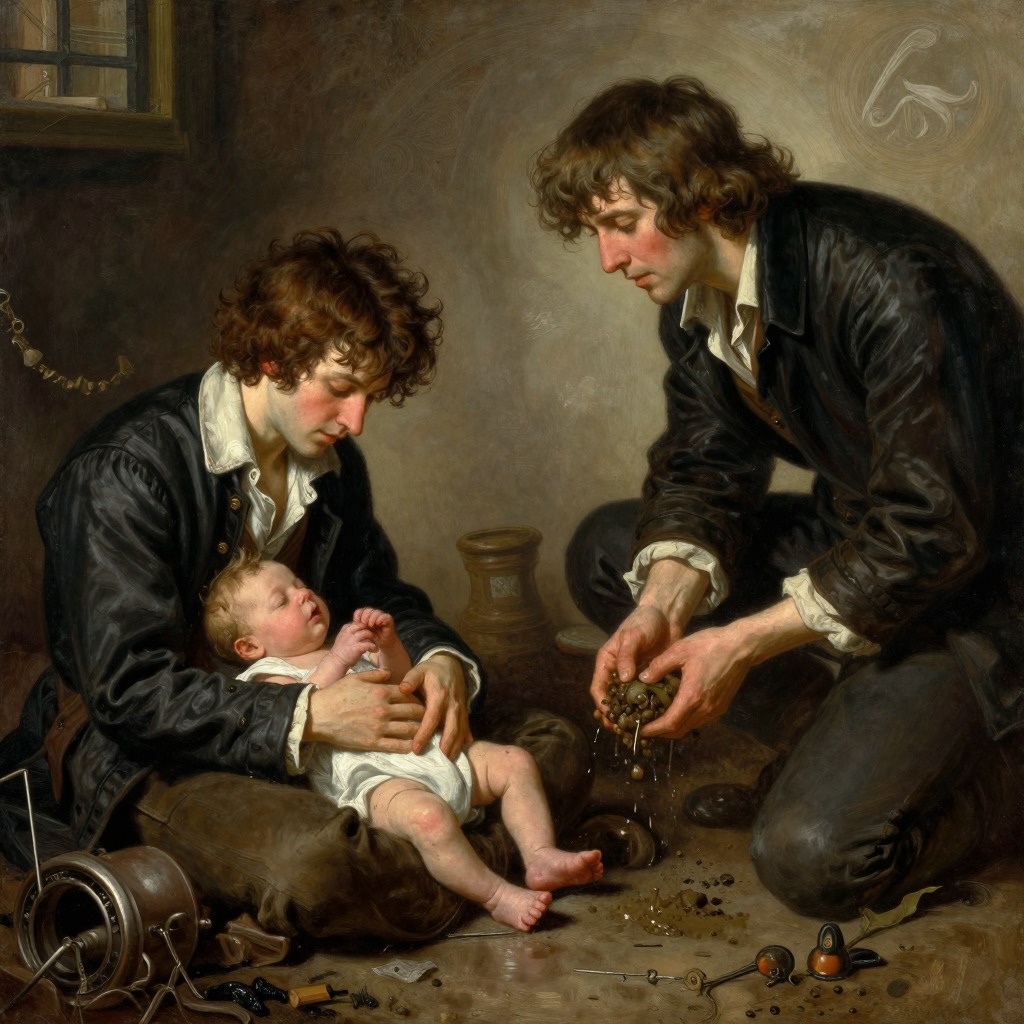
Jean-Baptiste Grenouille is born on the most putrid spot in Paris, the Cimetière des Innocents, during a heatwave. His mother, a fishwife, gives birth under a fish stall and abandons him, expecting him to die as her previous four children had. The infant's cries attract a crowd, leading to his mother's arrest and eventual execution for infanticide. This event establishes Grenouille's origin in filth and his mother's rejection, setting the stage for his lifelong struggle for identity and his lack of human scent.
shortly after birth
Grenouille's wet nurse Jeanne Bussie
After his mother's arrest, Grenouille is passed to several wet nurses who reject him for his greed. He is finally baptized at the Cloister of Saint-Merri and given to Jeanne Bussie. Bussie soon returns him to Father Terrier, claiming the infant is possessed because he lacks a normal baby's scent. This early rejection highlights Grenouille's fundamental otherness and his lack of the human odor that bonds people, a theme that will define his life.
a few weeks after birth
Grenouille's brief stay with Father Terrier
Father Terrier, a monk at the Cloister of Saint-Merri, initially dismisses the wet nurse's fears as superstition. However, when he is alone with the infant, he experiences a profound unease as Grenouille's nose seems to smell him, penetrating his soul. Terrier, horrified, quickly arranges to send the child to Madame Gaillard's foster home, paying a year in advance. This event marks the first time Grenouille's extraordinary olfactory power is recognized, causing fear and revulsion.
age 0 to 8
Grenouille's foster mother Madame Gaillard
Madame Gaillard, a woman emotionally deadened by a childhood injury, takes in Grenouille. She is indifferent to his lack of scent and his strange nature, providing only the bare necessities. Grenouille survives several childhood illnesses and attempts by other children to kill him, developing a tough, tick-like resilience. His time with Gaillard is a period of hibernation, where he learns to survive without love or human connection, storing up olfactory memories.
age 8 to 13
Grenouille's apprenticeship under Grimal
When the cloister stops paying, Madame Gaillard sells Grenouille to the tanner Grimal. Grenouille works in brutal conditions, scraping hides and hauling water, but survives anthrax, becoming immune. He proves so useful that Grimal treats him like a valuable pet, granting him small freedoms. This period teaches Grenouille to endure physical hardship and to be utterly subservient, while he secretly begins to explore the olfactory world of Paris.
age 13 to 15
Grenouille's olfactory exploration of Paris
With his newfound freedom, Grenouille roams Paris, dissecting and cataloging thousands of scents. He explores markets, streets, and the rich quarters, building an inner library of odors. He is particularly drawn to the smell of the sea from the Place de Grève. This exploration is his true education, developing his genius for scent and his desire to possess and create new odors, setting the foundation for his future as a perfumer.
1 September 1753
Murder of the red-haired girl
During a fireworks display, Grenouille catches a scent of unprecedented beauty. He follows it to a courtyard in the Rue des Marais, where he finds a young red-haired girl. Overwhelmed by her scent, he strangles her to possess it, then smells her entire body. This murder is a turning point: he realizes his life's purpose is to be the greatest perfumer, and the girl's scent becomes the template for his future work. He feels no remorse, only a sense of destiny.
after the first murder
Grenouille's self-perception as a genius
After the murder, Grenouille experiences a profound sense of happiness and self-discovery. He believes he has been born a second time, now knowing he is a genius. He begins to systematically organize his olfactory memories, building an inner fortress of scents. This event solidifies his narcissistic and megalomaniacal worldview, where he sees himself as destined to revolutionize the world of scent, using the murdered girl's essence as his compass.
autumn 1753
Baldini and his assistant Chénier
Giuseppe Baldini, an aging perfumer on the Pont au Change, struggles to compete with the modern perfumer Pélissier. His assistant Chénier knows Baldini's creative powers are exhausted. Baldini secretly buys a bottle of Pélissier's successful perfume 'Amor and Psyche' to copy it, but fails to analyze its formula. This scene establishes Baldini's decline and his desperation, setting the stage for Grenouille's arrival.
during Baldini's decline
Baldini's rivalry with Pélissier
Baldini reflects bitterly on the success of his rival Pélissier, a vinegar maker who has become a fashionable perfumer. He laments the loss of traditional craft and the rise of novelty, blaming the Enlightenment for society's decay. This internal monologue reveals Baldini's conservative worldview and his inability to adapt, making him vulnerable to Grenouille's genius.
evening, autumn 1753
Demonstration at Baldini's
Grenouille delivers goatskins to Baldini and, after a tense confrontation, demonstrates his ability to recreate 'Amor and Psyche' by smell alone. He then creates a superior version, 'Nuit Napolitaine', which overwhelms Baldini with its beauty. This event transforms Baldini's fortunes and marks Grenouille's entry into the world of professional perfumery, though Baldini takes all the credit.
1753 to 1756
Grenouille's apprenticeship under Baldini
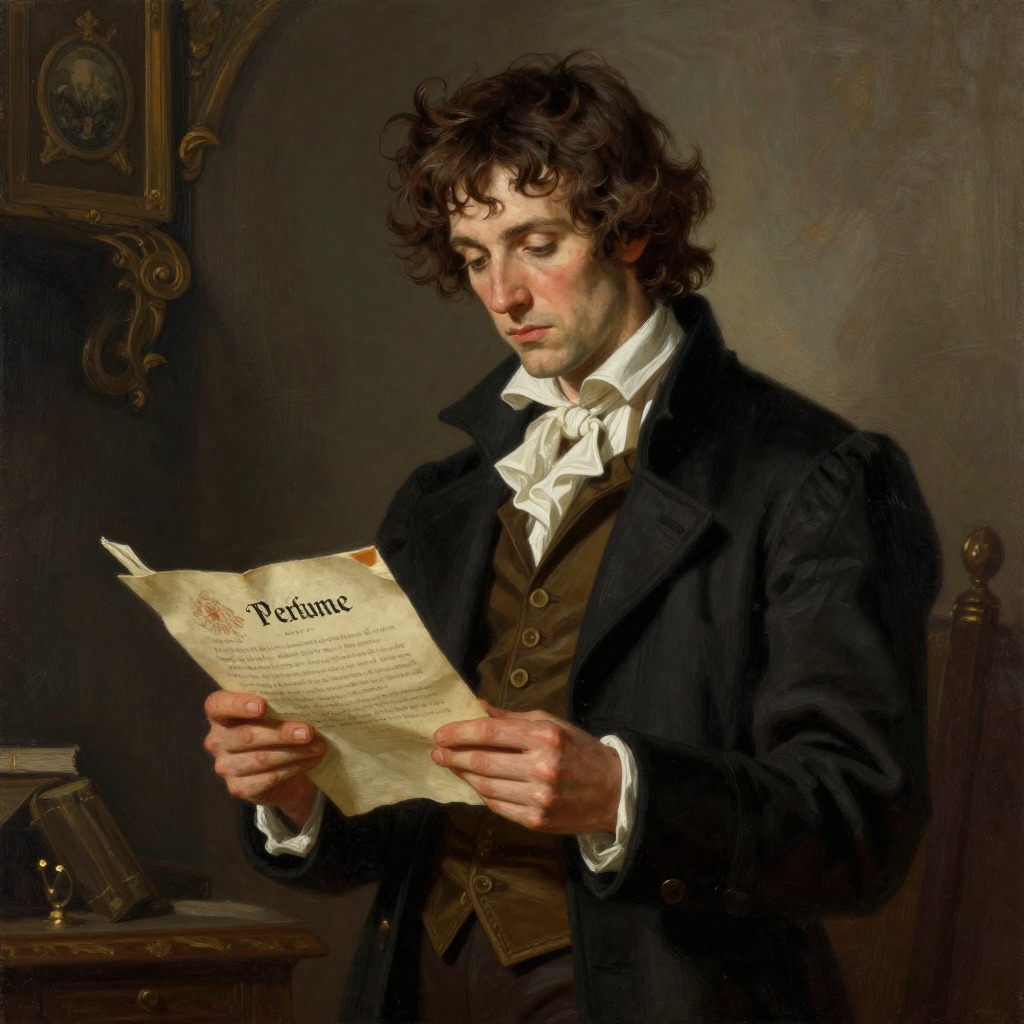
Baldini buys Grenouille from Grimal and sets him to work creating new perfumes. Grenouille learns the craft's language and techniques, including distillation, while secretly planning his own future. He becomes the hidden source of Baldini's success, producing a stream of innovative scents that make the House of Baldini famous across Europe. Grenouille uses this time to master the art and to prepare for his ultimate goal.
during his apprenticeship with Baldini
Grenouille's distillation experiments
Fascinated by distillation, Grenouille experiments with extracting scents from various materials, including glass, brass, and dirt. He fails to distill new, non-plant odors, leading to a period of despair and illness. This failure teaches him the limits of distillation and drives him to seek other methods, such as enfleurage, which he learns about from Baldini. The episode underscores his relentless pursuit of olfactory mastery.
during his apprenticeship with Baldini
Grenouille's illness and recovery
After his failed distillation experiments, Grenouille falls gravely ill with a high fever and boils. Baldini, fearing the loss of his golden goose, calls a doctor who pronounces him near death. However, Grenouille recovers after learning from Baldini about enfleurage techniques used in Grasse. This illness and recovery mark a turning point, as Grenouille now has a new goal: to go south and master the art of capturing delicate scents.
spring 1756
Collapse of Baldini's house
After Grenouille leaves, Baldini feels relieved but is killed that night when his house on the Pont au Change collapses into the Seine. His wife also dies, and his fortune and the little book of formulas are lost. This event symbolically ends Grenouille's Parisian past and frees him from any obligation to Baldini, allowing him to pursue his own path south.
spring 1756
Grenouille's journey south
Grenouille leaves Paris with a small sum of money and a journeyman's papers. He avoids human contact, traveling by night and reveling in the pure, unpeopled air. His goal is Grasse, but he is driven more by a desire to escape humanity. This journey is a period of purification and preparation, as he sheds the last traces of his former life and moves toward his destiny.
August 1756 to February 1763
Retreat in the Plomb du Cantal
Grenouille discovers the Plomb du Cantal, a remote volcano in the Massif Central, and lives in a cave for seven years. He survives on minimal food and water, spending most of his time in a fantasy world of scents, where he is the omnipotent ruler of an olfactory empire. This period of extreme solitude allows him to fully develop his inner world, but it ends when he has a nightmare about his own odorlessness, forcing him to confront his lack of identity.
February 1763
Grenouille's discovery of his odorlessness
After his nightmare, Grenouille realizes he has no personal scent. He tests this by airing his clothes and finds they carry no trace of his odor. This horrifying discovery shatters his self-contained world and drives him to leave the mountain. He must now find a way to create a human scent for himself, a quest that will lead him to Grasse and to murder.
February 1763
Grenouille's encounter with the Marquis de la Taillade-Espinasse
After leaving the mountain, Grenouille is found by farmers and brought to the Marquis de la Taillade-Espinasse, a scientist who believes in the 'Fluidum letale' theory. The marquis presents Grenouille as proof of his theory, 'curing' him with a vital ventilation machine and a special diet. Grenouille plays along, and after being cleaned and dressed, he is presented as a miracle of science. This event gives Grenouille a new identity and access to a perfumer's laboratory.
March 1763
Creation of the human scent
In Montpellier, Grenouille fakes a seizure to get access to Runel's perfumery. There, he creates a perfume that mimics human odor, using cat shit, cheese, and other foul ingredients, masked by floral scents. When he wears it, people perceive him as a normal human being for the first time. This is a pivotal achievement: he now has the power to pass among humans and, more importantly, to manipulate their emotions.
March 1763
Grenouille's triumph in Montpellier
Grenouille, wearing his new human scent, attends a second lecture by the marquis. His presence, enhanced by the perfume, captivates the audience, who cheer for the marquis's theory. Grenouille realizes the power of his scent to inspire love and adoration. He decides to create an even more powerful perfume, an 'angel's scent', to rule the hearts of men. This event marks his transition from a passive observer to an active manipulator.
March 1764
Grenouille's arrival in Grasse
Grenouille travels to Grasse, the perfume capital of the world. He is immediately struck by the scent of a young girl, Laure Richis, which is even more beautiful than the scent of the red-haired girl. He decides he must possess it, but he needs time to learn the techniques of enfleurage to capture it properly. He takes a job with Madame Arnulfi, a perfumer, to master these skills.
1764 to 1765
Grenouille's working relationship with Druot
Grenouille works under the brutish journeyman Dominique Druot at Madame Arnulfi's workshop. He learns the techniques of maceration and enfleurage, quickly surpassing Druot in skill. Grenouille deliberately hides his genius, acting subservient, while secretly using the workshop to experiment with capturing scents from living beings. This period is one of intense learning and preparation for his ultimate project.
1764 to 1765
Grenouille's experiments with enfleurage
Grenouille perfects the art of enfleurage, first on objects, then on animals, and finally on humans. He successfully captures the scent of a puppy and, later, the scent of a dead man from his sheets. He learns to kill his subjects quickly to prevent fear from tainting the scent. These experiments give him the technical ability to steal the scents of living humans, preparing him for his series of murders.
May 1765
The first murders in Grasse
Grenouille begins his campaign to collect the scents of beautiful young virgins. He murders a fifteen-year-old girl in a rose field, taking her hair and clothes. This is the first of twenty-four murders, each victim chosen for her unique beauty. The murders are carried out with precision, and the bodies are found naked and shorn, causing panic in Grasse. Grenouille is building a collection of essences for his ultimate perfume.
summer to autumn 1765
Collective fear during the murders
As the murders continue, the people of Grasse are gripped by fear. The police are helpless, and the town council appeals to the bishop, who excommunicates the murderer. The murders stop in October, and the town believes the curse has worked. This period of collective hysteria contrasts with Grenouille's cold, methodical work, highlighting his complete alienation from human emotion.
1765 to 1766
Antoine Richis and his daughter Laure
Antoine Richis, the second consul and wealthiest man in Grasse, becomes increasingly fearful for his daughter Laure, whose beauty is legendary. He correctly deduces that the murderer is a collector of beauty and that Laure is the ultimate prize. He devises a plan to marry her off quickly to protect her, but his fear and love for her are tinged with an incestuous desire. This sets the stage for the final confrontation.
March 1766
Richis's flight with Laure
Richis stages a departure for Grenoble but secretly takes Laure south towards the coast, planning to hide her in a monastery. Grenouille, sensing the loss of Laure's scent, follows them. Richis, confident in his plan, feels safe for the first time in months. This cat-and-mouse chase culminates in the inn at La Napoule, where Grenouille finally catches up to them.
night, March 1766
Murder of Laure Richis
Grenouille sneaks into Laure's room at the inn in La Napoule. He kills her with a single blow to the head, then wraps her body in oiled cloths to capture her scent. He cuts off her hair and takes her clothes. This is the twenty-fifth and most important murder, providing the keystone for his ultimate perfume. The murder is carried out with cold efficiency, and Grenouille feels a sense of profound satisfaction.
ten days after the murder
Grenouille's arrest
The watchman Gabriel Tagliasco identifies Grenouille as the man who inquired about Richis's route. Grenouille is arrested, and the clothes and hair of all twenty-five victims are found in his cabin. He confesses to all the murders but refuses to explain his motives, saying only 'I needed them'. The evidence is overwhelming, and he is sentenced to a brutal execution.
15 April 1766
Execution of Grenouille and the orgy
On the day of his execution, Grenouille wears his ultimate perfume. As he steps from the carriage, the crowd is overwhelmed by love and desire. The execution turns into a massive orgy, with people copulating in the streets. Richis, instead of killing Grenouille, adopts him as his son. Grenouille is horrified by his triumph, realizing he cannot enjoy the love he has forced upon others. He faints from the internal conflict.
after the execution
Richis's adoption of Grenouille
Richis, under the influence of Grenouille's perfume, takes him home and declares him his son. He sees Laure in Grenouille and offers him his fortune. Grenouille, disgusted by this love, plays along but leaves at dawn. This event shows the complete power of Grenouille's perfume to override even a father's grief and desire for revenge, but also its ultimate emptiness for him.
June 1766
Grenouille's return to Paris
Grenouille travels back to Paris, avoiding human contact. He is disillusioned with his power, realizing it cannot give him a sense of self. He decides to die. He reaches Paris on a hot day and goes to the Cimetière des Innocents, the site of his birth. This journey is a reverse of his earlier flight from humanity, leading him back to his origins and to his final act.
25 June 1766
Death of Jean-Baptiste Grenouille
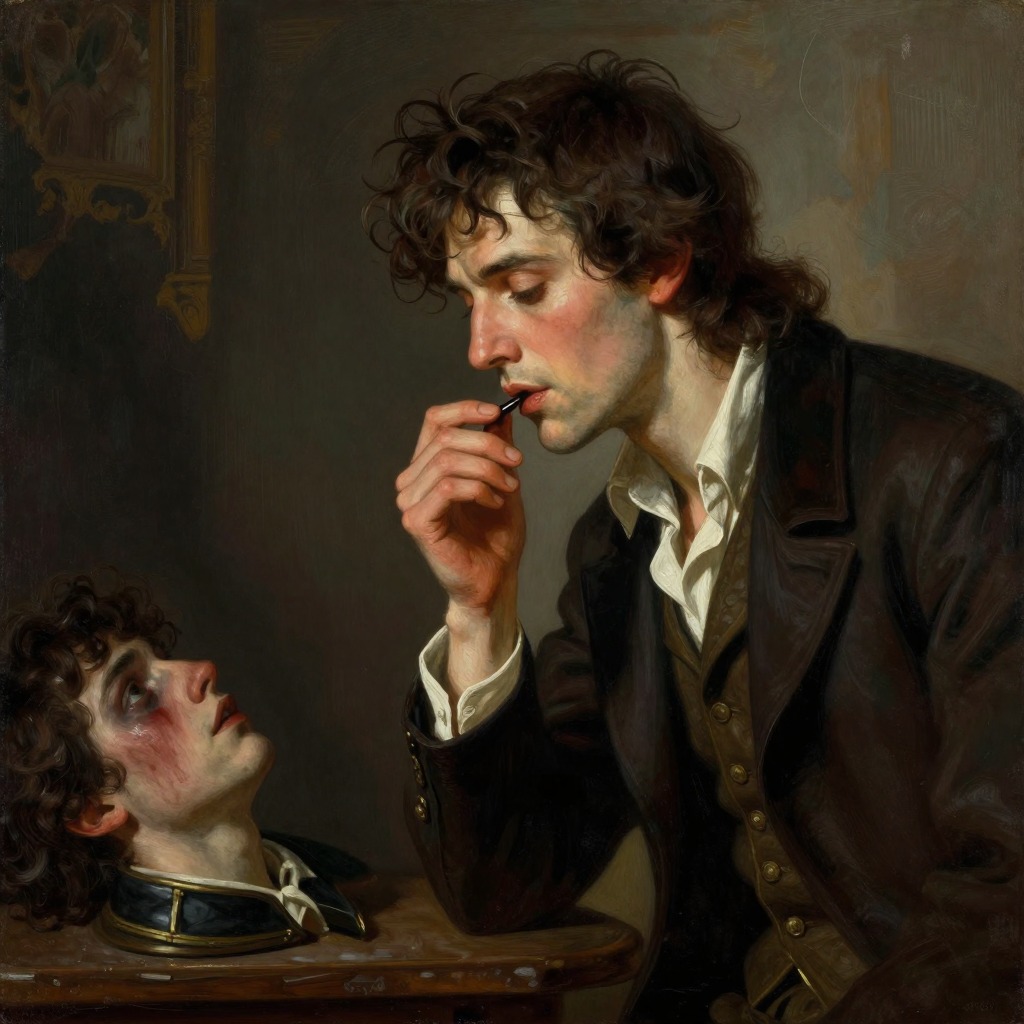
At the Cimetière des Innocents, Grenouille pours his remaining perfume over himself. A group of thieves and outcasts, drawn by his scent, are overcome with love and desire. They tear him apart and eat him, consuming every piece. Afterward, they feel a strange happiness and pride, having acted out of love for the first time. Grenouille is utterly destroyed, his body and scent gone, leaving no trace.