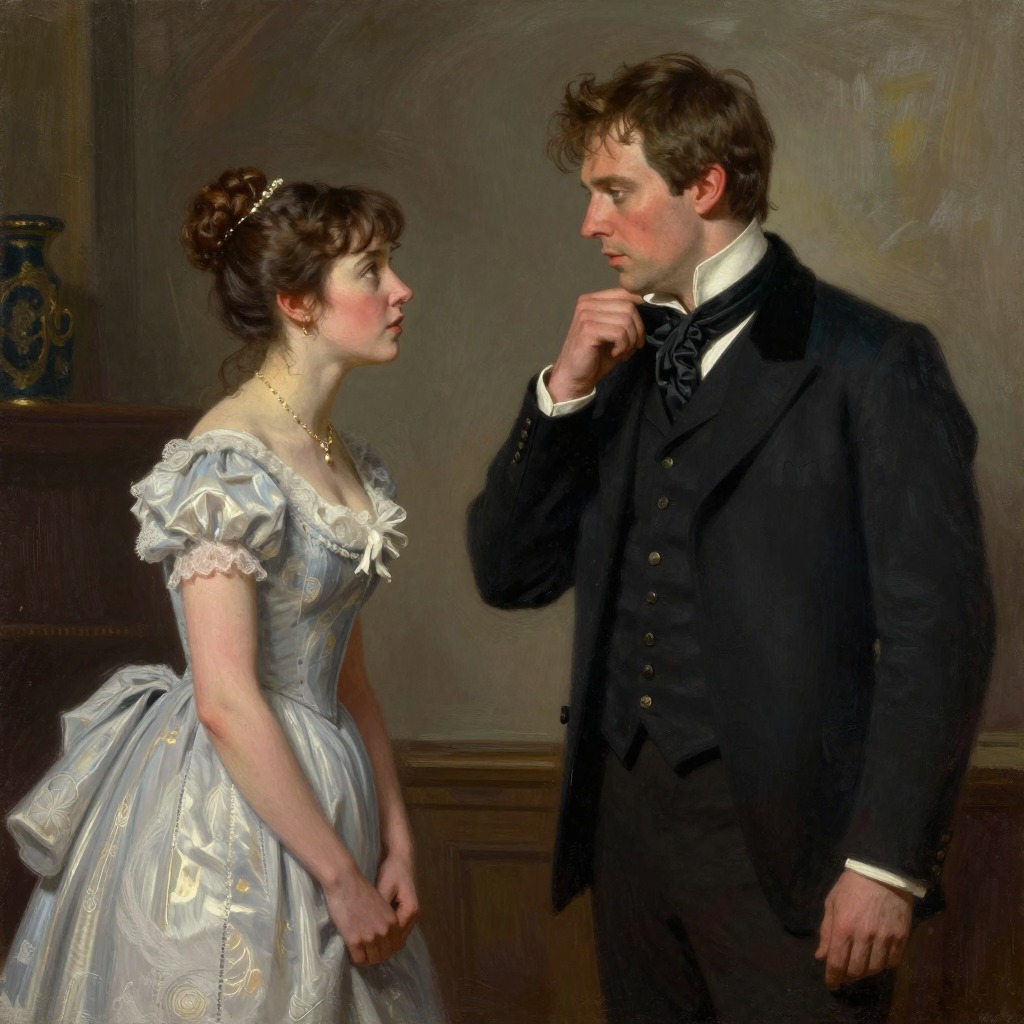
Portrait of Harriet Smith
The Portrait of Harriet Smith is a watercolour drawing executed by Emma Woodhouse during the early phase of her friendship with Harriet, intended as a token of their intimacy and as a vehicle for Emma's matchmaking designs upon Mr. Elton. The portrait becomes a material emblem of Emma's self-deception, her manipulation of Harriet's affections, and the social ambitions that drive her schemes, and its fate—framed, displayed, and ultimately rendered a symbol of mistaken hopes—mirrors the trajectory of Emma's own errors.
Creation and Artistic Context
Emma, who had once had a great passion for taking likenesses and had attempted several of her friends, had given up the practice in disgust after a frustrating experience drawing her brother-in-law, John Knightley. She had vowed never to take another likeness, but broke her resolution for Harriet's sake, declaring that "as there are no husbands and wives in the case at present, I will break my resolution now." The portrait was to be a whole-length in water-colours, like the one she had made of John Knightley, and was destined, if she could please herself, to hold a very honourable station over the mantelpiece. Emma's artistic skill, though spirited, was not as accomplished as she believed; she had made more progress in drawing than many might have done with so little labour as she would ever submit to, but steadiness had always been wanting, and in nothing had she approached the degree of excellence she ought not to have failed of. She was not much deceived as to her own skill, but she was not unwilling to have others deceived, or sorry to know her reputation for accomplishment often higher than it deserved.
The Sitting and Mr. Elton's Involvement
The sitting began with Harriet smiling and blushing, afraid of not keeping her attitude and countenance, presenting a very sweet mixture of youthful expression to the steady eyes of the artist. Mr. Elton, however, proved a constant distraction, fidgeting behind Harriet and watching every touch. Emma was obliged to put an end to it and request him to place himself elsewhere, then employed him in reading aloud to amuse away the difficulties of her part and lessen the irksomeness of Miss Smith's. Mr. Elton was only too happy, and though Emma could not respect his eye as a judge of art, his love and his complaisance were unexceptionable. The sitting was altogether very satisfactory; Emma was quite enough pleased with the first day's sketch to wish to go on. She meant to throw in a little improvement to the figure, to give a little more height, and considerably more elegance, having great confidence of its being in every way a pretty drawing at last, and of its filling its destined place with credit to them both—a standing memorial of the beauty of one, the skill of the other, and the friendship of both, with as many other agreeable associations as Mr. Elton's very promising attachment was likely to add.
Reception and Framing
Every body who saw it was pleased, but Mr. Elton was in continual raptures, defending it through every criticism. When Mrs. Weston observed that the expression of the eye was most correct but that Miss Smith did not have those eyebrows and eyelashes, Mr. Elton insisted it was a most perfect resemblance in every feature. When Mr. Knightley noted that Emma had made Harriet too tall, Mr. Elton warmly defended the proportions, invoking foreshortening. Even Mr. Woodhouse's concern that Harriet seemed to be sitting out of doors and might catch cold was met by Mr. Elton's praise of the "inimitable spirit" of the tree and the "naivete of Miss Smith's manners." The next thing wanted was to get the picture framed, and Mr. Elton gallantly offered to ride to London to execute the commission, declaring it would be impossible to say how much he should be gratified by being employed on such an errand. "What a precious deposit!" he said with a tender sigh as he received it. Emma thought him almost too gallant to be in love, but supposed there might be a hundred different ways of being in love.
Symbol of Misinterpretation
The portrait became a central piece of evidence in Emma's mistaken conviction that Mr. Elton was in love with Harriet. When Mr. Elton took the drawing to London to choose the frame, Emma imagined him showing it to his mother and sisters, telling how much more beautiful the original was, and allowing them to hear Harriet's name. After the picture, elegantly framed, came safely to hand soon after Mr. Elton's return, it was hung over the mantelpiece of the common sitting-room, and he got up to look at it, sighing out his half sentences of admiration just as he ought. Emma was soon perfectly satisfied of Mr. Martin's being no otherwise remembered than as he furnished a contrast with Mr. Elton, of the utmost advantage to the latter. Yet when Mr. Elton's true intentions were revealed—that he had never thought seriously of Harriet and had been addressing himself to Emma all along—the portrait was among the circumstances that Emma looked back upon in confusion. "The picture!—How eager he had been about the picture!—and the charade!—and an hundred other circumstances;—how clearly they had seemed to point at Harriet." The portrait, which had seemed so clear a proof of Mr. Elton's attachment to Harriet, was in fact a product of Emma's own wishful interpretation, a material embodiment of her self-deception and the blindness of her matchmaking schemes.