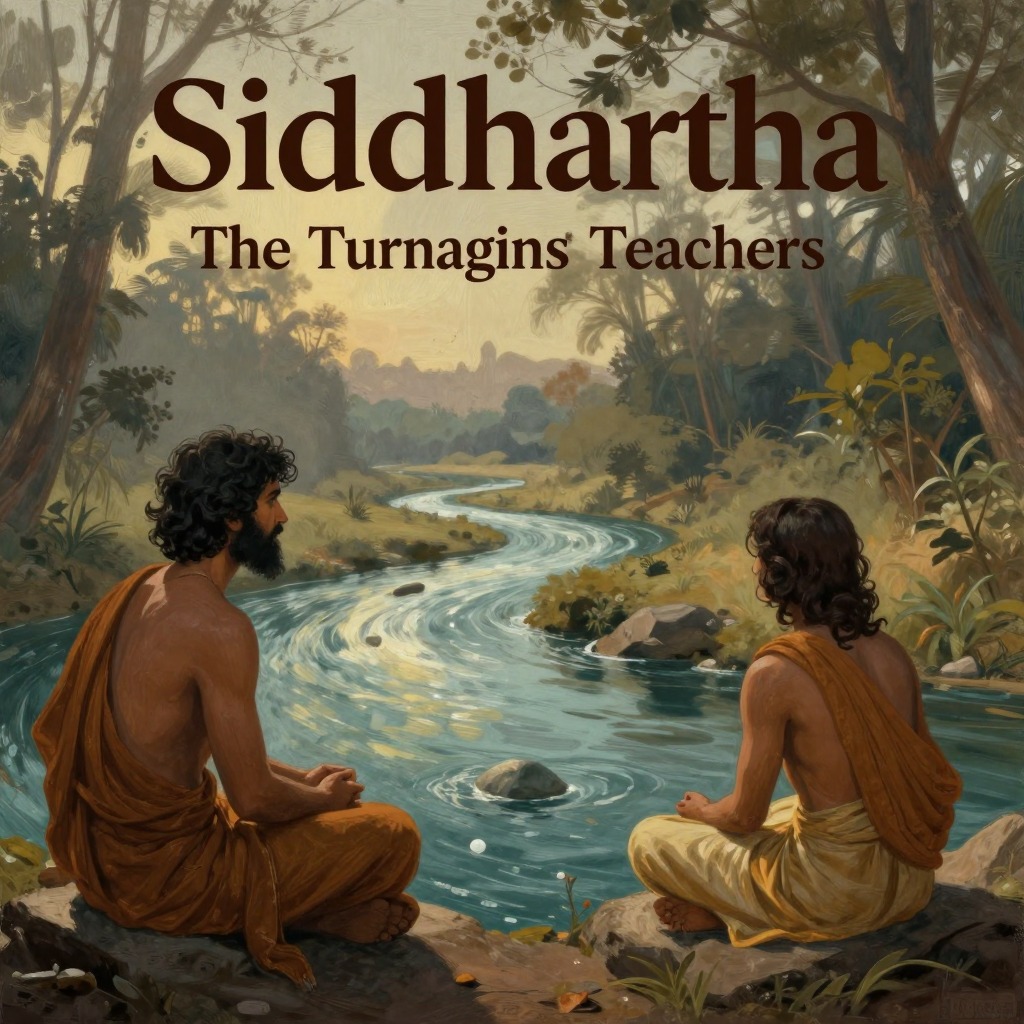
Siddhartha and the oldest Samana's teacher-student relationship
Siddhartha and the oldest Samana's teacher-student relationship is a crucial, transitional stage in Siddhartha's spiritual journey, one that provides him with powerful techniques for self-denial but ultimately leaves his fundamental thirst for enlightenment unquenched. The relationship is defined by Siddhartha's initial obedience, his rigorous practice of the Samana's methods, his growing intellectual and spiritual critique of those methods, and a final, ironic display of the mastery he has achieved even as he decides to abandon the path.
Initiation and Obedience
When Siddhartha and Govinda first encounter the Samanas—three skinny, withered ascetics on a pilgrimage—Siddhartha is immediately drawn to their way of life. He resolves to join them, and after a silent, night-long vigil that forces his father's reluctant blessing, he and Govinda offer the ascetics their companionship and obedience. They are accepted. Siddhartha immediately adopts the Samana's harsh disciplines: he gives away his garments, wears only a loincloth and an earth-colored cloak, eats once a day and never cooked food, and undertakes extreme fasts of fifteen and then twenty-eight days. The flesh wanes from his thighs and cheeks; feverish dreams flicker from his enlarged eyes; a dry, shaggy beard grows on his chin. He learns to expose himself to the burning sun until he feels no pain, to stand in the rainy season until he feels no cold, and to crouch in thorny bushes until no blood flows. Instructed by the oldest of the Samanas, he practices self-denial and meditation according to new rules, learning to breathe sparingly, to calm his heartbeat, and to slip his soul into other forms—a heron, a dead jackal—experiencing their deaths and decay. He kills his senses and his memory, fleeing from his self a thousand times into nothingness, into the animal, into the stone.
Disillusionment and Critique
Despite his mastery of these techniques, Siddhartha begins to nurse a profound discontent. He confides to Govinda that what he has learned among the Samanas—meditation, holding his breath, insensitivity to pain—he could have learned more quickly and by simpler means, even in a tavern among carters and gamblers. He argues that these practices are merely a short numbing of the senses, a temporary escape from the agony of being a self, no different in essence from the drunkard's escape into rice-wine. Govinda protests, insisting that a Samana is no drunkard and that their path is a spiral upward, but Siddhartha remains unconvinced. He observes that their oldest teacher, now about sixty years old, has not reached Nirvana and likely never will. Siddhartha concludes that among all the Samanas, perhaps not a single one will find the path of paths; they find only comfort, numbness, and feats to deceive others. This realization crystallizes into a deeper insight: that there is nothing to be learned, that knowledge has no worse enemy than the desire to know it, than learning itself.
The Final Break and a Demonstration of Power
When news of Gotama the Buddha reaches the Samanas in the forest, Govinda is eager to go and hear the teachings. Siddhartha agrees, though with a characteristic skepticism. He informs the oldest Samana of their decision to leave, doing so with all the courtesy and modesty becoming to a younger student. The old man, however, becomes angry and speaks loudly, using crude swearwords. In response, Siddhartha whispers to Govinda that he will show the old man what he has learned from him. Positioning himself closely in front of the Samana, Siddhartha captures the old man's glance with his own, concentrating his soul. He deprives the Samana of his power, makes him mute, takes away his free will, and subdues him under his own will. The old man becomes motionless, his arms hanging down, his will paralysed. Siddhartha's thoughts bring the Samana under their control, and the old man makes several bows, performs gestures of blessing, and stammeringly wishes them a good journey. Govinda is astonished, remarking that it is very hard to cast a spell on an old Samana, and that Siddhartha could soon learn to walk on water. Siddhartha dismisses the feat, saying he does not seek to walk on water and that old Samanas may be content with such tricks. The relationship ends with Siddhartha having mastered the very powers he has come to see as ultimately futile, a paradox that defines his entire trajectory.
Legacy and Thematic Significance
The relationship with the oldest Samana leaves a lasting imprint on Siddhartha, even as he rejects its ultimate value. The skills he learned—thinking, waiting, fasting—become his core assets, which he later boasts of to Kamala and which enable his success in the worldly life of a merchant. Yet the experience also instills in him a deep distrust of teachers and teachings, a conviction that wisdom cannot be passed on, and a recognition that the self he sought to kill through asceticism only retreated into arrogance and spirituality. The Samana's path, with its emphasis on self-denial and the annihilation of desire, is a necessary but incomplete stage, one that Siddhartha must fully exhaust before he can begin the journey toward a more holistic understanding of the world, one that embraces both the sacred and the profane, the stone and the river, the sinner and the Buddha.