
Introduction
What is critical reading? Critical reading is the active process of understanding, questioning, analyzing, and evaluating a text instead of accepting every statement at face value. It asks a reader to identify the author’s main claim, examine the evidence, notice assumptions, consider context, and decide whether the conclusion is justified.
Critical reading is not the same as searching for faults. A critical reader can agree with an author while still testing the reasoning. Reading critically also does not require moving slowly through every sentence. It means choosing the depth and critical reading strategies that fit the purpose of the task.
This skill matters whenever you read a research paper, news report, textbook, business proposal, essay, or persuasive article. Readify can support the process by reading eligible documents aloud, helping you revisit difficult passages, and making long texts easier to approach. However, the app does not perform critical reading for you. The questions, comparisons, and judgments must still come from the reader.
If you have a document you want to examine, you can start reading and listening with Readify while applying the seven-step method below.

What Is Critical Reading?
Critical reading combines comprehension with analysis and evaluation. First, you determine what the text says. Next, you examine how the author constructs the argument. Finally, you evaluate whether the ideas deserve acceptance, rejection, or further investigation.
That progression explains why critical reading begins with accurate understanding. You cannot fairly challenge an argument you have misunderstood. Reading critically therefore requires patience at the beginning: define unfamiliar terms, locate the thesis, follow the structure, and summarize the author’s position in neutral language.
Once the meaning is clear, a critical reader asks deeper questions:
- What is the author trying to persuade me to believe or do?
- What evidence supports the main claim?
- Are important terms defined consistently?
- Which assumptions connect the evidence to the conclusion?
- What relevant information or perspective is missing?
- Does the conclusion follow from the evidence presented?
The University of Leeds guide to critical reading recommends deciding why you are reading, what you want from the text, what you already know, and how you will know when you have read enough. These questions turn critical reading into a purposeful activity rather than an automatic trip from the first page to the last.
Critical Reading vs. Ordinary Reading
Ordinary reading often focuses on receiving information: following a story, finding a fact, or understanding instructions. Critical reading goes further by examining the choices behind the information. It asks why the author selected particular examples, whether an alternative explanation fits the evidence, and how language influences the reader.
The difference is not that one mode is intelligent and the other is careless. People read for different reasons. A recipe, novel, safety notice, and academic paper do not demand the same level of scrutiny. A skilled critical reader knows when close analysis is useful and when straightforward comprehension is enough.
Reading critically also differs from highlighting everything that seems important. Highlighting can support critical reading, but colored lines alone do not show analysis. The useful work happens when a note explains why a claim matters, how it connects to another source, or what question remains unanswered.
In practice, critical reading is active reading with a clear evaluative purpose. The reader predicts, questions, annotates, summarizes, compares, and verifies rather than simply collecting sentences.
Critical Reading vs. Critical Thinking
Critical reading and critical thinking overlap, but they are not identical. Critical reading focuses on discovering and analyzing what is happening inside a particular text. Critical thinking is the broader process of evaluating ideas and deciding what to believe or do.
The distinction is useful because a text should be understood before it is judged. A critical reader identifies the claim and reconstructs the reasoning. Critical thinking then connects that argument with prior knowledge, other sources, standards of evidence, and possible consequences.
The University of Leeds critical-thinking guide describes the skill as questioning information rather than accepting it at face value and weighing different arguments with evidence. Critical reading supplies the careful textual understanding that makes this evaluation possible.
The two processes continually inform each other. Reading critically can reveal a weak assumption, prompting broader critical thinking. Prior knowledge can also make a critical reader return to a paragraph and examine its wording more carefully.
Why Critical Reading Matters
Critical reading improves more than academic performance. It helps people distinguish a supported claim from a confident assertion, recognize when statistics lack context, and notice when emotional language substitutes for evidence.
For students, critical reading supports stronger essays because it produces notes about arguments and relationships rather than isolated quotations. For researchers, it helps identify methods, limitations, and gaps. For professionals, reading critically can improve decisions about proposals, reports, policies, and market claims. For everyday readers, it offers a disciplined response to persuasive content and conflicting information.
Critical reading also prevents two opposite mistakes. The first is accepting a text because it sounds authoritative. The second is rejecting it merely because it challenges an existing belief. A critical reader aims for proportion: confidence should rise or fall with the quality of the evidence.
Most importantly, critical reading makes reading participatory. The author contributes an argument, but the reader tests its meaning and strength. That participation is what separates reading critically from passively storing information.
7 Critical Reading Strategies
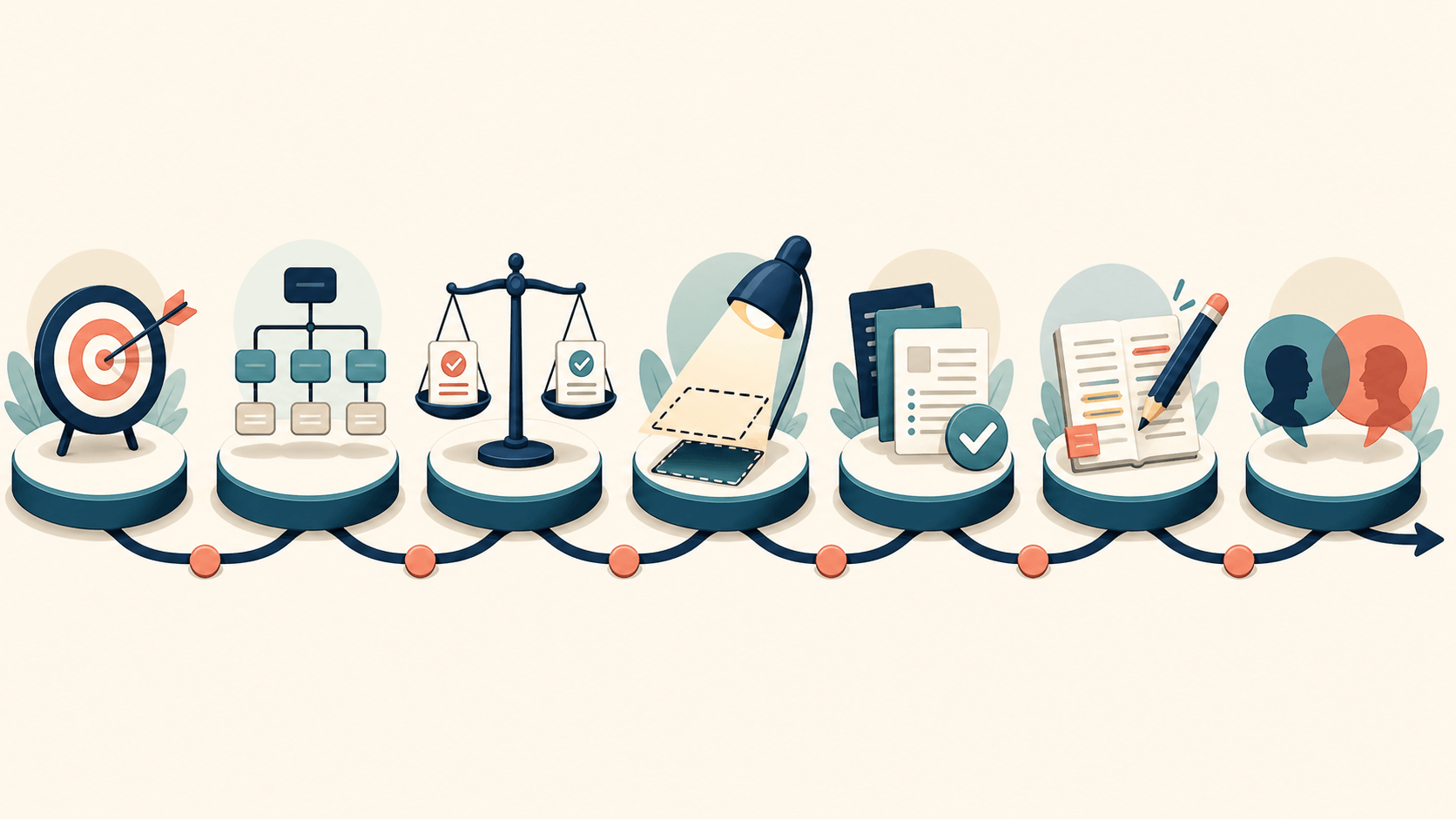
The following critical reading strategies form a repeatable workflow. They can be used with academic papers, long-form journalism, essays, reports, and other argumentative texts. You do not need to apply every step with equal intensity to every document. Adjust the process to the importance and complexity of the material.
1. Define Your Purpose Before You Begin
Start critical reading by writing down what you need from the text. Are you looking for background knowledge, evidence for an assignment, a competing viewpoint, a method to reproduce, or a decision you must make?
Purpose determines attention. If you need to evaluate a research paper, the method and limitations may matter more than the historical introduction. If you are comparing two proposals, costs, assumptions, and predicted outcomes deserve priority.
Preview the title, author, publication, date, headings, abstract, introduction, and conclusion. This first pass gives critical reading a map. Predict the thesis and structure, but treat that prediction as provisional. A critical reader updates expectations as the text provides more information.
This strategy also prevents wasted effort. Reading critically does not mean reading every source at the same depth. The Open University’s critical-reading guidance emphasizes an efficient approach alongside analysis and comparison. Skim first, then decide which sections deserve intensive reading.
2. Identify the Main Claim and Supporting Structure
The next critical reading task is to state the central claim in your own words. Avoid copying the thesis sentence. Paraphrasing tests whether you understand what the author is actually arguing.
Then map the structure beneath that claim:
- What reasons support it?
- What evidence supports each reason?
- What definitions or assumptions connect the parts?
- Does the author address counterarguments?
- What conclusion follows?
Reading critically becomes easier when the argument is visible as a structure rather than a wall of paragraphs. A critical reader can use a short outline, margin notes, or a simple claim–evidence–assumption pattern.
Be careful with texts that contain information but no clear argument. A report may primarily describe findings; a reference page may explain a process. Critical reading still applies, but the questions shift toward selection, accuracy, completeness, method, and relevance.
3. Separate Claims, Evidence, and Interpretation
One of the most useful critical reading strategies is labeling what each sentence is doing. A claim states what the author wants the reader to accept. Evidence offers support. Interpretation explains what the evidence is supposed to mean.
These elements are easy to blur. A statistic may be accurate while the conclusion drawn from it is too broad. A personal example may illustrate a possibility without showing how common it is. An expert quotation may provide informed judgment but not direct proof.
While reading critically, ask whether the evidence is relevant, sufficient, current, and representative. Check whether a correlation is presented as a cause. Notice whether percentages are given without sample sizes or baselines. Look for comparisons that use different time periods, populations, or definitions.
A critical reader does not dismiss qualitative evidence simply because it is not numerical. Interviews, observations, case studies, and textual examples can be appropriate. The key critical reading question is whether the type of evidence matches the claim being made.
4. Question Assumptions, Language, and Bias
Every argument contains assumptions—ideas treated as true without being fully demonstrated in the text. Critical reading makes those assumptions visible.
Ask what must be true for the reasoning to work. A productivity article may assume that speed is always desirable. A policy proposal may assume that people will respond to an incentive in the same way. A technology review may assume that having more features creates a better experience.
Next, examine language. Words such as “obvious,” “everyone,” “proven,” “natural,” and “revolutionary” can make a claim feel stronger without adding evidence. Metaphors, labels, passive constructions, and emotional examples can also guide interpretation.
Bias does not automatically make a source useless. Every author writes from a position shaped by experience, discipline, goals, and available information. Reading critically means identifying that position and considering how it affects the questions asked, sources selected, and conclusions emphasized.
The Monash University guide to reading critically recommends examining the author’s position, purpose, assumptions, strengths, and weaknesses. These habits help a critical reader distinguish perspective from distortion.
5. Check the Source and Verify Important Evidence
Critical reading includes reading around the text. Investigate the author’s relevant expertise, the publication’s standards, the date, the funding or sponsorship, and whether corrections or updates exist.
Follow citations to their original sources when a claim is important. Do not assume a link supports the sentence simply because it appears nearby. Check whether the cited research says what the author claims, whether it involved an appropriate population, and whether a later study changed the picture.
Reading critically also requires lateral reading: leave the page and see what independent sources say about the author, organization, claim, or event. Compare reporting from sources with different perspectives. For academic work, look for reviews, replications, and responses rather than relying on one paper.
Verification should be proportional. You do not need to investigate every ordinary statement. Focus critical reading effort on claims that are surprising, consequential, central to the argument, or likely to influence a decision.
6. Annotate, Pause, and Summarize
Annotation makes critical reading visible. Mark the thesis, major reasons, key evidence, definitions, assumptions, counterarguments, and unanswered questions. Use short labels rather than copying whole sentences.
A simple annotation code can keep reading critically efficient:
- C: central claim
- E: evidence
- A: assumption
- Q: question
- X: contradiction or tension
- L: link to another source or idea
After a section, stop and summarize it without looking at the text. If the summary is vague, return to the passage. The Open University’s active-reading guidance recommends asking questions of a text and testing recall by putting it aside and writing down the key points.
Pausing matters because critical reading cannot happen if the material never leaves working memory long enough to be reorganized. A critical reader creates small breaks to paraphrase, question, and connect ideas.
Listening can support this step. Hearing a dense passage may expose awkward reasoning or a hidden shift in tone. However, reading critically still requires deliberate pauses. Continuous audio that becomes background noise does not produce critical engagement.
7. Compare Perspectives and Form a Provisional Judgment
Finish critical reading by placing the text in conversation with other sources. Where do authors agree? Are they using the same definitions? Do they interpret similar evidence differently? Does one source address a limitation another ignores?
Create a comparison based on claims, evidence, assumptions, methods, and context—not merely whether you like each conclusion. Reading critically means giving a strong opposing argument a fair representation before evaluating it.
Then form a provisional judgment. You might conclude that the argument is convincing, partly convincing, unsupported, useful within limits, or impossible to assess with the available evidence. Record what would change your mind or what additional information you need.
The word “provisional” is important. A critical reader remains open to revision. Critical reading is not a performance of certainty; it is a disciplined way to match confidence to evidence.
How Listening Can Support Critical Reading
Critical reading is often associated with silent study, but listening can support the process when it is used actively. Text to speech can make a long PDF less intimidating, offer another way to process difficult syntax, and help readers return to passages that need closer attention.
Reading critically with audio works best when the reader controls the session. Preview the document visually or through a screen reader, choose a section, listen with a question in mind, pause at important claims, and record a summary or objection. Switching between visible text and narration can help a critical reader notice both structure and tone.
Playback speed should match the task. Faster listening may be useful for reviewing familiar material or locating a relevant section. Slower playback is better when evidence, definitions, or reasoning requires careful attention. Reading critically is not a race, and the fastest speed is not automatically the most productive.
Replay can also strengthen critical reading. A reader may hear a conclusion, return to the evidence, and ask whether the connection is justified. The important point is that audio provides access and repetition; it does not evaluate the argument.

How Readify Fits a Critical Reading Workflow
Readify can turn supported PDF, EPUB, DOCX, TXT, and web content into spoken audio. For critical reading, its value lies in controlling how a reader approaches and revisits a document rather than providing an automatic verdict on whether the author is correct.
Preview the Material
Import an eligible document and inspect its structure before listening from beginning to end. Identify the title, author, headings, introduction, conclusion, and sections most relevant to your purpose. Critical reading begins with selection.
Choose a Voice and Useful Speed
A comfortable voice reduces unnecessary listening friction. Adjust the pace to the material: faster for overview, slower for analysis. Reading critically may require changing speed several times within the same document.
Pause at Claims and Evidence
Stop after a major claim and restate it in your own words. Ask what evidence was offered and what assumption connects the two. If the relationship is unclear, replay the passage or return to the visible text.
Read and Listen Together
When available in your workflow, follow the text while listening so you can notice terminology, citations, and paragraph structure. This combination can support active reading, especially when a dense passage is difficult to process in one mode alone.
Keep Judgment With the Reader
Readify can improve access to the document, but critical reading depends on your questions and verification. Do not treat a fluent AI voice as evidence that a statement is trustworthy. Natural narration can make weak reasoning sound confident, so the critical reader must continue checking sources and logic.
For more guidance on evaluating reading technology, see Readify’s guide to features that support text and reading. You can then get started for free with one document and test whether listening, pausing, and replaying improve your critical reading workflow.

Other Tools That Can Support Reading Critically
Different tools serve different parts of the workflow. Hypothesis focuses on web and PDF annotation, which can help a critical reader record questions and evidence. Zotero supports collecting sources and managing citations for comparison and verification. NaturalReader is another text-to-speech option for readers who want to compare narration and document support.
No tool replaces critical reading strategies. Annotation software can store notes without improving them. A reference manager can organize weak sources. A text-to-speech tool can narrate unsupported claims beautifully. The benefit appears only when the critical reader uses each tool for a defined purpose.
Common Critical Reading Mistakes
Highlighting Without Explaining
Marking a sentence is not the same as analyzing it. Add a short reason: claim, evidence, assumption, contradiction, or question. Critical reading improves when every mark has a purpose.
Criticizing Before Understanding
Reading critically does not mean searching for a quick objection. Summarize the argument fairly before evaluating it. A critical reader should be able to state the author’s position in terms the author would recognize.
Treating All Sources as Equal
A peer-reviewed study, opinion essay, company page, anonymous post, and government dataset have different purposes and review processes. Critical reading considers source type and context instead of counting every citation as equivalent.
Confusing Disagreement With Evaluation
Rejecting a conclusion because it feels wrong is not critical reading. Identify which premise, evidence, definition, or inference fails. Reading critically requires reasons that another person can examine.
Letting Audio Become Background Noise
Listening while multitasking may be useful for general exposure, but critical reading requires attention. If you cannot summarize the last section, pause, return, and reduce competing tasks.
Asking AI to Make the Final Judgment
AI can help generate questions or summarize a section, but its output can omit context or introduce errors. Compare any AI-generated explanation with the source. The goal is to become a stronger critical reader, not to outsource the judgment that defines critical reading.
Frequently Asked Questions
What Is Critical Reading?
Critical reading is the active process of understanding, analyzing, questioning, and evaluating a text. It involves identifying claims, examining evidence, uncovering assumptions, considering context, and deciding how strongly the text supports its conclusions.
What Are the Main Critical Reading Strategies?
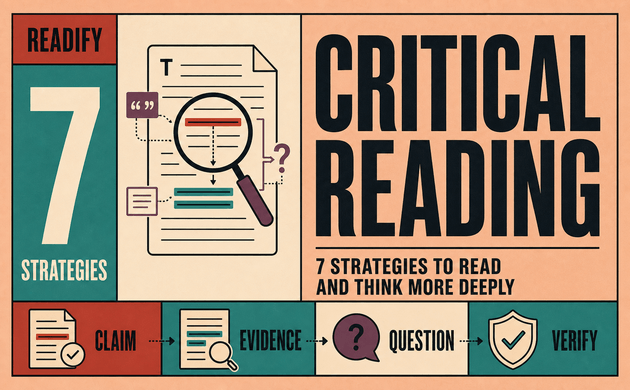
The main critical reading strategies include defining your purpose, previewing the text, identifying the central claim, mapping the argument, separating evidence from interpretation, questioning assumptions, checking sources, annotating, summarizing, and comparing perspectives.
What Is the Difference Between Critical Reading and Critical Thinking?
Critical reading focuses on accurately understanding and analyzing a particular text. Critical thinking is the broader evaluation of information and ideas used to decide what to believe or do. Reading critically supplies the textual understanding that critical thinking needs.
How Do You Read Critically?
To read critically, begin with a question, identify the author’s claim, trace the evidence and assumptions, annotate important points, verify consequential claims, compare other perspectives, and form a judgment proportional to the evidence.
How Can I Become a Better Critical Reader?
Practice with short, argumentative texts. Summarize each argument without copying, label claims and evidence, write questions in the margins, check one important source, and compare your conclusion with another perspective. A critical reader improves through repeated, deliberate practice.
Is Critical Reading the Same as Active Reading?
They overlap, but they are not identical. Active reading involves engaging with a text through questions, annotations, predictions, and summaries. Critical reading uses those active behaviors specifically to analyze and evaluate meaning, evidence, assumptions, and credibility.
Can Listening Improve Critical Reading?
Listening can support critical reading by providing another way to process dense language, revisit passages, and notice tone. It works best when the listener pauses, summarizes, checks the visible text, and evaluates evidence rather than letting the audio play in the background.
Can Readify Read Academic PDFs Aloud?
Readify supports PDF files and other common document formats. Performance depends on the document: text-based PDFs are generally easier to process than scans or image-heavy layouts. A critical reader should verify citations, tables, formulas, and OCR-derived passages against the original page.
Does Readify Perform Critical Reading Automatically?
No. Readify can make supported text easier to hear, navigate, pause, and replay, but it cannot replace the reader’s evaluation. Critical reading requires human decisions about evidence, assumptions, context, relevance, and credibility.
Read, Question, and Think More Deeply
Critical reading turns a text from something you receive into something you investigate. It begins with understanding, moves through analysis, and ends with a judgment that remains open to better evidence.
The seven critical reading strategies are straightforward: define your purpose, find the claim, separate evidence from interpretation, question assumptions, verify important sources, annotate and summarize, and compare perspectives. Their value comes from repeated use.
Reading critically does not require suspicion toward every sentence. It requires curiosity, fairness, and standards. A strong critical reader can recognize a convincing argument, explain a weak one, and admit when the available evidence is not enough.
Readify can support that work by making long documents easier to approach through natural narration, adjustable pacing, and replay. Bring one eligible text, choose a question, and get started for free—but keep the most important part of critical reading in your own hands: the judgment.
