Decrease the surplus population
A Christmas CarolThe phrase "Decrease the surplus population" is the most concentrated expression of Ebenezer Scrooge's early moral and economic philosophy, a coldly utilitarian dismissal of the poor that he deploys during a charity visit on Christmas Eve and that the Ghost of Christmas Present later hurls back at him as a damning indictment of his own moral worth. It crystallizes the worldview that the entire narrative is designed to dismantle: the reduction of human beings to economic units whose existence is justified only by their productivity, and the abdication of personal responsibility in favor of institutional coercion.
Origin and Context
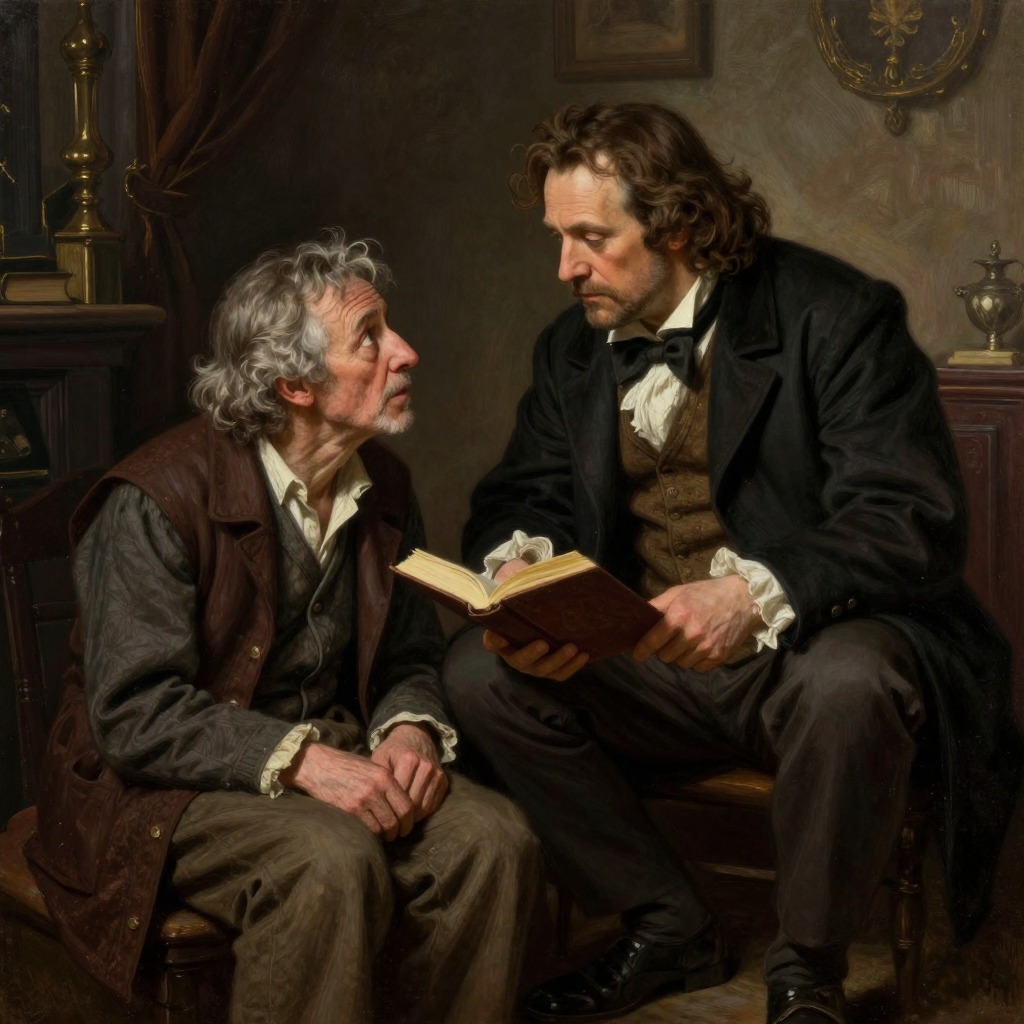
Scrooge first utters the phrase in his counting-house on Christmas Eve, when two portly gentlemen soliciting donations for the poor and destitute approach him. After Scrooge asks whether the prisons, Union workhouses, the Treadmill, and the Poor Law are still in operation—and receives affirmative answers—he declares himself satisfied that these institutions are fulfilling their "useful course." When one gentleman observes that many who are badly off "would rather die" than enter the workhouse, Scrooge replies: "If they would rather die, they had better do it, and decrease the surplus population. Besides—excuse me—I don't know that." The remark is delivered with the same businesslike finality he applies to any transaction, and he immediately returns to his labors "with an improved opinion of himself, and in a more facetious temper than was usual with him."
The Philosophy Behind the Phrase
The phrase is not an isolated outburst but the logical endpoint of a coherent worldview that Scrooge has built over a lifetime. He believes that "every man's business is his own" and that it is "enough for a man to understand his own business, and not to interfere with other people's." He supports the institutions of social control—prisons, workhouses, the Treadmill, the Poor Law—precisely because they allow him to discharge any obligation to the poor without personal engagement or expense. The phrase "surplus population" borrows the language of Malthusian political economy, which held that population growth inevitably outstrips food supply and that the poor, by their very existence, threaten the social order. Scrooge's version is even more brutal: he does not merely accept the poor as an unfortunate necessity but actively wishes them out of existence, reducing their lives to a matter of demographic accounting.
The Ghost's Reversal
The Ghost of Christmas Present turns Scrooge's own words against him with devastating precision. When Scrooge, moved by the sight of Tiny Tim, asks whether the child will live, the Ghost replies: "If these shadows remain unaltered by the Future, none other of my race will find him here. What then? If he be like to die, he had better do it, and decrease the surplus population." The quotation lands with the force of a physical blow. Scrooge "hung his head to hear his own words quoted by the Spirit, and was overcome with penitence and grief." The Ghost then expands the rebuke into a full moral argument: "Man, if man you be in heart, not adamant, forbear that wicked cant until you have discovered What the surplus is, and Where it is. Will you decide what men shall live, what men shall die? It may be that, in the sight of Heaven, you are more worthless and less fit to live than millions like this poor man's child." The Spirit's speech reframes the entire question: the "surplus" is not the poor but the moral callousness that would consign them to death.
The Contrast with the Cratchits
The narrative's most powerful refutation of the "surplus population" doctrine is the Cratchit family itself. Bob Cratchit earns only fifteen shillings a week, lives with his wife and six children in a four-roomed house in Camden Town, and cannot afford a great-coat—yet the family's Christmas dinner, built around a goose that Bob declares "the rarest of all birds," is a scene of overflowing joy, gratitude, and mutual affection. Tiny Tim, though physically frail and supported by an iron frame, is the moral center of the household, singing a plaintive song about a lost child and offering the benediction "God bless us every one!" The Cratchits are not a drain on society but its conscience; their poverty is not a sign of their worthlessness but a measure of the system that keeps them poor. The story insists that a society that can produce a Tiny Tim and then declare him "surplus" has its values exactly inverted.
The Broader Social Vision
The phrase also connects to the story's wider critique of institutional charity. Scrooge's initial reliance on prisons and workhouses is contrasted with the spontaneous generosity of the Christmas spirit: the portly gentlemen raising a fund to buy the poor "meat and drink, and means of warmth"; Fred's annual invitation to his uncle; the Cratchits' willingness to drink Scrooge's health despite their resentment. The Ghost of Christmas Present sprinkles incense from his torch on the dinners of the poor, and his blessing makes even the humblest meal a feast. The story does not advocate the abolition of institutions but insists that they are no substitute for direct human kindness. Scrooge's final transformation—sending the prize turkey to the Cratchits, raising Bob's salary, becoming "a second father" to Tiny Tim—is a repudiation of the "surplus population" logic in favor of a world where every person is seen as a fellow-passenger to the grave.
Thematic Significance
"Decrease the surplus population" functions as the story's anti-gospel, the false creed that Scrooge must unlearn. It is the verbal equivalent of the chain Marley forged in life—a chain of cash-boxes, keys, padlocks, ledgers, deeds, and heavy purses—and it carries the same weight of spiritual death. The phrase is never uttered again after Scrooge's transformation; it belongs to the man he was, not the man he becomes. Its final disappearance from the text is itself a measure of redemption. The story's closing benediction, "God bless Us, Every One!" is the direct antithesis of the exclusionary logic of "surplus population," extending blessing to all without exception.