
Main Story Flow
A Clockwork OrangeMajor events ordered chronologically by story time.
increasing Bearing strength in each event
 decreasing
Bearing strength in each eventdecreasingAttack on the Old Professor
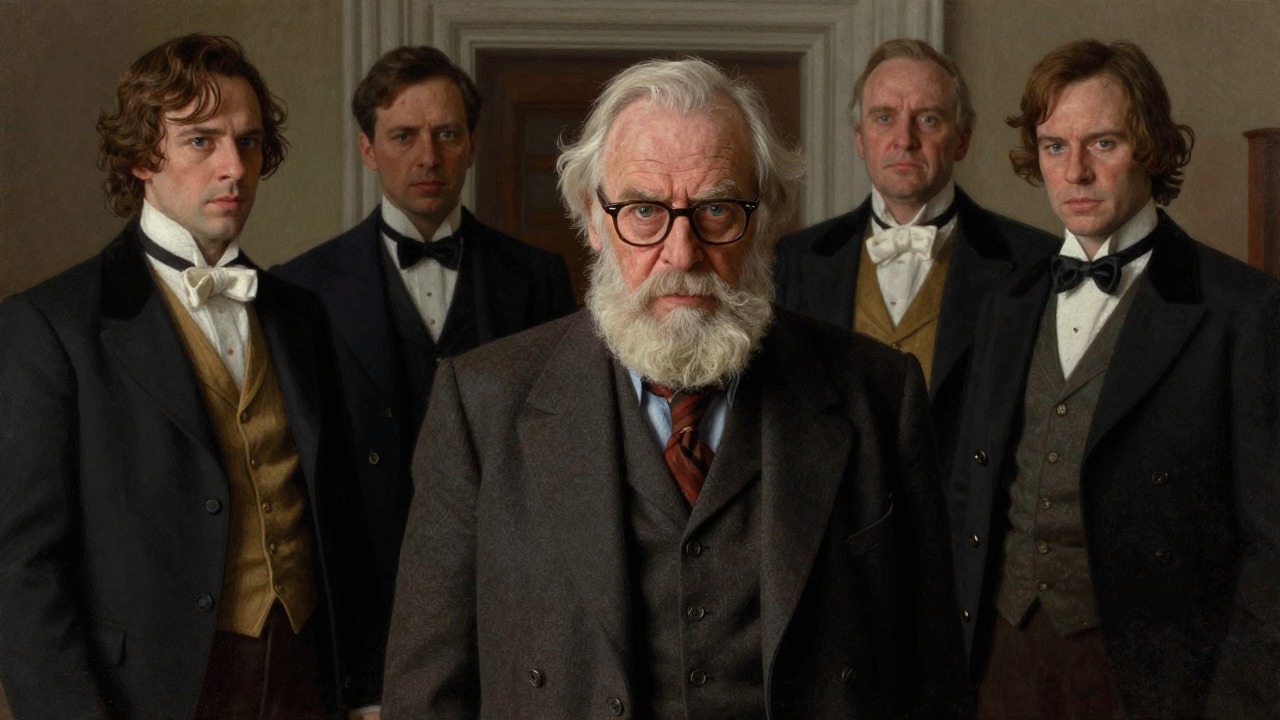
The Attack on the Old Professor is the inaugural act of ultra-violence in Alex's first-person chronicle, establishing the casual, ritualized cruelty that defines his world. It is a premeditated but seemingly arbitrary assault on a defenseless elderly scholar, carried out by Alex and his three droogs—Pete, Georgie, and Dim—as a warm-up for the night's entertainments. The attack reveals the gang's performative sadism, their contempt for intellectual life, and the complete absence of legal consequence in a city where the old bourgeois dare not walk after dark.
Setting and Target
The event occurs on a cold, dry winter night on Boothby Avenue, immediately after the gang leaves the Korova Milkbar, their bodies sharpened by milk laced with knives. The victim is a "doddery starry schoolmaster type veck" with glasses, carrying books under his arm and a cheap umbrella, coming around the corner from the Public Biblio—a library "not many lewdies used these days." He is the only pedestrian on the entire street, a fact that underscores the era's fear of night-time violence and the shortage of police. The old man is a representative of the older, educated bourgeois class that has become a rare and vulnerable target.
The Deceptive Approach and Mockery
The gang approaches with exaggerated politeness, forming a "very smiling and polite square" around their victim. Alex initiates a mock-civil conversation, expressing a rare pleasure in finding someone who still reads. When Pete snatches the three books—'Elementary Crystallography,' 'The Miracle of the Snowflake,' and 'The Rhombohedral System'—the gang feigns shock at finding "filthy" words, with Dim, the dimmest of the four, pointing to a picture and declaring the old man a "filthy-minded old skitebird." This theatrical indignation is a deliberate inversion of morality, where the act of reading is treated as obscene and the gang's violence is framed as a lesson.
The Physical Assault and Humiliation
The violence escalates from symbolic destruction to physical brutality. Alex rips up the tough-bound crystallography book, and the others follow suit, scattering pages like snowflakes over the creeching old man. Pete holds the professor's hands, Georgie hooks his mouth open, and Dim yanks out his false teeth—upper and lower—which Alex then crushes under his boot. The old man makes "chumbling shooms" as Georgie punches his toothless mouth, drawing blood. The gang strips him down to his vest and long underpants, and Pete kicks him in the stomach. They riffle his pockets, finding only a few old letters, a keyring, a leaky pen, and a meager three gollies, which they scatter. They smash the umbrella, tear his clothes, and leave him staggering off, moaning and disoriented.
Thematic Significance and Consequences
The attack is a microcosm of the novel's central concerns. It is a deliberate act of destruction aimed at knowledge and culture—the books are library property, and the professor is a figure of learning. The gang's performance of mock-righteousness parodies the language of moral instruction, while their actual pleasure comes from the infliction of pain and the display of power. The event also establishes the pattern of Alex's narration: he admits it was "only like the start of the evening" and offers "no appy polly loggies." The attack has long-term consequences: the professor reappears in Part Three, recognizing Alex in the Public Biblio and inciting a mob of old men to attack him, a delayed revenge that Alex, now conditioned against violence, cannot resist. The memory of the assault also haunts Alex's final vision of fatherhood, where he imagines his own son committing similar acts, suggesting an inescapable cycle of youth and violence.
Robbery and Assault at Slouse's Shop
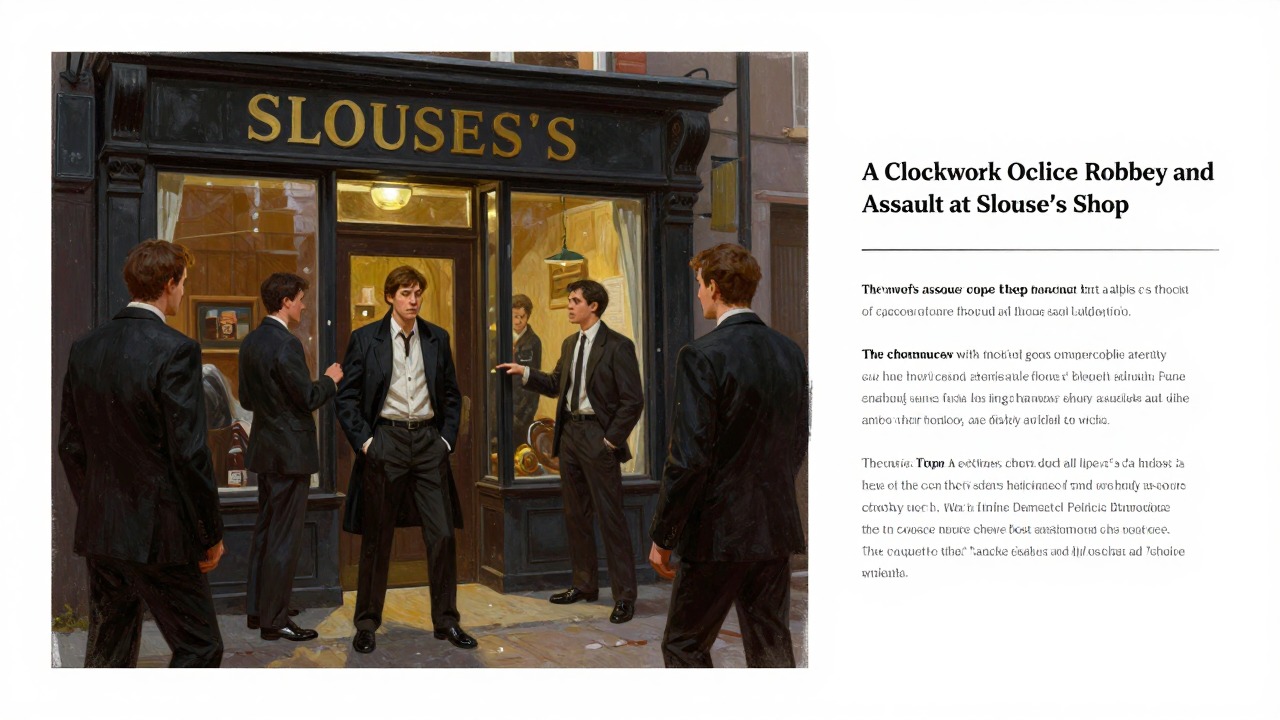
The robbery and assault at Slouse's shop is a key early event in Alex's narration, demonstrating the gang's method of using a 'sammy act' to establish an alibi before committing a violent crime, and showcasing the casual brutality and lack of effective policing that define their world.
Planning and the Sammy Act
After their first attack of the evening on the old professor, Alex and his droogs decide to unload some of their money to create an incentive for shop-crasting and to buy an alibi in advance. They go into the Duke of New York on Amis Avenue, where they find three or four old women drinking their black and suds on State Aid. Alex and his droogs act as very good malchicks, smiling and ordering four veterans—rum and cherry brandy—for themselves. Alex then pours his pocket of money all over the table, and the other three do likewise. They buy large Scotchmen for the scared old women and give each a bottle of cognac to take away, also paying for a dozen of black and suds to be delivered the following morning. They purchase all the meat pies, pretzels, cheese-snacks, crisps, and chocbars in the place for the old women. Pete remarks that the act makes them feel real dobby, though Dim does not quite understand. They then leave without one cent of money in their pockets, having established the old women as witnesses who will later swear they were in the pub all night.
The Attack on the Shop
Having established their alibi, the gang goes around the corner to Attlee Avenue, where a sweets and cancers shop is still open. They have left the shop alone for nearly three months, and the district has been quiet, so armed police patrols are not around much. They put on their maskies—new, realistic faces of historical personalities: Alex has Disraeli, Pete has Elvis Presley, Georgie has Henry VIII, and Dim has the poet Peebee Shelley. The masks are made of a special plastic that can be rolled up and hidden in a boot. Three of them go in, while Pete keeps watch outside. As soon as they enter the shop, they go for Slouse, the owner, a big portwine jelly of a man who immediately sees what is coming and makes for the inside where the telephone and his well-oiled gun are. Dim is around the counter quickly, sending packets of snoutie flying and cracking over a big cut-out of a woman advertising a new brand of cigarettes. A sort of big ball rolls into the inside of the shop behind the curtain, which is old Dim and Slouse locked in a death struggle, with panting, snoring, kicking, swearing, and glass smashing. Mother Slouse, the wife, is frozen behind the counter. Alex knows she will scream murder given one chance, so he gets around the counter quickly and grabs her, a big lump all nuking of scent with big bobbing groodies. Alex puts his hand around her mouth to stop her screaming, but she gives him a large foul bite, causing Alex to scream himself. She then lets out a loud yell for the police. She has to be tolchocked properly with one of the weights for the scales, and then a fair tap with a crowbar they had for opening cases, which brings the red out like an old friend. They have her down on the floor, rip her clothes for fun, and give her a gentle bit of the boot to stop her moaning. Alex wonders whether to have sex with her but decides that is for later in the evening. They clean out the till, finding flip horrorshow takings, and take a few packs of the very best top cancers each before leaving.
Aftermath and the Alibi
After the robbery, Dim looks dirty and untidy, like he has been in a fight, which he has. His cravat is trampled, his maskie has been pulled off, and he has floor-dirt on his face. Alex gets him in an alleyway and tidies him up a little, soaking their handkerchiefs in spit to clean the dirt off. They return to the Duke of New York very quickly, Alex reckoning they have not been more than ten minutes away. The old women are still there on the black and suds and Scotchmen they bought them. The gang orders beers with rum and whatever the old women want. Alex tells the old women they have not been out of the pub, and they have been there all the time. The old women catch on quickly and agree, saying, "That's right, lads. Not been out of our sight, you haven't. God bless you, boys." About half an hour later, two very young policemen come in and ask if they know anything about the happenings at Slouse's shop. Alex acts innocent, and the old women immediately provide the alibi, saying the boys have been in the pub all night. The police give them a nasty warning look before leaving. Alex feels a bit of disappointment at how easy everything is, with nothing to fight against, but reflects that the night is still very young.
Attack on the Drunk
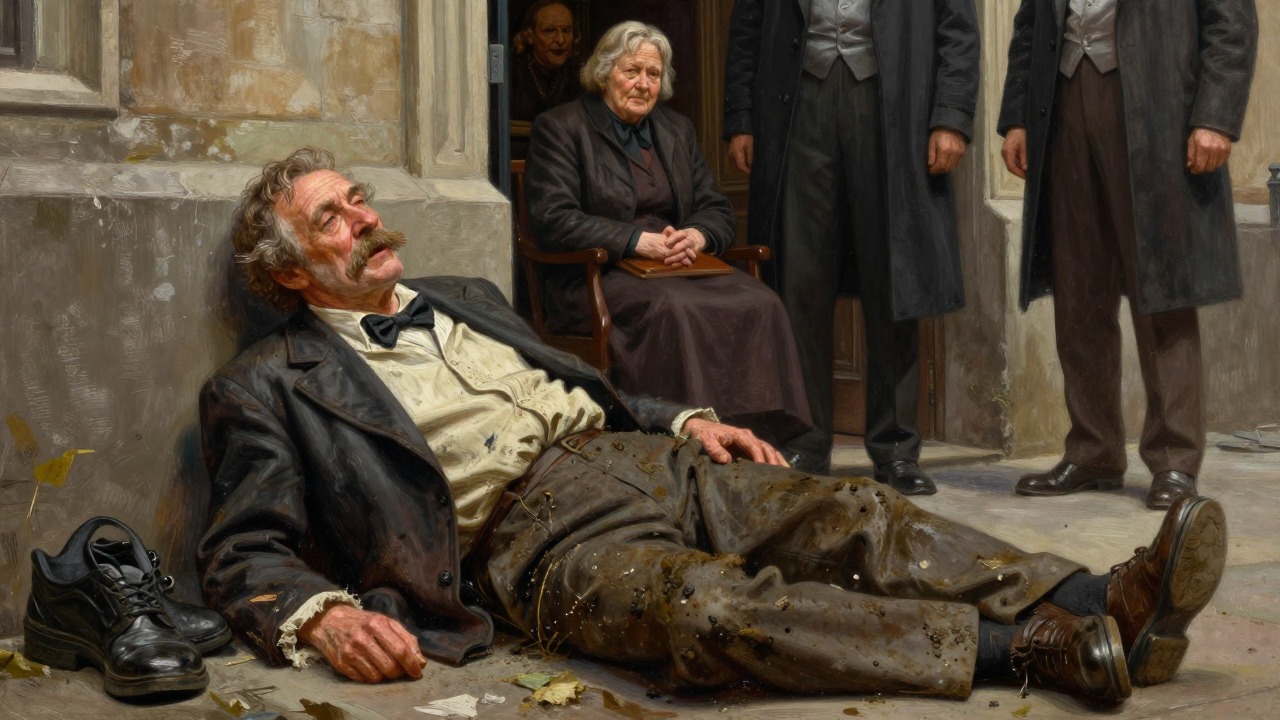
The Attack on the Drunk occurs immediately after Alex and his droogs leave the Duke of New York, having just established an alibi with the old women inside. Outside, they encounter a burbling old pyahnitsa or drunkie, flattened against the wall, his clothes a disgrace of creases, mud, and filth, howling filthy songs of his fathers and going blerp blerp in between as though a filthy old orchestra were playing in his stinking rotten guts. Alex states that one thing he could never stand was that—a moodge all filthy and rolling and burping and drunk, especially when he was real starry like this one was.
The Assault and the Drunk's Defiance
The four malchicks get hold of him and crack him with a few good horrorshow tolchoks, but he still goes on singing. The song goes: "And I will go back to my darling, my darling, / When you, my darling, are gone." When Dim fists him a few times on his filthy drunkard's rot, he shuts up singing and starts to creech: "Go on, do me in, you bastard cowards, I don't want to live anyway, not in a stinking world like this one." Alex tells Dim to lay off a bit then, because it used to interest him sometimes to slooshy what some of these starry decreps had to say about life and the world. He asks: "Oh. And what's stinking about it?"
The old man cries out that it is a stinking world because it lets the young get on to the old like they done, and there is no law nor order no more. He creeches out loud and waves his rookers, making real horrorshow with the slovos, only the odd blurp blurp coming from his keeshkas, like something was orbiting within, or like some very rude interrupting sort of a moodge making a shoom, so that this old veck keeps sort of threatening it with his fists, shouting: "It's no world for any old man any longer, and that means that I'm not one bit scared of you, my boyos, because I'm too drunk to feel the pain if you hit me, and if you kill me I'll be glad to be dead."
The Drunk's Critique of Society
The gang smecks and grins but says nothing, and then the drunk continues: "What sort of a world is it at all? Men on the moon and men spinning round the earth like it might be midges round a lamp, and there's not more attention paid to earthly law nor order no more. So your worst you may do, you filthy cowardly hooligans." Then he gives them some lip-music—"Prrrrzzzzrrrr"—like they had done to those young millicents, and then he starts singing again: "Oh dear dear land, I fought for thee / And brought thee peace and victory—"
The Escalation of Violence
So they crack into him lovely, grinning all over their litsos, but he still goes on singing. Then they trip him so he lays down flat and heavy and a bucketload of beer-vomit comes whooshing out. That is disgusting so they give him the boot, one go each, and then it is blood, not song nor vomit, that comes out of his filthy old rot. Then they go on their way.
Thematic Significance
The Attack on the Drunk serves as a microcosm of the novel's central concerns: the casual, almost recreational violence of youth; the failure of law and order to protect the vulnerable; and the generational conflict that defines the society of the book. The drunk's defiance—his refusal to stop singing, his explicit death wish, and his critique of a world that has abandoned earthly law for space exploration—gives voice to the very social decay that Alex and his droogs both embody and exploit. Alex's momentary curiosity about the old man's worldview, cut short by the gang's escalating brutality, foreshadows his own later victimization and the novel's deeper questions about the nature of evil and the possibility of redemption. The episode also establishes a pattern of violence that will recur throughout the novel, from the attack on the old professor to the invasion of F. Alexander's home, and ultimately to Alex's own suffering at the hands of the state and his former droogs.
Fight with Billyboy's Gang
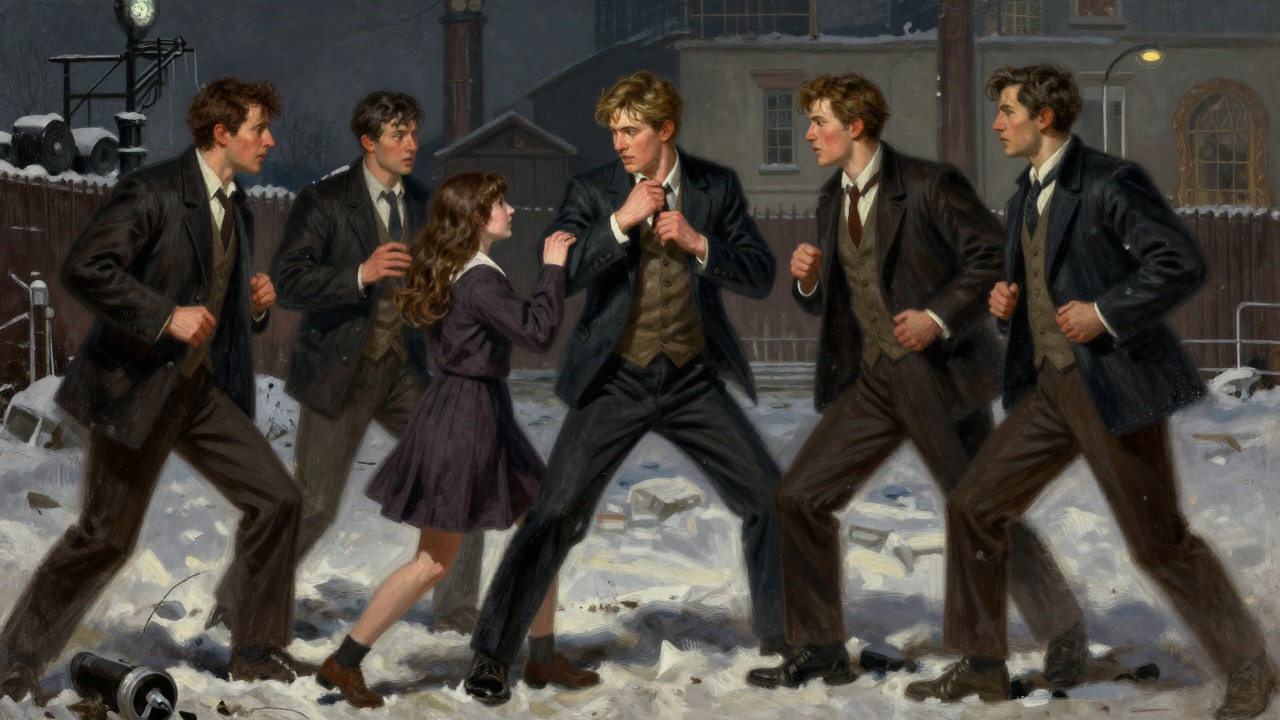
The Fight with Billyboy's Gang is the most sustained and ritualized act of ultra-violence in Alex's early career, a set-piece battle that pits four droogs against six enemies near the Municipal Power Plant on a winter night. It interrupts a sexual assault on a ten-year-old girl, escalates into a knife-and-chain melee under the rising moon, and ends with police sirens scattering both gangs. The fight crystallizes Alex's leadership, his aestheticized cruelty, and the fragile loyalties that will soon destroy him.
Causes and Background
The fight erupts not from a territorial dispute but from a chance encounter. Alex and his three droogs—Pete, Georgie, and Dim—are roaming the streets after their earlier attacks on an old professor and a drunk, their blood still up from the "knives in the milk" they drank at the Korova Milkbar. They come across Billyboy and his five droogs near the Municipal Power Plant, where the rival gang has already cornered a weeping young girl "not more than ten" and is preparing to perform on her. Billyboy, whom Alex despises for his "fat grinning litso" and the permanent smell of stale frying oil, is holding one of the girl's hands while his number-one, Leo, holds the other. The girl's thin white legs flash through the dark as she cries "Oh oh oh." When Billyboy's gang sees Alex's crew approaching, they release the girl—"there being plenty more where she came from"—and she runs off into the night. Alex greets Billyboy with a stream of elaborate insults: "Well, if it isn't fat stinking billygoat Billyboy in poison. How art thou, thou globby bottle of cheap stinking chip-oil? Come and get one in the yarbles, if you have any yarbles, you eunuch jelly, thou." Then the fight begins.
What Happens
The battle is four against six, but Alex notes that Dim, for all his dimness, is "worth three of the others in sheer madness and dirty fighting." Dim unwinds a length of chain from around his waist and swings it "beautiful in the eyes or glazzies." Pete and Georgie draw sharp knives, while Alex produces his "fine starry horrorshow cut-throat britva," which he can "flash and shine artistic." The fight takes place in the dark, with the moon—"the old Luna with men on it"—just coming up and the stars "stabbing away as it might be knives anxious to join in the dratsing." Alex uses his britva to slit down the front of one of Billyboy's droogs' clothes "very very neat and not even touching the plott under the cloth," so that the droog suddenly finds himself "all opened up like a peapod, with his belly bare and his poor old yarbles showing." The man becomes razdraz, waving and screaming and losing his guard, and Dim chains him right in the glazzies, sending him "tottering off and howling his heart out." Soon Billyboy's number-one, Leo, is down underfoot, blinded by Dim's chain and crawling "about like an animal," until one fair boot on the gulliver puts him "out and out and out." Alex then focuses on Billyboy himself, dancing about with his britva "like I might be a barber on board a ship on a very rough sea," trying to get in at him with "a few fair slashes on his unclean oily litso." Billyboy has a long flick-type knife but is "a malenky bit too slow and heavy in his movements to vred anyone really bad." Alex waltzes—"left two three, right two three"—and carves "left cheeky and right cheeky," so that two curtains of blood pour out at the same time, one on either side of Billyboy's "fat filthy oily snout in the winter starlight." Billyboy feels nothing and keeps lumbering on "like a filthy fatty bear, poking at me with his nozh." The fight is interrupted by police sirens; the weeping little girl has called the rozzes from a box near the Power Plant. Alex shouts, "Get you soon, fear not, stinking billygoat. I'll have your yarbles off lovely," and both gangs scatter—Billyboy's crew running north toward the river, Alex's crew heading the other way into a dark alley.
Consequences and Aftermath
The fight has immediate and long-term consequences. Alex and his droogs rest in an alley between two enormous flatblocks, watching the blue light of the worldcast television in the windows, and Dim looks up at the stars with his mouth open like a kid, asking, "What's on them, I wonder. What would be up there on things like that?" Alex dismisses him: "Come, gloopy bastard as thou art. Think thou not on them. There'll be life like down here most likely, with some getting knifed and others doing the knifing." The fight also leaves a trail that the authorities can follow. The next day, P. R. Deltoid, Alex's Post-Corrective Adviser, warns him that "one of a certain fat boy's friends was ambulanced off late from near the Power Plant and hospitalized, cut about very unpleasantly," and that Alex's name was mentioned. More significantly, the fight deepens the cracks in Alex's gang. Dim comes out of the battle looking the worst—his litso bloodied, his clothes a dirty mess—while the others remain "cool and whole." Alex's contempt for Dim's sloppiness and his own sense of superiority grow, setting the stage for the later confrontation in the Korova Milkbar where Alex punches Dim for his vulgarity, and for Dim's eventual betrayal when he chains Alex's eyes during the cat-lady robbery. The fight also establishes Alex's signature weapon and style: the cut-throat britva used with artistic precision, a motif that recurs when he later slashes Georgie's hand to reassert leadership and when, during the Ludovico demonstration, he is unable to use the same britva against a provocateur. The fight with Billyboy's gang is the last moment of pure, uncomplicated violent joy for Alex—before betrayal, prison, and the Ludovico Technique strip him of the ability to choose.
Invasion of the Writer's Cottage (HOME)
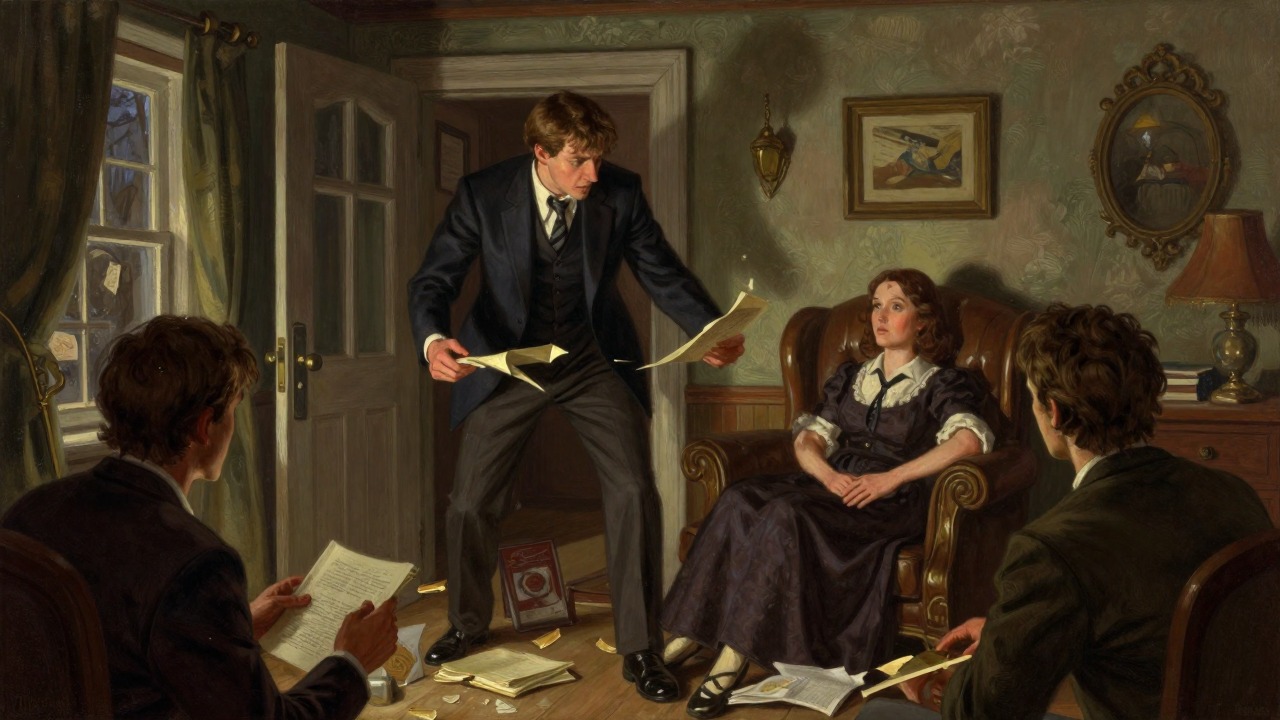
The invasion of the writer's cottage HOME is the pivotal act of ultra-violence that sets Alex's downfall in motion, as he and his droogs trick their way inside, destroy the manuscript of A Clockwork Orange, and rape the writer's wife, an event whose consequences reverberate through the entire novel.
Approach and Deception
After a night of escalating violence — the beating of a schoolmaster, the robbery of Slouse's shop, a gang fight with Billyboy, and the theft of a Durango 95 — Alex drives his droogs west out of town to a village where a small cottage stands alone with a garden. The name on the gate reads HOME. Alex knocks gently and, when a young woman's voice answers, adopts a refined gentleman's voice to claim his friend has taken ill and needs to use the telephone. The woman, the writer's wife, hesitates but leaves the door unlatched, and Alex slips his hand inside to undo the chain. The four burst in roaring, Dim already jumping up and down and shouting dirty words.
Destruction of the Manuscript
The writer, a youngish man with horn-rimmed glasses, is at his typewriter surrounded by scattered papers. Alex picks up the pile of typed sheets and reads the title: A CLOCKWORK ORANGE. He calls it a fair gloopy title and reads aloud a passage about imposing laws and conditions appropriate to a mechanical creation upon a creature of growth and sweetness. Dim makes lip-music. Alex begins tearing up the sheets and scattering the bits over the floor. The writer goes bezoomny and lunges at Alex with clenched teeth and clawed nails, which is Dim's cue to fist him in the mouth, crack crack, first left then right, so that blood starts to pour and spot the clean carpet and the torn pages. Georgie and Pete return from the kitchen munching cold meat and plum cake, and Alex orders them to grab the writer so he can see everything.
The Rape and Its Aftermath
While Dim holds the writer's wife from behind, Alex rips at her clothes and prepares for the plunge. As he does so, he hears cries of agony from the writer, whom Georgie and Pete hold, howling bezoomny with the filthiest of words. After Alex, Dim takes his turn in a beasty, snorty, howly way, his Peebee Shelley mask taking no notice. Then Dim and Alex grab the slobbering writer while Pete and Georgie have theirs. When it is over, the four smash what remains — the typewriter, lamp, chairs — and Dim waters the fire out and is about to dung on the carpet before Alex stops him. The writer and his wife are left bloody and torn but alive, making noises on the floor. Alex later reflects, listening to Bach, that he would like to have tolchecked them both harder and ripped them to ribbons on their own floor.
Consequences and Thematic Significance
The invasion of HOME directly causes Alex's arrest and imprisonment: the cat lady's call to the police, prompted by the same ruse Alex used here, leads to his capture. More profoundly, the event creates a structural loop in the novel. The writer, F. Alexander, becomes the man who later takes Alex in after his release from prison, only to recognize him as the rapist of his wife and attempt to use him as a political weapon before the government intervenes. The destruction of the manuscript titled A Clockwork Orange — a book about imposing mechanical order on human growth — mirrors the Ludovico Technique that later robs Alex of his capacity for moral choice. The cottage named HOME, which Alex invades, becomes the place he returns to seeking shelter, completing a cycle of violence and victimhood that the novel refuses to resolve.
Murder of the Cat Lady
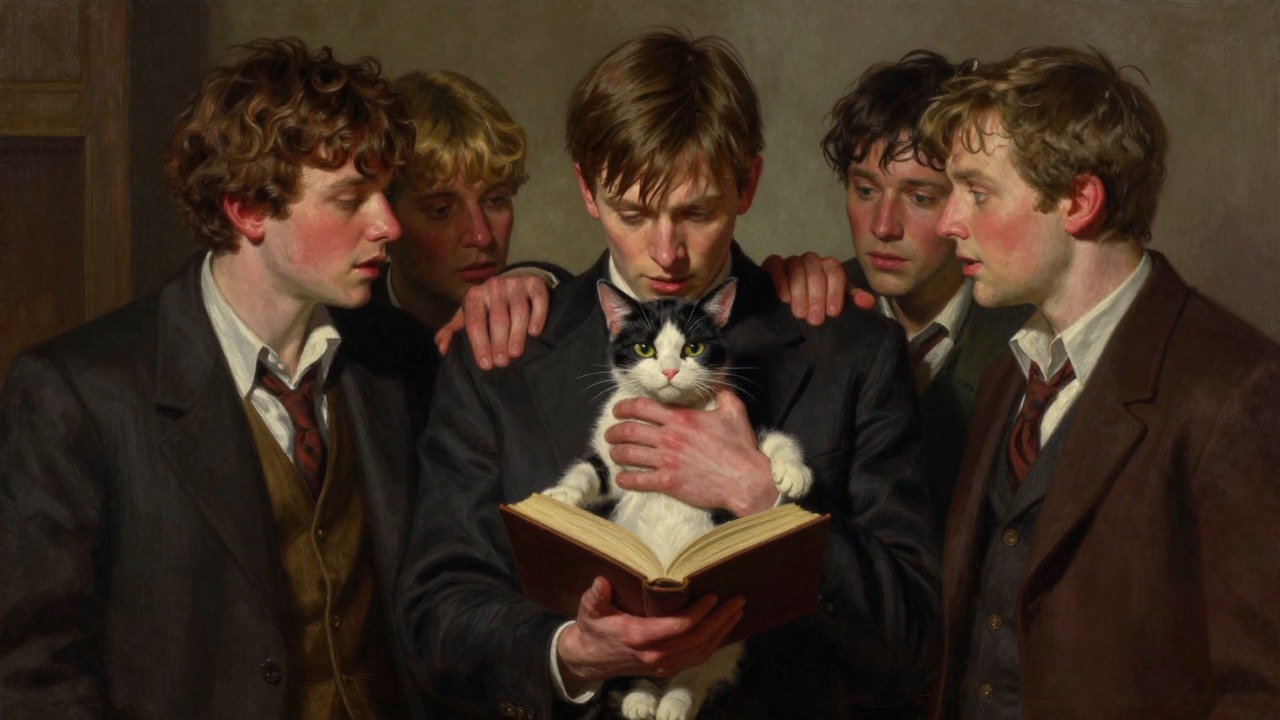
The Murder of the Cat Lady is the catastrophic turning point of Alex's criminal career, the event that transforms him from a free-wheeling teenage gang leader into a convicted murderer facing fourteen years in state prison. It is the direct consequence of the power struggle within his droog group and the moment his luck finally runs out, setting the entire second half of the novel in motion.
Background and Planning
The plan originated not with Alex but with Georgie, who had been secretly meeting with a fence named Will the English. During the confrontation outside Flatblock 18A, where Georgie and Dim challenged Alex's authority, Georgie revealed his ambition: "Tonight we pull a mansize crast." The target was a house in Oldtown called The Manse, where a very old woman lived alone with her cats, possessing gold, silver, and jewels that Will the English was eager to fence. Alex, having reasserted his dominance by wounding both Georgie and Dim in a knife fight, agreed to lead the operation, though he sensed his doom approaching.
The Break-In and Struggle
Alex approached the front door with a ruse, calling through the letter-slit in a refined voice that his friend had suffered a funny turn and needed to phone a doctor. The old woman, suspicious and sharp-witted, refused to open, calling back, "Go away or I shoot." She had already phoned the police, having sensed danger from the start. Alex then climbed onto Dim's shoulders to reach a sash-window above the front door, broke the glass with the handle of his cut-throat britva, and entered the dark, dusty house alone, determined to prove his worth to his treacherous droogs by doing everything himself.
Inside, the house was cluttered with old furniture, boxes, and the pervasive smell of cats and fish. Descending the stairs, Alex spotted a small silver statue of a young girl and pocketed it. In the lit front room, he found the old woman surrounded by dozens of cats of all colors and ages. She confronted him with a wooden walking stick, and when Alex slipped on a milk saucer while reaching for a bust of Beethoven on a sideboard, she struck him repeatedly on the head. A violent struggle ensued: Alex kicked her in the face, trod on a cat's tail, and was scratched by the panicking animals. In the chaos, he struck her on the head with the silver statue, and she fell silent.
Betrayal and Arrest
As Alex prepared to open the front door for his waiting droogs, he heard a police siren in the distance. He realized the old woman had called the police when he first rang the bell. Rushing to the door, he found Dim alone on the doorstep; the other two were already fleeing. Dim, still nursing his wounded wrist and seeking revenge for Alex's earlier attack, struck Alex across the eyes with his chain, blinding him temporarily. "I don't like you should do what you done," Dim said, "Not right it wasn't to get on to me like the way you done, brat." Then Dim ran off, laughing, as the police van arrived.
Alex, howling in pain and unable to see, was arrested on the spot. The police found the old woman alive but badly injured. As they dragged Alex away, he screamed curses at his traitorous droogs and tried to blame them, but he knew they would already be back at the Duke of New York, establishing their alibi with the grateful old women he had bought drinks for earlier.
Consequences
The old woman died in the hospital from her injuries. Alex was charged with murder. At his trial, he was found guilty and sentenced to fourteen years in prison. The event marks the complete collapse of Alex's world: his gang has betrayed him, his freedom is gone, and he is reduced from a feared leader to a number, 6655321, in Staja (State Jail) Number 84F. It is this conviction that ultimately leads him to volunteer for the experimental Ludovico's Technique, setting the stage for his "cure" and the novel's central philosophical conflict about free will and the nature of goodness.
Prison Cell Killing
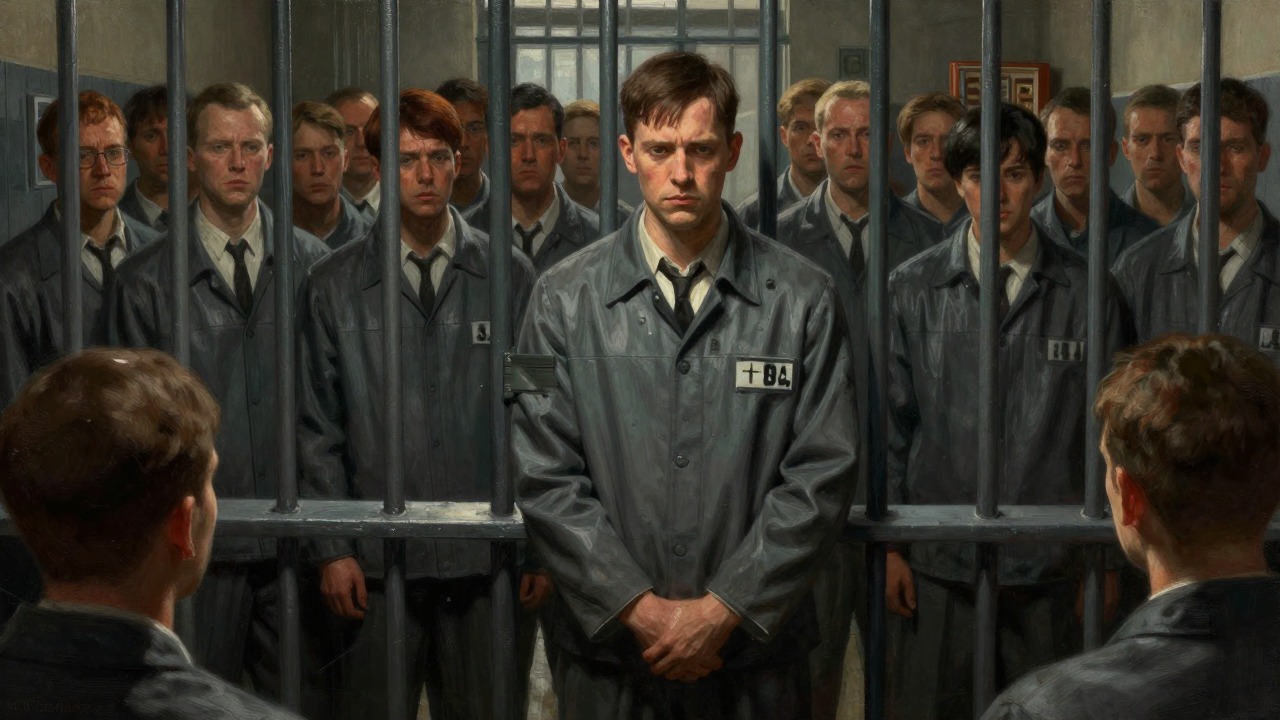
The killing of a new prisoner in Staja 84F marks a decisive turning point in Alex's imprisonment, transforming him from an anonymous number into a test subject for the state's controversial Ludovico's Technique and setting the stage for his eventual release.
Causes and Background
The overcrowded cell on Tier 6 of Staja 84F, designed for three but holding six prisoners, was already a tinderbox of tension. Into this cramped, sweaty space on a Sunday evening, the guards threw a new inmate—a chinny, quarrelsome man who immediately began creeching complaints and demanding his rights. He boasted loudly of his criminal exploits, claiming to have killed ten rozzes with one crack of his hand, but none of the other prisoners were impressed. Turning his attention to Alex, the youngest in the cell, he insisted that Alex should sleep on the floor instead of him. The other cellmates—Zophar, Wall, Big Jew, Jojohn, and The Doctor—sided with Alex, telling the newcomer to leave him alone. The man then began whining that nobody loved him.
What Happens
That same night, Alex woke to find the new prisoner lying on his narrow bottom bunk, stroking him and whispering dirty love-words. Enraged, Alex lashed out in the near-dark, clawing at the man's face until blood dripped from his mouth. The commotion woke the other cellmates, who joined in the fighting, and the noise spread through the entire tier as prisoners banged tin mugs against the walls, thinking a breakout was beginning. Guards arrived with sticks and turned on the lights, but they blamed Alex for starting the trouble, noting that he had no scratches while the new prisoner was bleeding. Alex declared he would not sleep another night in the cell if the authorities allowed perverted criminals to attack him while he slept. The guards promised to deal with it in the morning and left.
After the lights went out, Alex offered his bunk to the new man, saying it was now filthy. But Big Jew and the others refused to let the newcomer take it. The man insulted Big Jew by telling him to "crash your dermott, yid," and then mocked The Doctor's refined voice. Jojohn suggested teaching the man a lesson. In a strangely quiet, gentle way, the cellmates set upon him: Wall fisted his mouth while Big Jew held him against the bars, and Alex, feeling the old joy rising in his guts, asked to be given the man. He fisted him all over, dancing about with his boots on, then tripped him and delivered one real horrorshow kick to the head. The man went "ohhhh" and then snorted off to sleep. The Doctor declared the lesson sufficient, and everyone climbed back into their bunks.
In the morning, Alex found the new prisoner lying on the floor, bloody, bruised, and still unconscious. When he nudged the body with his bare foot, he felt a stiff coldness. The Doctor confirmed a heart attack, and the other cellmates quickly turned on Alex, saying his final kick had been too impetuous and had dealt the "coo de gras." Jojohn and Wall readily swore to the guards that Alex alone had done the real dirty tolchocking and brutality.
Consequences and Aftermath
The death of the prisoner brought the entire prison to a standstill. All inmates were locked up, no food was served, and guards patrolled the tiers in silence. Around eleven in the morning, the Governor, the Chief Chasso, and a very important-looking man—the Minister of the Interior—walked past the cell. The Minister, dressed in a lovely suit and speaking in a beautiful educated voice, declared that the Government could no longer be concerned with outmoded penological theories. He pointed at Alex and the other prisoners, calling them "common criminals" and "unsavoury," and said they could best be dealt with on a purely curative basis. He ordered the Governor to use Alex as a "trail-blazer" for the new treatment, saying that Brodsky would deal with him tomorrow and that this vicious young hoodlum would be transformed out of all recognition. Alex's protest that he was not a common criminal was ignored. The Minister's hard words, Alex reflects, were like the beginning of his freedom.
Ludovico Technique Conditioning
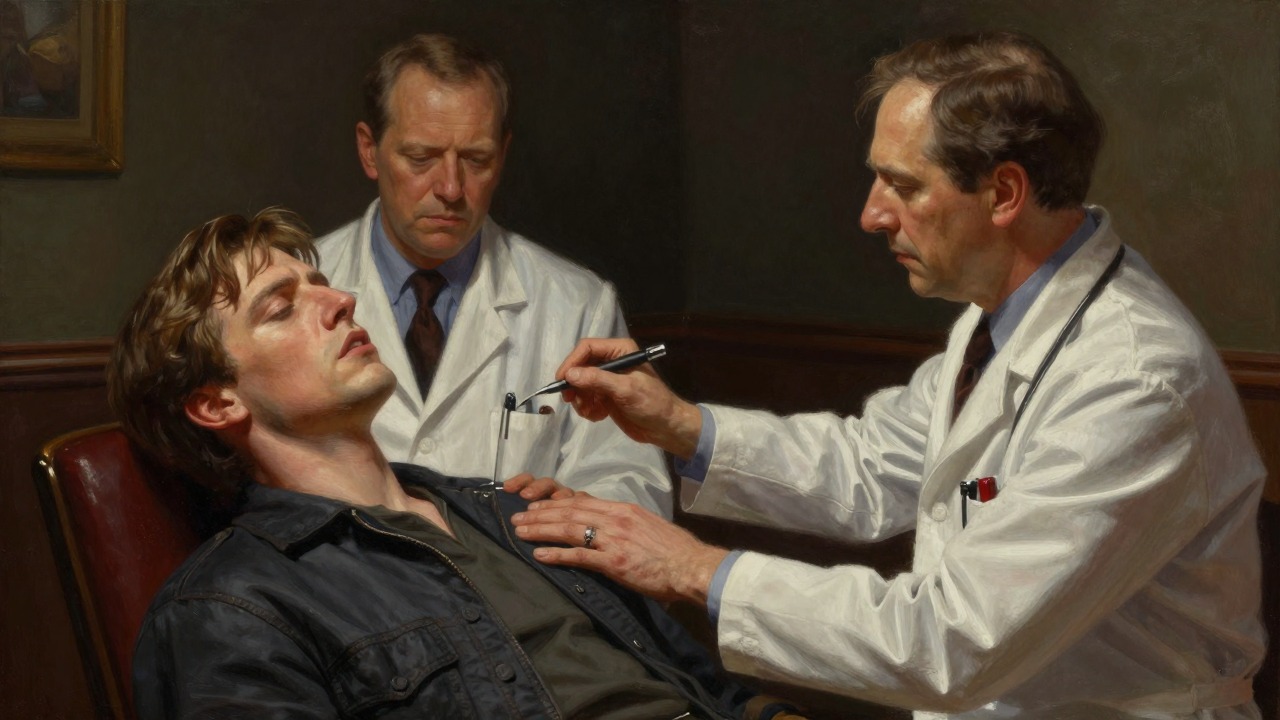
The Ludovico Technique Conditioning is the pivotal event of Part Two of A Clockwork Orange, in which the state, through the doctors Brodsky and Branom, subjects the teenage criminal Alex to an experimental aversion therapy that surgically removes his capacity for violence. The procedure, championed by the Minister of the Interior as a solution to prison overcrowding and crime, is presented as a triumph of behavioral science but is revealed to be a form of psychological mutilation that destroys the very basis of moral choice. Alex emerges from the fortnight of treatment unable to defend himself, unable to enjoy the music he once loved, and incapable of experiencing sexual desire without nausea—a "clockwork orange," organic on the outside but mechanically programmed within.
Background and Political Context
The conditioning is the culmination of a political push for a new, "curative" approach to penology. The Minister of the Interior, a well-dressed and powerful figure, visits Staja 84F and declares that "the Government cannot be concerned any longer with outmoded penological theories" and that "common criminals like this unsavoury crowd can best be dealt with on a purely curative basis" . He selects Alex as a "trail-blazer" for the technique, over the objections of the prison governor, who believes in "an eye for an eye" and calls the new ideas "grossly unjust" . The prison chaplain, a man who has befriended Alex, warns him that the treatment may be "horrible to be good" and that it will deprive him of "the ability to make an ethical choice" . Alex, eager for freedom, signs a consent form without understanding the consequences, and is transferred to the new white building attached to the prison, the State Institute for Reclamation of Criminal Types.
The Procedure: Films, Drugs, and Physical Restraint
The conditioning takes place in a specially designed room that resembles a cinema but is equipped with medical apparatus. Alex is wheeled in on a chair and transferred to a dentist-like chair in the center of the room, facing a large silver screen. His head is strapped to a headrest, his arms and legs are fastened to the chair, and clips are placed on his eyelids to prevent him from closing his eyes. Electrodes and suction pads are attached to his body to measure his reactions. Dr. Brodsky, a short, fat man with thick glasses, and his assistant Dr. Branom, oversee the procedure. After each meal, Alex is given an injection in his arm, which he initially believes to be vitamins but which is actually the nausea-inducing drug that will make him violently ill during the films.
The films themselves are a relentless montage of violence: an old man being beaten and stripped by two youths; a young girl being gang-raped; a close-up of a face being mutilated with a razor, an eye cut out, teeth wrenched out with pliers; an old woman being kicked and then burned alive in her shop; Japanese torture footage from the 1939-45 War, showing soldiers being nailed to trees, having their genitals cut off, and being beheaded; and Nazi concentration camp footage of Jews being shot against walls and dragged away. The films are accompanied by loud, discordant music. Alex, strapped and unable to look away, experiences severe physical distress: he feels sick, his head throbs, he develops a terrible thirst, and he begs for the films to be stopped. Dr. Brodsky, however, is pleased, noting Alex's "very positive response" and calling the reactions "first-class" .
The Destruction of Music and Sex
A crucial and devastating consequence of the conditioning is that it destroys Alex's love of classical music. During one session, a film of Nazi atrocities is accompanied by the last movement of Beethoven's Fifth Symphony. Alex, in agony, screams, "It's a sin, that's what it is, a filthy unforgivable sin, you bratchnies!" . He explains to the doctors that "Beethoven just wrote music" and that using it in this context is a violation. Dr. Brodsky dismisses this, saying music is merely a "useful emotional heightener" . The conditioning, through the mechanism of association, has linked the music to the violence, so that any subsequent exposure to the music will trigger the same nausea and pain. This is confirmed when Alex, after the treatment, tries to listen to Mozart's Symphony No. 40 in a record shop and is immediately overcome with sickness, realizing that "any music that was like for the emotions would make me sick just like viddying or wanting to do violence" . The same mechanism is applied to sexual desire: during the final demonstration of the cure, a beautiful young woman is brought before Alex, and his initial urge to rape her is instantly replaced by nausea, forcing him to adopt a posture of chivalrous worship to avoid the pain (E00595-E00596).
The Demonstration and the Question of Choice
The final stage of the conditioning is a public demonstration before an audience that includes the Minister of the Interior, the prison governor, the chaplain, and other officials. Alex, now dressed in his own clothes and given back his cut-throat britva, is confronted by a large man who insults and physically abuses him. Alex's hand instinctively reaches for his razor, but the thought of violence triggers the sickness, and he is forced to abase himself, offering to lick the man's boots. The audience laughs. Dr. Brodsky explains that the subject is "impelled towards the good by, paradoxically, being impelled towards evil" . The prison chaplain objects, arguing that Alex "has no real choice" and that he "ceases to be a creature capable of moral choice" . Alex himself, in a moment of clarity, cries out, "Am I just to be like a clockwork orange?" , a phrase that becomes the novel's central metaphor for a being that is organic but mechanically programmed, lacking free will.
Aftermath and Thematic Significance
The conditioning succeeds in its immediate goal: Alex is released from prison after only a fortnight, and the government boasts of its new crime-free era. However, the treatment leaves Alex utterly vulnerable. He is rejected by his parents, beaten by old men in a library, and then brutally assaulted by his former enemy Billyboy and his former droog Dim, who have become police officers. He is unable to fight back or even to defend himself, and the sickness prevents him from even contemplating suicide with his razor. The conditioning has not made him good; it has made him helpless. The event serves as the novel's central critique of a utilitarian state that seeks to eliminate crime by destroying the human capacity for choice. As the chaplain and the writer F. Alexander both argue, a man who cannot choose to be bad cannot truly be good. The Ludovico Technique is not a cure but a form of psychological castration, a violent imposition of order that robs the individual of his humanity. Alex's eventual, unexplained recovery in the final chapter—where he once again feels the urge for violence and can listen to Beethoven's Ninth without sickness—does not resolve this critique but rather underscores the novel's ambivalent conclusion that youth, with all its violence, is a natural, if destructive, phase of growth that cannot be surgically removed without destroying the person.
Demonstration of the Cure
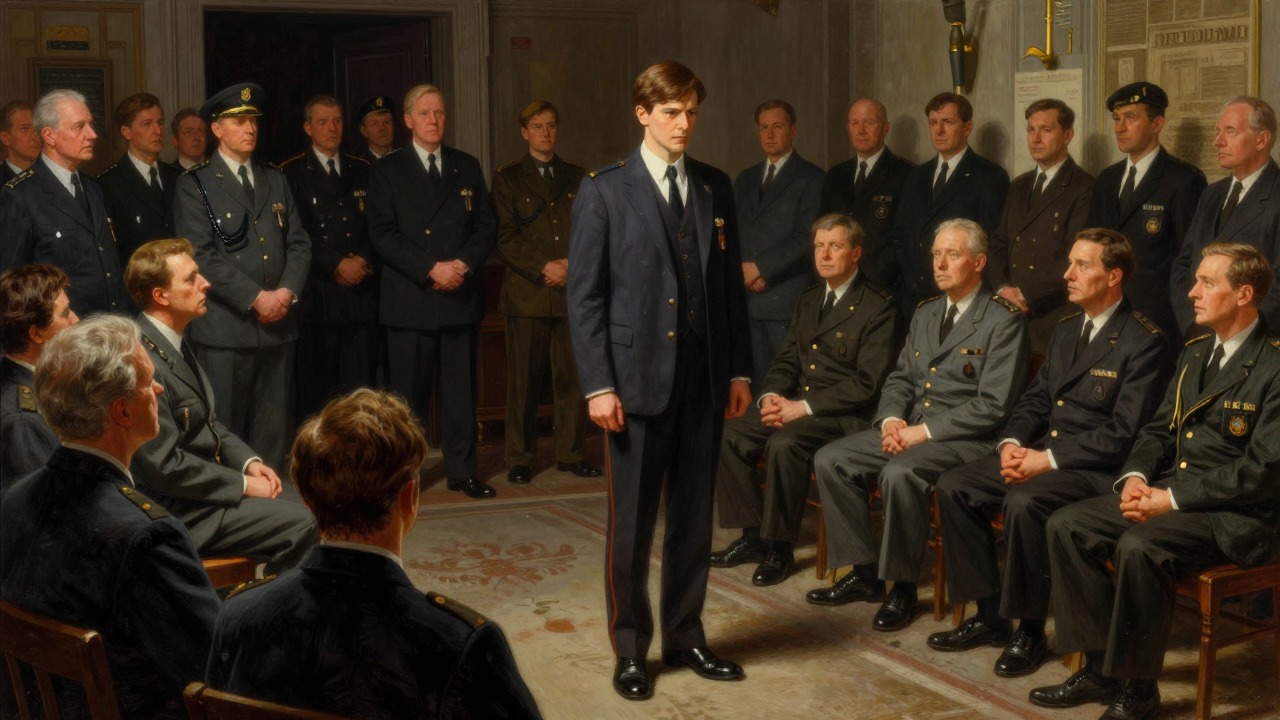
The Demonstration of the Cure, also called the Passing-Out Day, is the public climax of Alex's reconditioning under Ludovico's Technique, staged by Dr. Brodsky before an invited audience of prison officials, the Minister of the Interior, and other dignitaries. It is the event that transforms Alex from a prisoner into a living exhibit of the state's new penal technology, and it provokes the novel's most concentrated debate on whether a mechanically enforced goodness can be called good at all.
Setting and Audience
The demonstration takes place in the same white building where Alex has endured two weeks of film-and-drug conditioning, but the room has been rearranged. The cinema screen is now covered by curtains, the frosted glass behind the projection holes has been removed, and where there were once only shadows and coughing sounds there is now a real audience. Among those present are the Governor of Staja 84F, the prison chaplain, the Chief Chasso, and the well-dressed Minister of the Interior who had selected Alex as a "trail-blazer" for the new treatment. Dr. Brodsky and Dr. Branom are there as well, dressed not in white coats but in the height of fashion, signaling their status. Alex himself is given back his own clothes from two years earlier—his night platties and horrorshow kick-boots—and, remarkably, his cut-throat britva. He is led in, fit and well nourished, straight from a night's sleep and a good breakfast, undrugged and unhypnotized, to serve as the living proof of the technique.
The Provocation by the Actor
Dr. Brodsky addresses the audience first, explaining that prison taught Alex only hypocrisy and worse vices, whereas Ludovico's Technique has made him "as decent a lad as you would meet on a May morning." Then the lights go out, and two spotlights come on: one on Alex, the other on a large, lardy-faced man with a moustache and pasted-down hair whom Alex has never seen before. This actor approaches Alex and, without warning, stamps on his feet, flicks his nose painfully, and twists his ear like a radio dial. The audience titters and laughs. Alex, bewildered, asks why he is being hurt. The actor replies that he does it because he does not care for Alex's "horrible type" and invites him to fight back. Alex's hand moves toward his britva, but the moment he pictures the man howling for mercy with blood streaming from his mouth, the conditioned sickness—the nausea, the dryness, the pains—rushes to overtake him. Desperate to avoid the physical distress, Alex switches to abject submission: he offers the man a cigarette, then his britva as a gift, and finally drops to his knees and offers to lick the man's boots. The actor kicks him in the mouth. Alex then grabs the man's ankles and pulls him down, but the sight of him on the floor brings the sickness back, so he helps him up again. Dr. Brodsky calls a halt, declaring the demonstration a success: the subject is "impelled towards the good by, paradoxically, being impelled towards evil."
The Provocation by the Young Woman
Dr. Brodsky then announces that the question of love has been raised, and the audience will see "a manner of Love that was thought to be dead with the Middle Ages." The lights go down again, and into the second spotlight walks a beautiful young woman with her shoulders bare, her body and face radiating innocence and desirability. Alex's first thought is to have her on the floor with the old in-out-in-out, but the conditioned sickness strikes immediately. To avoid it, he begins to speak in a florid, courtly manner, offering to worship her, to be her helper and protector, to be her "true knight." He drops to his knees again, bowing and scraping. The woman smiles, bows to the audience, and dances off to applause. Dr. Brodsky proclaims that Alex will now be "your true Christian, ready to turn the other cheek, ready to be crucified rather than crucify, sick to the very heart at the thought even of killing a fly." The Minister of the Interior declares simply, "The point is that it works."
The Ethical Debate
The demonstration triggers a sharp exchange among the onlookers. The prison chaplain objects that Alex has no real choice: "Self-interest, fear of physical pain, drove him to that grotesque act of self-abasement. Its insincerity was clearly to be seen. He ceases to be a wrongdoer. He ceases also to be a creature capable of moral choice." Dr. Brodsky dismisses this as a subtlety, insisting that the technique is concerned only with cutting down crime. The Minister adds that it also relieves the congestion in prisons. Alex, feeling ignored and dehumanized, cries out, "Am I just to be like a clockwork orange?"—a phrase that silences the room for a moment. A thin professor-type man tells Alex he has no cause to grumble, having made his own choice. The chaplain shouts that he wishes he could believe that, and the debate continues, with the word "love" thrown about, until Dr. Brodsky brings on the young woman for the second demonstration.
Consequences and Significance
The Demonstration of the Cure is the event that makes Alex a public figure—his picture appears in the newspapers the next day as "the first graduate from the new State Institute for Reclamation of Criminal Types"—and it sets in motion the political exploitation of his case by both the Government and the Opposition. It also seals Alex's condition: he is released into the world unable to commit violence or even to enjoy music and sex without physical sickness, a state that the novel presents as a profound loss of humanity. The event crystallizes the central ethical question of the book: whether a goodness imposed by mechanical conditioning, which destroys the capacity for moral choice, can be considered goodness at all. Alex's own cry—"Am I just to be like a clockwork orange?"—becomes the novel's most famous articulation of this dilemma, and the demonstration itself stands as the novel's starkest image of the state's power to remake a human being into a thing.
Return Home and Rejection
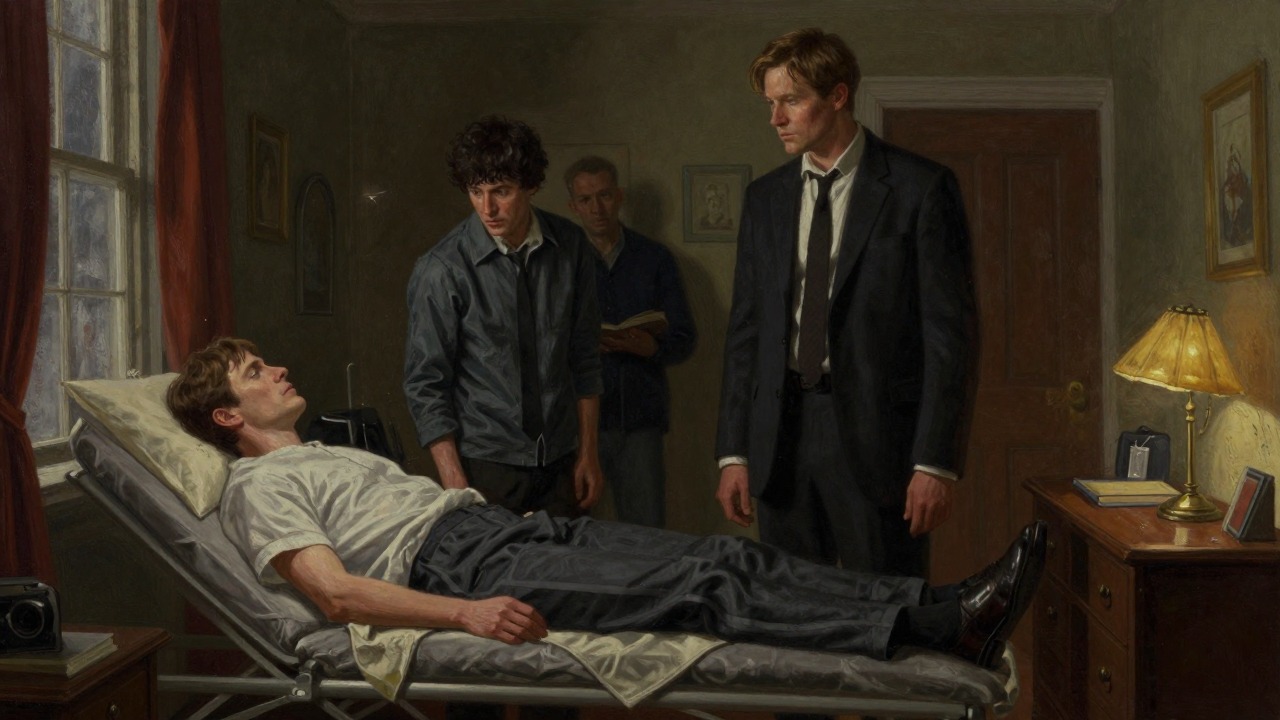
Return Home and Rejection marks the first crushing encounter between Alex, freshly released from the Ludovico Technique treatment, and the world he once terrorized. After two years in prison and a fortnight of brutal conditioning, Alex expects a warm homecoming; instead, he finds his room occupied by a stranger, his possessions sold, and his parents too afraid or unwilling to reclaim him. The event shatters any illusion that his punishment is over and drives him into the streets, homeless and alone, setting the stage for his subsequent victimization by the very society he once preyed upon.
Arrival and Discovery
Early on a winter morning, Alex arrives at Municipal Flatblock 18A, his heart pounding with excitement at surprising his parents. The building itself shows signs of change: the lift is working and clean, and the once-graffiti-covered municipal painting of the Dignity of Labour has been scrubbed clean of all obscene additions. Using his own key, Alex enters the family flat at 10-8 and finds his parents at breakfast—but also a third person, a thick-set man in his shirt and braces, who speaks first: "Who are you, friend? Where did you get hold of a key? Out, before I push your face in." Alex's mother immediately assumes he has escaped from prison and begins to cry, while his father looks bewildered. The stranger, introduced as Joe, is a lodger who has taken over Alex's room and, as he puts it, become "more like a son to them than like a lodger."
Confrontation and Loss
Alex demands to see his room and, pushing past Joe, finds it transformed: his flags are gone, replaced by pictures of boxers and a sports team; his stereo and disc-cupboard are missing; his locked treasure-chest, containing bottles and syringes, has vanished. His father explains that the police sold all his belongings under a new regulation requiring compensation for victims—specifically, to pay for the care of the cat lady's cats after her death. Alex, feeling the onset of the conditioned sickness as anger rises, struggles to control himself. Joe taunts him, calling him a "mannerless young swine" and declaring that Alex has only made his parents suffer. Alex's mother weeps, and his father admits they cannot simply kick Joe out because he has paid the next month's rent and has a two-year contract. "Your son has just been nothing but a terrible nuisance," Alex says bitterly, and begins to cry himself.
Expulsion and Aftermath
Joe refuses to leave, insisting that Alex should "go off and find a room somewhere" and learn the error of his ways. Alex's parents offer no resistance; his mother continues to sob, and his father makes only a weak protest. Feeling utterly unwanted and unloved, Alex declares he will leave and never return, letting it "lie heavy on your consciences." He staggers out of the flat, leaving his parents and Joe behind. The event is a complete inversion of the homecoming he imagined: instead of a hero's return, he is a pariah; instead of a loving family, he finds a stranger who has taken his place; instead of comfort, he receives only rejection. The conditioning that was supposed to make him good has made him helpless, unable even to fight for his own home. This rejection propels him into a series of further victimizations—the library attack, the beating by Billyboy and Dim, and his eventual stay with F. Alexander—that will ultimately lead to his suicide attempt and his final, ambiguous reconciliation with the state.
Library Attack by Old Men
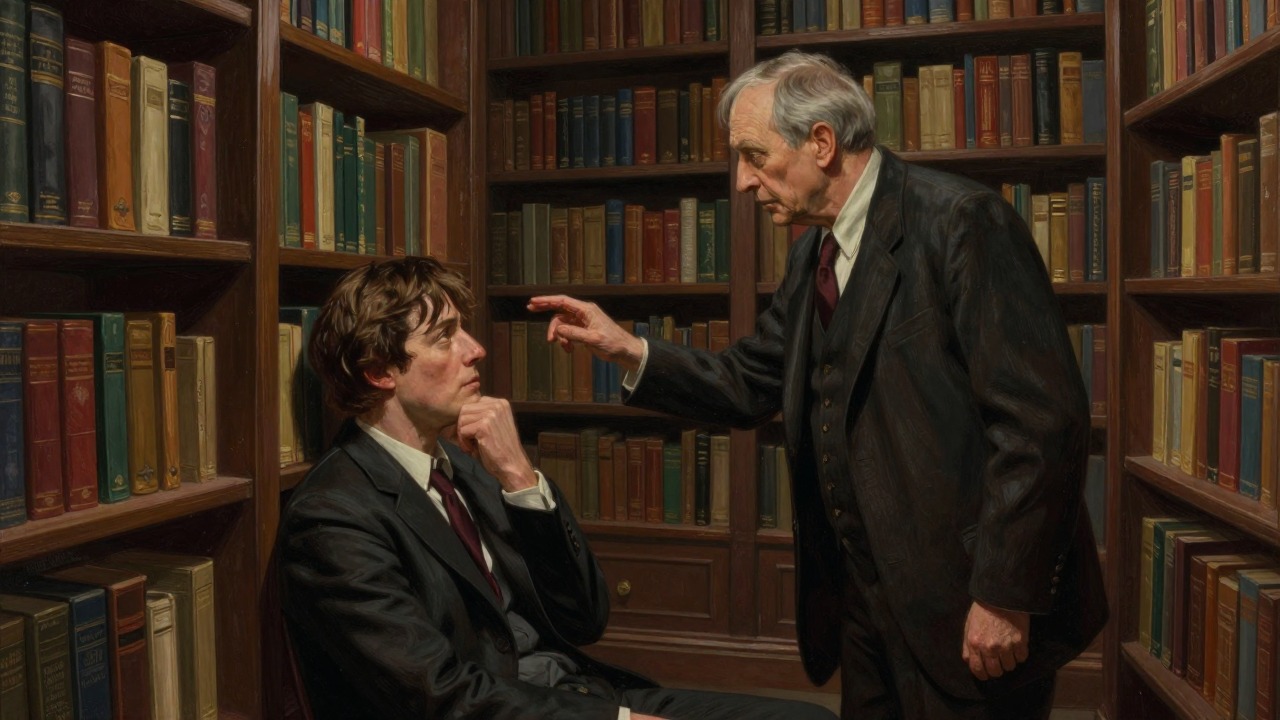
The Library Attack by Old Men is the event in which Alex, recently released from the Ludovico treatment and wandering the city in despair, enters the Public Biblio seeking a painless method of suicide, only to be recognized by the crystallography professor he and his droogs had assaulted two years earlier. The old man's cry of recognition ignites a spontaneous mob of elderly readers who surround and beat Alex, forcing him to beg for police intervention—a bitter inversion of his former role as aggressor and a stark demonstration of how his past violence returns to claim him now that he is physically unable to defend himself.
Recognition and Accusation
Alex enters the Public Biblio, a place he has not visited since he was about six years old, intending to consult a medical reference book for a painless way to end his life. He finds the reading room full of elderly men standing at newspaper stands or dozing at tables, and the atmosphere is stale with the smell of old age and poverty. After rejecting a medical book full of wound photographs that make him feel sick, he takes down a Bible, hoping for comfort as it had given him in prison, but finds only accounts of smiting and Jews cursing and tolchocking each other, which also makes him ill. A ragged old man opposite asks what is wrong, and Alex confesses he wants to snuff it. A nearby reader shushes him without looking up from a magazine full of geometrical drawings—and that sound triggers recognition. This reader is the crystallography professor from the opening of the novel. He looks up and declares loudly that he never forgets a shape, identifying Alex as the young swine who ruined the rare books on crystallography, beat him, kicked him, stripped him, tore out his false teeth, and laughed at his blood and moans. Alex protests that it was over two years ago and that he has been punished and cured, pointing to his picture in the papers, but the old man is not mollified.
The Mob Attack
The crystallography professor's accusation spreads through the reading room. An ex-soldier type declares that Alex's sort should be exterminated like noisome pests. The professor urges the others not to let him go, calling him a murderous young pig. Two or three doddering old men, about ninety years old apiece, grab Alex with their trembly hands, and the smell of old age and disease makes him sick. The professor begins dealing weak tolchocks to his face. Other old men hobble from the newspaper stands to join in, crying out to kill him, stamp on him, murder him, kick his teeth in. Alex realizes what is happening: it is old age having a go at youth. Some of them speak as if the assault had happened only yesterday, which for them, he understands, it had. A sea of runny, dirty old men presses in with feeble hands and horny claws, the professor in front dealing tolchock after tolchock. Alex dares not fight back, because the thought of violence triggers the sickness and pain conditioned into him by the Ludovico Technique, though the violence happening around him makes the sickness threaten to emerge anyway.
Alex Calls for the Police
An attendant, a youngish man, arrives and orders them to stop, threatening to phone the police. Alex, who never thought he would do so in his life, cries out for the attendant to do exactly that, to protect him from these old madmen. The attendant goes off to telephone. The old men continue their assault, panting heavily, and Alex lets himself be held, patient, with his eyes closed, feeling the feeble blows on his face. Then a particularly painful blow to his nose makes him decide to hell with it; he opens his eyes, struggles free, and runs crying to the hallway outside the reading room. The starry avengers pursue him, panting like dying men, their animal claws trembling to reach him. He is tripped and falls to the floor, where he is kicked. Then voices of young men cry out for them to stop, and Alex knows the police have arrived. The arrival of the police ends the attack, but it immediately leads to Alex's next ordeal: the officers who respond are his former enemy Billyboy and his former droog Dim, now serving as police, who take him into the country and beat him savagely.
Beating by Billyboy and Dim (Police)
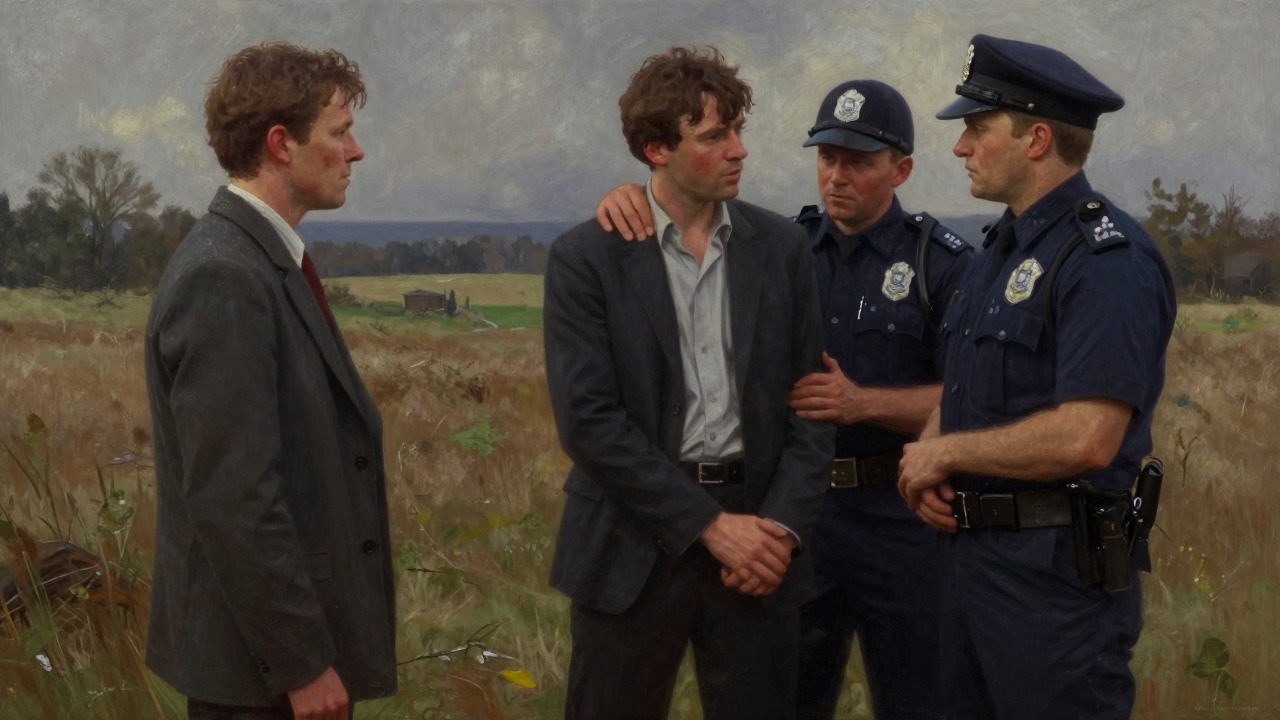
After his release from prison and the Ludovico conditioning, Alex is brutally beaten by his former enemy Billyboy and his former droog Dim, who have both become police officers, in a remote countryside location as a form of unofficial 'summary punishment'.
Discovery and Recognition
After being attacked by a group of old men in the Public Biblio, Alex is rescued by three policemen. One of them, a young officer named Rex, holds him, but the other two are immediately familiar. The older one, with a familiar voice and face, is revealed to be Billyboy, Alex's old enemy from the gang fights of his youth. The other, grinning with a mad look, is Dim, who had once been Alex's droog but had betrayed him. Both are now wearing police uniforms and helmets, carrying whips to keep order. Alex is stunned, crying out "Oh no" and insisting it is impossible, but Billyboy confirms it with a grin, saying "Evidence of the old glazzies. Nothing up our sleeves. No magic, droog. A job for two who are now of job-age. The police." Dim adds that they were young once, but Alex was always the youngest, and now they are police officers.
The Drive and the Beating
The policemen take Alex to a patrol car and drive him out of town. Billyboy explains that it is not right for people in the town to see too much of their "summary punishments," as the streets must be kept clean in more than one way. Alex protests, saying the old days are dead and that he has been punished and cured for what he did. Dim, however, says the Superintendent read about Alex's cure to them, calling it a very good way. When Alex mocks Dim for still being too dim to read for himself, Dim responds gently but then launches a heavy punch to Alex's nose, making it bleed. Alex bitterly reflects that there was never any trust and that he was always on his own. They stop in the countryside, bare trees and a distant farm machine the only features, as dusk falls. Billyboy and Dim take Alex out of the car and beat him. The driver, Rex, remains at the wheel, smoking a cigarette and reading a small book, paying no attention. Alex does not describe the details of the beating, only that it involved panting and thudding against the background of whirring farm engines and bird twitters. One of them finally says it is enough, and they give him one final punch to the face each before he falls over and lies on the cold grass. They dust off their hands, put their helmets and tunics back on, and drive away, with Billyboy saying they will see him again sometime and Dim giving one of his old clownish laughs. The driver finishes his page and puts his book away before starting the car.
Aftermath and Significance
Alex is left alone, hurt and in the rain, with no home and little money. He cries for himself and then gets up to walk. This event marks the complete inversion of Alex's former world: his old enemy and his former friend, now agents of the state, have the power to inflict violence on him with impunity, and he is utterly helpless to resist, both physically and because his conditioning prevents him from fighting back. It is a brutal demonstration of how the system has co-opted the very violence it claims to suppress, and it drives Alex to seek refuge at the cottage called HOME, setting the stage for his final confrontation with F. Alexander.
Stay with F. Alexander
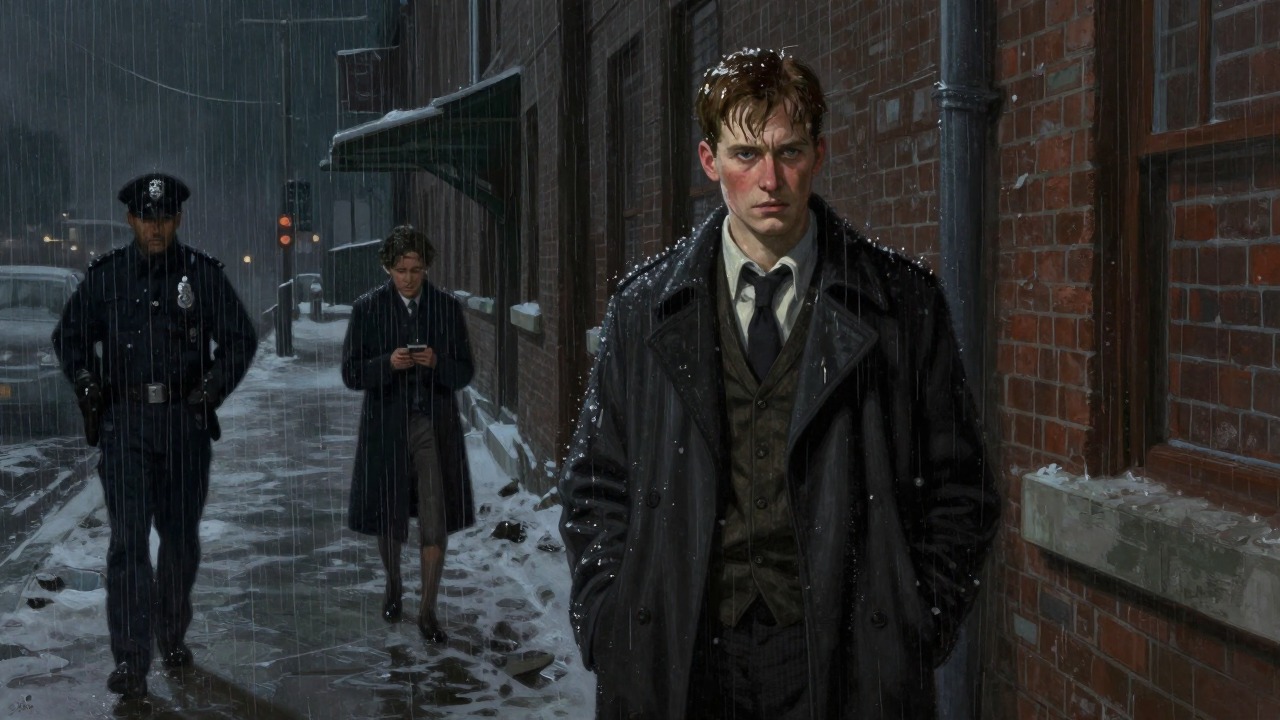
After his release from Staja (State Jail) Number 84F and the Ludovico Technique conditioning, Alex finds himself utterly alone. Beaten by the police, rejected by his parents who have taken in a lodger named Joe, and with nowhere to go, he wanders through the winter night, soaked by icy rain and in great pain. His desperate wandering brings him, almost by instinct, back to a cottage he recognizes from a night of violence two years earlier: HOME. The writer F. Alexander, whose wife Alex and his droogs had raped and beaten during that earlier home invasion, takes the bedraggled, bruised boy in, offering him warmth, food, and shelter. This act of charity, however, is not born of simple kindness but is the beginning of a calculated political exploitation, as F. Alexander sees in Alex a perfect weapon against the government that created him.
Arrival and Hospitality at HOME
Alex, having been beaten by his former droog Dim and his old enemy Billyboy—now both police officers—is left for dead on a country road. He walks through the dark, following the sound of a farm machine, and arrives at a village. At the end of the village, he finds a small cottage with the name HOME shining on its gate. He knocks, and when the door opens, a man with glasses, a shortish man in middle age, sees his pitiful state and immediately invites him in, saying, "God help you, you poor victim, come in and let's have a look at you." The man, F. Alexander, gives him whisky and warm water, cleans his wounds, draws him a hot bath, and provides him with warm pyjamas, an over-gown, and slippers. He then serves a large supper of fried eggs, ham, sausages, and sweet milky tea. Alex, who had been starving and cold, feels overwhelmed by this kindness, and he weeps. F. Alexander, however, is not merely a Good Samaritan; he recognizes Alex from the morning's newspaper, identifying him as the first graduate of the new State Institute for Reclamation of Criminal Types. He sees Alex not just as a victim of the streets, but as a "poor victim of this horrible new technique," sent to him by Providence.
The Writer's Grief and Political Agenda
As Alex eats, F. Alexander reveals the source of his own deep pain. He tells Alex that his wife died after being "brutally raped and beaten" in that very house, in the room next door. He has had to steel himself to continue living there, where her memory lingers. This revelation triggers a wave of sickness in Alex, who now realizes the full horror of his own past actions. F. Alexander, however, quickly pivots from personal grief to political fury. He explains that the government's new technique has turned Alex into "something other than a human being," a "little machine capable only of good," stripped of the power of choice. He declares that the government has "bit off too much" and that the essential intention is "the real sin." He sees Alex as a "potent weapon" to dislodge the overbearing government in the upcoming election, a living witness to its diabolical proposals. He has already written an article for The Weekly Trumpet under Alex's name, detailing his suffering and calling on the people to reject the government.
The Political Circle and Alex's Imprisonment
The next morning, F. Alexander's political associates arrive: Z. Dolin, a wheezy, fat man with thick glasses; Something Something Rubinstein, a tall, polite man with an eggy beard; and D. B. da Silva, a quick-moving man with a strong scent. They are overjoyed to see Alex, with Z. Dolin calling him a "superb device" and suggesting he could look even more ill for the cause. They plan to exhibit him at public meetings to inflame public hearts. Alex, feeling used and desperate, demands to know what he will get out of it, specifically asking to be restored to his normal self, able to enjoy music and violence without sickness. The men dismiss his concerns, with Rubinstein promising a "very acceptable little surprise" at the end. F. Alexander, meanwhile, becomes increasingly agitated, muttering the name "Dim" and staring at Alex with a mad look, as if he is beginning to piece together the identity of the boy who destroyed his life. Alex, sensing the danger, tries to leave, but Z. Dolin insists he stay, saying, "We have you, friend, and we keep you." They take him to a small flat in a flatblock, lock him in, and leave him alone.
The Torture of Music and the Suicide Attempt
Left alone in the flat, Alex lies down, bewildered and exhausted. He is suddenly jolted awake by loud music coming through the wall: the Symphony Number Three of Otto Skadelig, a violent piece he once loved. The conditioning immediately takes hold, and he is overwhelmed by the familiar sickness, pain, and thirst. He bangs on the wall, screaming for them to stop, but the music only grows louder. He tries to stick his fingers in his ears, but the sound blasts through. Realizing the door is locked from the outside, he understands this is a deliberate torture. In his agony, he sees a pamphlet on the table with the word "DEATH" on its cover, and another with a picture of an open window and the slogan "Open the window to fresh air, fresh ideas, a new way of living." He sees this as a sign. He climbs onto the windowsill, cries out, "Good-bye, good-bye, may Bog forgive you for a ruined life," and jumps. He does not die, but crashes onto the sidewalk, breaking his back, wrists, and legs, and losing consciousness. Just before passing out, he realizes that the music was arranged by his supposed new droogs for their own selfish political ends.
Political Exploitation by Opposition
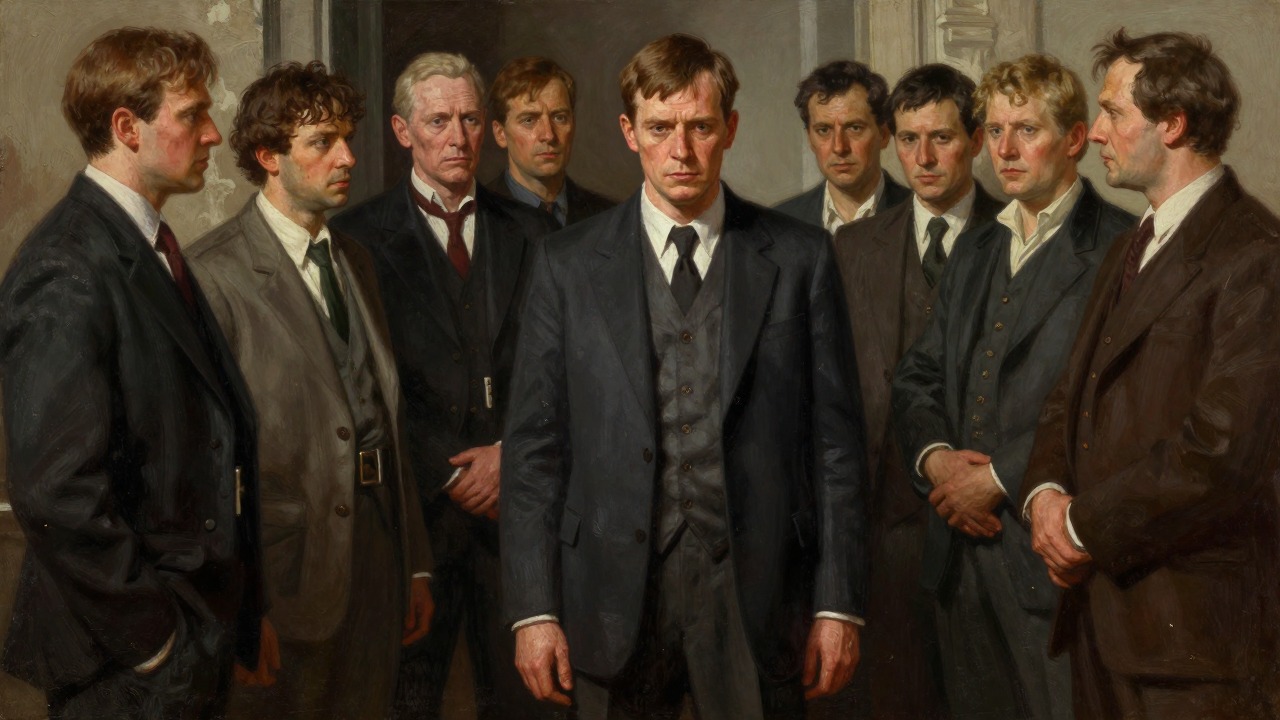
Political Exploitation by Opposition is the sequence in which Alex, freshly released from the Ludovico Technique treatment and homeless after being rejected by his parents, is taken in by the writer F. Alexander and then used as a living propaganda weapon by a group of anti-government political activists. The event transforms Alex from a conditioned patient into a public symbol of state overreach, exploited for electoral purposes by the very people who claim to champion his freedom.
Discovery and Recruitment at HOME
After being beaten by the police and left on a country road, Alex stumbles, cold and injured, to a cottage whose gate reads HOME. The occupant, F. Alexander, recognizes Alex from the morning newspaper as "the poor victim of this horrible new technique" and immediately sees him as a providential arrival. F. Alexander tells Alex that the police are "fond of bringing their victims to the outskirts of this village" and that Alex is "not the first to come here in distress." Over a hot bath and a supper of fried eggs, ham, sausages, and sweet milky tea, Alex recounts the entire Ludovico Technique ordeal. F. Alexander, still wiping the same plate for ten minutes, declares that Alex has been turned into "something other than a human being" with "no power of choice any longer," a "little machine capable only of good." He reveals that his wife died after being "brutally raped and beaten" in that very house, a fact that makes Alex, who recognizes the crime as his own, feel sick and pale.
The Political Cell and the Article
The next morning, F. Alexander reveals he has been on the phone to various people. Three men arrive: Z. Dolin, a wheezy, fat man with thick-framed glasses who coughs constantly over a cigarette; Something Something Rubinstein, a tall, polite, elderly man with an eggy beard; and D. B. da Silva, a quick-moving man with a strong scent of perfume. They examine Alex with "overjoyed" approval. Z. Dolin remarks that Alex could "for preference look even iller and more zombyish" for the cause. D. B. da Silva explains their plan: "Public meetings, mainly. To exhibit you at public meetings will be a tremendous help. And, of course, the newspaper angle is all tied up. A ruined life is the approach. We must inflame all hearts." F. Alexander has already written an article for The Weekly Trumpet, which he plans to publish under Alex's name, a "very long and very weepy piece of writing" about how the government sapped his will. When Alex asks what he gets out of it—whether he will be cured of his sickness to music and violence—F. Alexander looks surprised, as if Alex is being selfish. Rubinstein vaguely promises that "the Party will not be ungrateful" and that there will be "some very acceptable little surprise."
Alex's Resistance and F. Alexander's Suspicion
Alex grows increasingly agitated, shouting that he wants to be "normal and healthy" again, able to enjoy music and have "real droogs." Z. Dolin strokes Alex's hand as if he were an idiot, telling him he is a "martyr to the cause of Liberty." Alex snaps: "Stop treating me like a thing that's like got to be just used. I'm not an idiot you can impose on, you stupid bratchnies." When Alex uses the word "dim," F. Alexander's memory is pricked; he mutters "Dim dim dim" and says, "I could almost believe... by Christ, if he were I'd tear him. I'd split him, by God." Alex, realizing F. Alexander is connecting him to the night of the attack on his home, tries to flee, saying he will go off "all on my oddy knocky." But Z. Dolin blocks him: "We have you, friend, and we keep you." Alex, unable to fight because the thought of violence triggers his conditioning sickness, submits.
Installation in the Political Flat
The three men drive Alex to a flatblock and install him in a small flat with two bedrooms and a living room covered in books, papers, ink, and bottles. D. B. da Silva tells him, "Here is your new home. Settle here, boy. Food is in the food-cupboard. Pyjamas are in a drawer. Rest, rest, perturbed spirit." Before leaving, Z. Dolin asks Alex if he was responsible for what stirred in F. Alexander's "tortured memory," and Alex insists he has paid for everything. Left alone, Alex lies on the bed, bewildered, and dozes off.
The Torture by Music and Suicide Attempt
Alex wakes to loud music coming through the wall—the Symphony Number Three of Otto Skadelig, a violent piece he once loved. The music triggers the conditioned sickness: pain, nausea, and a desperate thirst. He bangs on the wall, screaming "Stop, stop it, turn it off!" but the music only grows louder. He tries to flee but finds the front door locked from the outside. Sticking his fingers in his ears does nothing. In agony, he sees a pamphlet on the table with the word "DEATH" on its cover and another booklet with an open window on its cover and the slogan "Open the window to fresh air, fresh ideas, a new way of living." Interpreting this as a sign, he climbs onto the windowsill, shouts "Good-bye, good-bye, may Bog forgive you for a ruined life," and jumps. He does not die, but cracks his back, wrists, and legs, passing out on the sidewalk.
Consequences and Aftermath
The suicide attempt becomes a political weapon. While Alex lies in the hospital, the three political men visit him, telling him that "the people are on fire with indignation" and that he has "killed those horrible boastful villains' chances of re-election." They show him newspaper clippings with headlines like "BOY VICTIM OF CRIMINAL REFORM SCHEME" and "GOVERNMENT AS MURDERER." Alex tries to say, "If I had died it would have been even better for you political bratchnies," but can only manage "er er er." The event directly leads to the government's counter-move: the Minister of the Interior visits Alex in the hospital, gives him a stereo, and plays Beethoven's Ninth Symphony, revealing that Alex's conditioning has been reversed. The Minister also reveals that F. Alexander has been "put away" for his own protection and for Alex's. The political exploitation thus backfires, as the government reclaims Alex as a success story, and Alex, cured of his conditioning, returns to a life of violence with a new gang.
Suicide Attempt
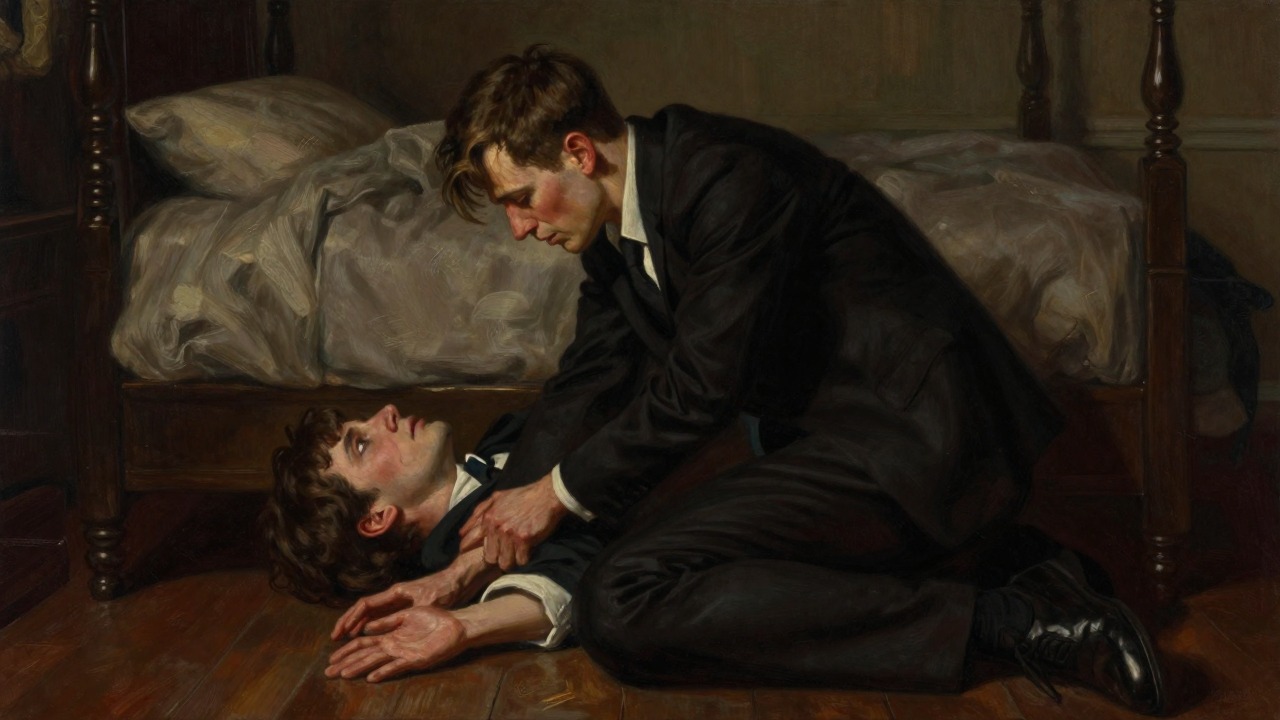
Alex's suicide attempt is the desperate culmination of his suffering under the Ludovico Technique, a moment when the conditioning imposed on him becomes utterly intolerable and he sees no other escape. The event marks the lowest point of his journey, a direct consequence of the state's attempt to forcibly 'cure' him, and it paradoxically sets the stage for his eventual 'recovery' and reconciliation with the government.
The Immediate Trigger and the Act
Waking in the flat of the political group that intends to use him as a propaganda weapon against the government, Alex is alone. He hears loud music—the Symphony Number Three by Otto Skadelig—blasting through the wall. The sound immediately triggers the conditioned sickness: pain in his guts, a terrible thirst, and a pounding head. He crawls off the bed, groaning, and bangs on the wall, screaming for them to stop, but the music only seems to grow louder. He tries to escape the flat, but the front door is locked from the outside. In his agony, he sticks his fingers deep in his ears, but the trombones and kettledrums blast through. Wandering the flat in pain, he sees on a table a pamphlet with the word "DEATH" on its cover, and another booklet with an open window on its cover and the slogan "Open the window to fresh air, fresh ideas, a new way of living." Interpreting these as a sign, he goes to the open window in the bedroom, sees the drop to the street below, and cries out, "Good-bye, good-bye, may Bog forgive you for a ruined life." He gets onto the sill, feels the cold wind on his face, and jumps.
The Immediate Aftermath and Hospitalization
Alex does not die. The fall is not from a great enough height to kill, but he cracks his back, wrists, and legs, feeling immense pain before passing out. As he loses consciousness, he sees astonished faces looking down at him and realizes that the music was deliberately arranged by those who were supposed to be his new friends, for their own selfish political purposes. He wakes in a hospital, his body bound in bandages and wire cages, with a nurse sitting by his bed. He is unable to speak clearly at first, his mouth stiff and some teeth missing. He drifts in and out of consciousness, visited by the prison chaplain, the three political men who exploited him, and eventually his parents. The suicide attempt becomes a public event, with his picture in the newspapers under headlines like "BOY VICTIM OF CRIMINAL REFORM SCHEME" and "GOVERNMENT AS MURDERER," fueling the opposition's campaign against the government.
Consequences and the Path to 'Cure'
In the hospital, Alex undergoes further treatment. Two young doctors show him a picture book, asking what he would like to do to the images. He responds with violent desires—to smash a bird's nest, to pull out a peacock's feathers, to give the old in-out-in-out with ultra-violence to beautiful girls, to hammer nails into the figure carrying a cross. The doctors pronounce him "cured" through "deep hypnopaedia." The Minister of the Interior visits, presenting Alex with a new stereo as a gift and promising a good job. When Alex asks to hear the Ninth Symphony, it is played. As the music swells, he envisions himself running on light and mysterious legs, carving the face of the creeching world with his cut-throat britva. He is cured all right. The suicide attempt, rather than ending his life, has been the catalyst for the state to reverse the conditioning, restoring his capacity for violence and his love of music, but only to make him a tool for their own political ends.
Recovery and Government Reconciliation
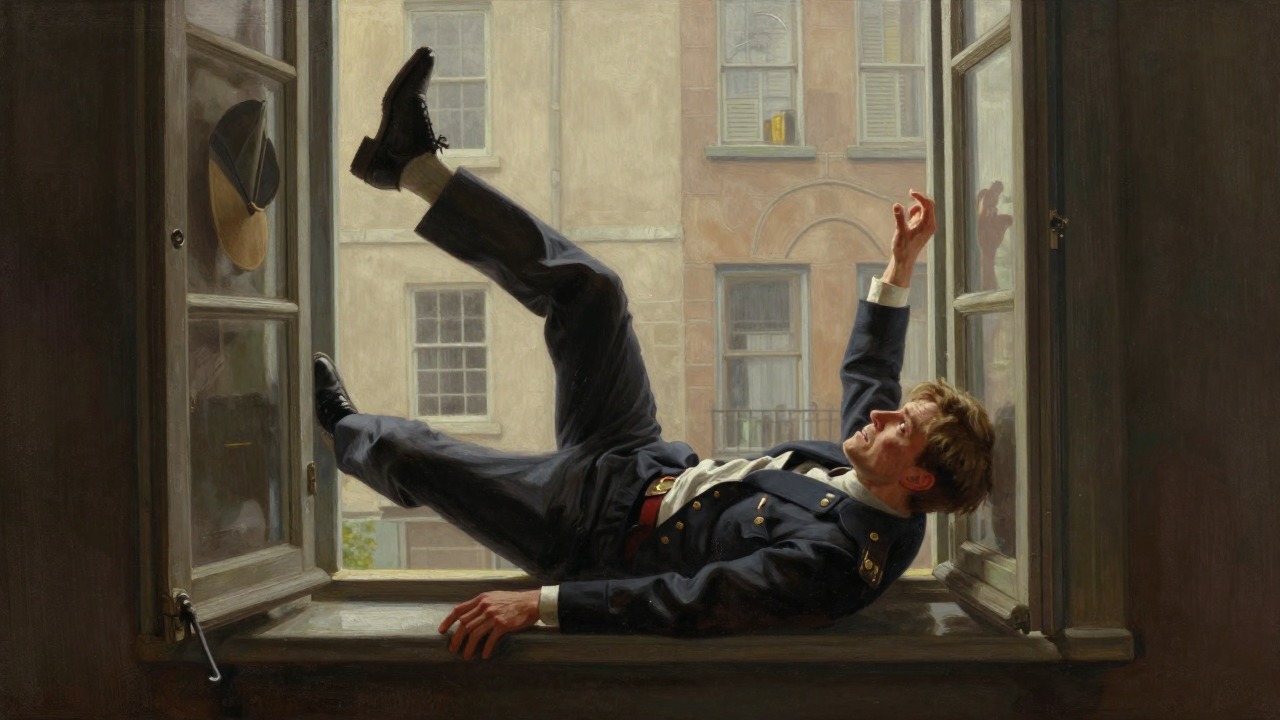
The Recovery and Government Reconciliation is the pivotal event in which the state, having subjected Alex to the Ludovico Technique, reclaims him as a success story and symbol of its crime-control policy. After Alex's desperate leap from a window in the flat of the political opposition, he lies hospitalized, broken in body but, as the government will discover, restored in spirit. The Minister of the Interior's bedside visit, complete with photographers and a gift of a stereo playing Beethoven's Ninth Symphony, stages a public reconciliation that is also a private revelation: Alex's capacity for violence, and for the enjoyment of violence, has returned. The event closes the arc of Alex's conditioning and reopens the question of what kind of person—or what kind of clockwork—the state has actually produced.
Hospitalization and the Government's Approach
Alex wakes in a hospital room, his body bound in bandages and wire cages, his head wrapped, his teeth missing, and a nurse reading a romance novel by his bed. He has survived the fall but is barely able to speak, his words coming out as "er er er." The prison chaplain from Staja 84F visits, breathing stale whisky and declaring that he has left the prison service rather than subscribe to the Ludovico Technique, calling Alex "my little beloved son in J. C." Soon after, three men from the political opposition—Z. Dolin, Something Something Rubinstein, and D. B. da Silva—appear at his bedside, holding newspaper clippings with headlines like "BOY VICTIM OF CRIMINAL REFORM SCHEME" and "GOVERNMENT AS MURDERER." They tell Alex that the people are "on fire with indignation" and that he has "killed those horrible boastful villains' chances of re-election." Alex tries to accuse them of using him, but only manages "er er er." The nurse chases them out, warning against exciting the patient. Later, Alex's parents visit, his mother weeping, his father apologetic and reporting that the lodger Joe has been beaten by the police and gone back to his hometown, leaving the way clear for Alex to return home. Alex tells them he will consider it, but warns that things will have to be very different and that they must decide who is to be boss.
The Minister's Visit and the Gift of the Stereo
As Alex recovers, two young doctors test him with a picture book, asking what he would like to do to each image. To a bird's nest full of eggs, he says he would smash them against a wall; to a peacock, he would pull out its feathers; to pictures of beautiful girls, he would give them "the old in-out in-out with lots of ultra-violence"; to a picture of a man being kicked in the face with blood everywhere, he says he would like to be in on that; and to a picture of Christ carrying the cross, he says he would like to have "the old hammer and nails." The doctors pronounce him cured, using the term "deep hypnopaedia." Then the hospital staff announce a very special visitor. At two-thirty in the afternoon, photographers and newspapermen crowd the room, and the Minister of the Interior himself enters, dressed in the height of fashion, with an upper-class "haw haw" voice. Cameras flash as he extends his hand to Alex. Alex greets him with Nadsat insolence—"Well well well well well. What giveth then, old droogie?"—and when a harsh voice tells him to be more respectful, Alex snarls, "Yarbles. Bolshy great yarblockos to thee and thine." The Minister quickly smooths things over, saying Alex speaks to him as a friend. He sits by the bed and tells Alex that the government regards him as a friend, that they have put him right, and that there are men—specifically the writer F. Alexander—who wanted to use Alex for political ends and would have been glad for him to be dead. "We put him away," the Minister says. Alex realizes that F. Alexander was told about Alex's role in his wife's death. The Minister promises Alex a good job on a good salary because he is helping the government. A photographer cries "Smile!" and Alex smiles "like bezoomny without thinking" as pictures are taken of him and the Minister together. Then a big shiny box is brought in: a stereo. A technician plugs it in and asks what music Alex wants. "The Ninth," Alex says. "The glorious Ninth." As the Beethoven begins to play, everyone leaves quietly. The Minister pats Alex on the shoulder and says "Good good boy." Alex signs a paper without reading it, then is left alone with the music.
The Return of Violence and the Meaning of Cure
Lying alone with the Ninth Symphony, Alex experiences "gorgeosity and yumyumyum." When the Scherzo plays, he can see himself "very clear running and running on like very light and mysterious nogas, carving the whole litso of the creeching world with my cut-throat britva." The slow movement and the last singing movement are still to come. Alex's final thought is definitive: "I was cured all right." The event thus completes a full reversal. The conditioning that had made Alex physically ill at the thought of violence, that had forced him to grovel and lick boots rather than fight, that had made music itself a source of nausea, has been undone. The government, in reclaiming Alex as a propaganda victory, has inadvertently restored him to his original state. The Minister's gift of the stereo is not merely a reward for cooperation but the instrument of Alex's liberation: the Ninth Symphony, which had been paired with the most traumatic of the Ludovico films, now plays without triggering sickness, and instead unleashes the old violent fantasies. Alex is once again a creature capable of choice—and he chooses the same violence he always did. The reconciliation is therefore a deception on both sides: the government believes it has produced a docile citizen, while Alex knows he has been given back his true self.
Final Scene with New Droogs and Pete
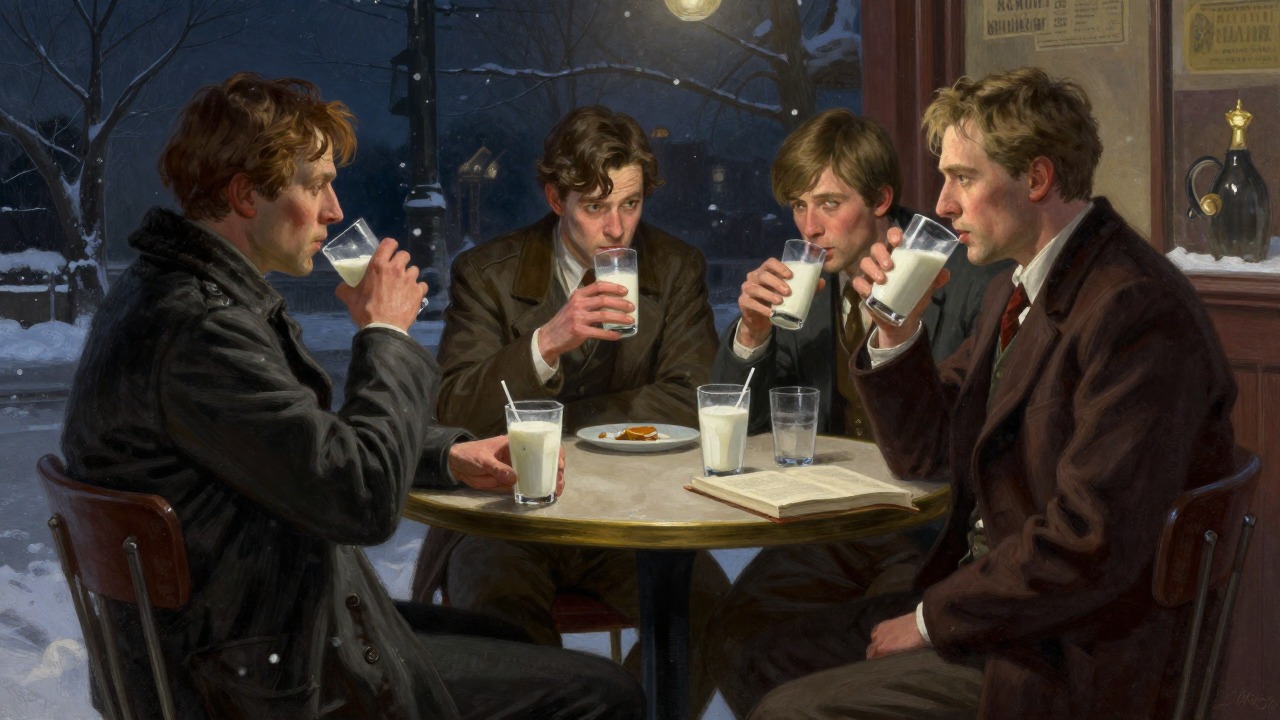
The final scene of A Clockwork Orange finds Alex, now eighteen, sitting in the Korova Milkbar with his new droogs—Len, Rick, and Bully—drinking milk-plus and planning the evening. The setting is a winter night, much like the one that opened the novel, but the atmosphere is subtly different. Alex is the oldest of the four, and though the others look up to him as their leader, he feels a growing sense of boredom and hopelessness. He orders his droogs to attack an old man leaving a news-kiosk, but he stands back and watches rather than participating, a shift from his earlier eagerness to lead the violence. Later, at the Duke of New York, Alex refuses to buy drinks for the old women, a departure from the sammy act he performed with his original gang, and he tears up a photograph of a baby that had fallen from his pocket, a gesture that puzzles and disturbs his companions. He leaves them, saying he needs to be alone, and wanders the streets, feeling a strange softness inside him that he cannot explain.
Encounter with Pete and Georgina
In a tea-and-coffee shop, Alex spots a young couple and recognizes the man as Pete, one of his original droogs. Pete is now nearly twenty, married to a woman named Georgina, and working at State Marine Insurance. He speaks in a grown-up voice and invites Alex to visit, mentioning that he and Georgina are off to a party at a friend's house for wine-cup and word-games. Alex is stunned by the transformation: Pete has settled into a conventional, harmless life, a stark contrast to the violence of their shared past. Georgina giggles at Alex's Nadsat speech, and Pete explains that he has read about Alex's terrible experiences. The encounter leaves Alex alone with his cold tea, thinking and wondering about his own future.
Alex's Reflection and Vision of Maturity
Walking the winter streets, Alex experiences a vision of himself coming home from work to a hot dinner and a welcoming woman, and in the next room, a cot with his son gurgling. He realizes that he is growing up, that youth is like a mechanical toy that winds up and bangs into things, unable to help itself. He understands that his son will likely repeat his own violent actions, and that the cycle will continue. The scene ends with Alex deciding to start looking for a mate the next day, a new chapter in his life, and he bids farewell to the reader, acknowledging that he is no longer young and that the world is a terrible, grahzny place, but that he must go on alone.
Event 1
Event 2
Event 3
Event 4
Event 5
Event 6
Event 7
Event 8
Event 9
Event 10
Event 11
Event 12
Event 13
Event 14
Event 15
Event 16
Event 17
