White Rabbit
Alice's Adventures in WonderlandThe White Rabbit is the first Wonderland creature Alice encounters, and his panicked dash down the rabbit-hole sets the entire adventure in motion. He is defined by his perpetual anxiety about lateness, his servile position in the Queen of Hearts' court, and his role as a messenger and herald who both initiates and punctuates Alice's journey. More than any single character, the White Rabbit embodies the arbitrary, time-driven, and hierarchical logic of Wonderland, a logic that Alice must navigate and ultimately defy.
Identity and Introduction
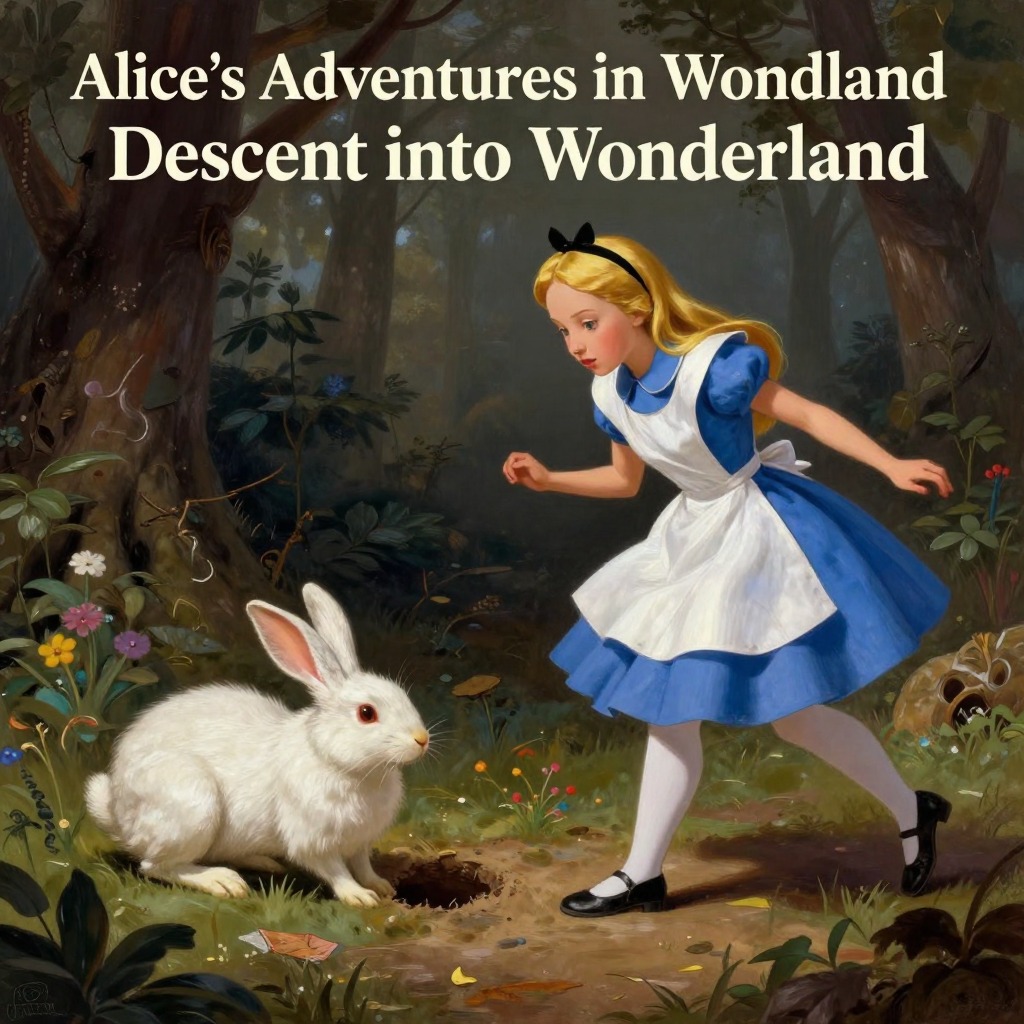
The White Rabbit first appears running close by Alice as she sits on the riverbank, and he is immediately marked by two extraordinary details: he takes a watch out of his waistcoat-pocket and he mutters to himself, "Oh dear! Oh dear! I shall be late!" Alice, burning with curiosity, follows him and sees him pop down a large rabbit-hole under the hedge, an act that leads her into the long fall into Wonderland. The Rabbit is thus the herald of the adventure, the figure whose mere presence—with his waistcoat, watch, and frantic urgency—transforms a drowsy summer afternoon into a journey into the unknown. His defining trait is established at once: a chronic, almost comical anxiety about time and duty, which will govern his every subsequent appearance.
Life and Plot Trajectory
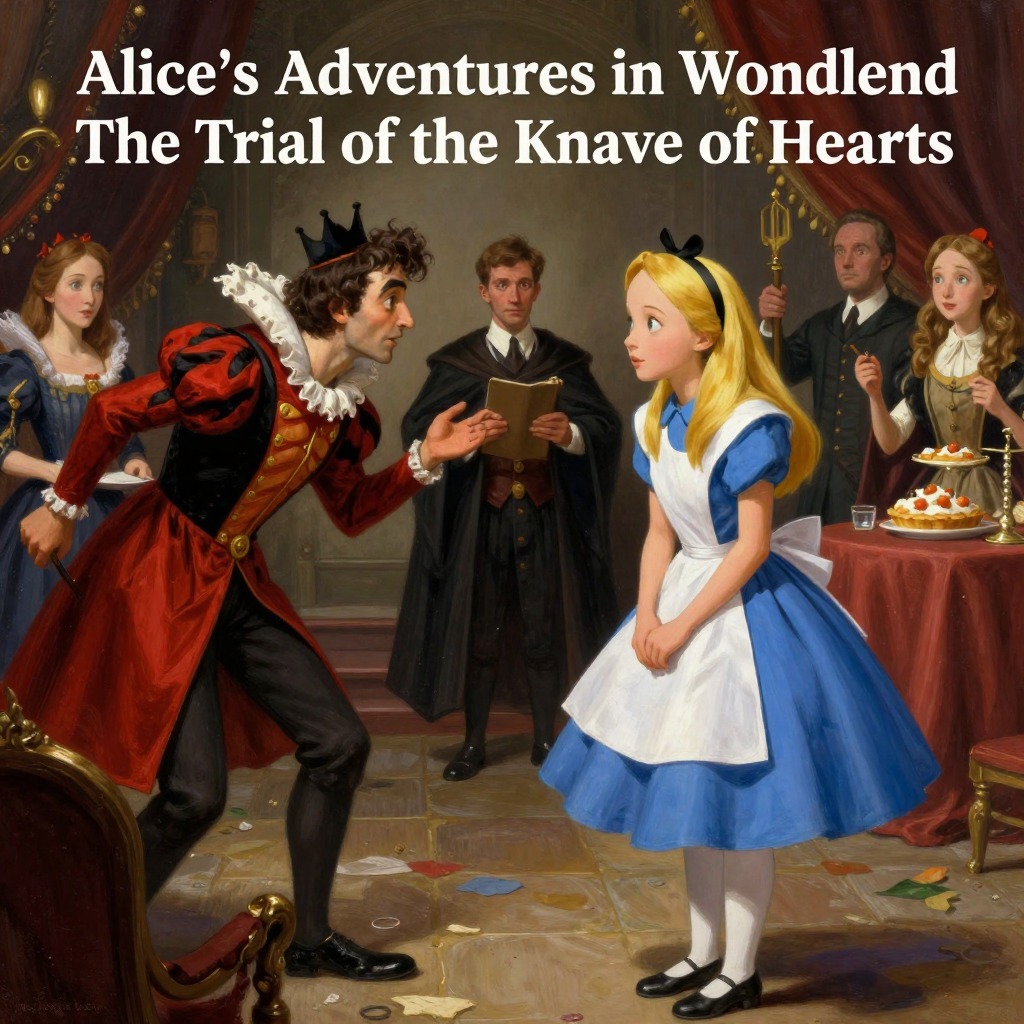
After Alice's initial fall, the White Rabbit reappears in the long hall, now splendidly dressed, carrying a pair of white kid gloves and a large fan, and muttering about the Duchess. When Alice timidly addresses him, he is so startled that he drops the gloves and fan and scurries away into the darkness. Later, he returns to the hall searching for these lost items, and mistakes Alice for his housemaid, Mary Ann, ordering her to fetch him a pair of gloves and a fan. This misidentification leads Alice into the White Rabbit's neat little house, where she drinks an unlabeled potion and grows to an enormous size, trapping herself inside. The Rabbit, attempting to retrieve his property, orchestrates a chaotic effort to remove her, summoning Pat and Bill the Lizard, and eventually proposing to burn the house down. Alice escapes by eating a cake that shrinks her, and the Rabbit vanishes from the narrative for a time. He reappears in the Queen's croquet-ground procession, walking among the guests, talking in a hurried, nervous manner, and smiling at everything that is said. He whispers to Alice that the Duchess is under sentence of execution for boxing the Queen's ears. In the trial of the Knave of Hearts, the White Rabbit serves as the herald, blowing three blasts on a trumpet, reading the accusation from a parchment scroll, and calling the witnesses. He also produces the crucial set of verses, the supposed evidence against the Knave. Throughout the trial, he attempts to correct the King's misstatements, whispering "Unimportant, your Majesty means, of course" when the King declares Alice's testimony "very important." His final function is to read the verses aloud, after which the trial descends into chaos.
Key Actions and Objectives
The White Rabbit's primary objective is the fulfillment of his duties, whether serving the Duchess or the Queen of Hearts. His actions are driven by a fear of punishment—"She'll get me executed, as sure as ferrets are ferrets!" he mutters about the Duchess. He is a messenger and a functionary, never a ruler or a rebel. His key actions include: initiating Alice's journey by running down the rabbit-hole; losing his gloves and fan, which Alice then uses and which cause her to shrink; mistakenly ordering Alice about as his housemaid; attempting to remove the giant Alice from his house by enlisting Pat and Bill; serving as a nervous courtier in the Queen's procession; and acting as the herald and reader of evidence in the trial. Each action reinforces his role as a subordinate who is perpetually anxious about the consequences of failure.
Relationships and Conflict
The White Rabbit's relationships are defined by hierarchy. He is terrified of the Duchess, whom he serves, and of the Queen of Hearts, whose court he attends. He shows no personal warmth toward Alice, treating her first as a stranger to be fled from, then as a servant to be ordered, and finally as a witness to be processed through the trial. His conflict with Alice is indirect: he is the unwitting cause of her size changes (through the fan and the potion in his house) and the object of her curiosity, but he never engages her in a direct confrontation. His true conflict is with the demands of his own position, a constant race against time and against the wrath of his superiors.
Change and Ending
The White Rabbit undergoes no personal transformation. He begins as a frantic, time-obsessed servant and ends the same way, reading verses in a chaotic trial. His final appearance in the narrative is as the reader of the evidence, after which the trial dissolves into Alice's rebellion and her awakening. In Alice's sister's dream at the book's conclusion, the White Rabbit is remembered as part of the vivid, strange landscape: "The long grass rustled at her feet as the White Rabbit hurried by." He remains, to the end, a figure of perpetual hurry, a fixed element of Wonderland's anxious machinery.
Narrative Role and Evaluation
The White Rabbit serves as the catalyst for the entire story and as a recurring symbol of Wonderland's arbitrary, time-bound authority. He is the first Wonderland creature Alice sees, and his watch and waistcoat are the initial signs that this world operates by a different, more frantic logic. He is a threshold guardian who, by his very existence, invites Alice to cross from the ordinary world into the extraordinary. His nervousness and servility contrast sharply with Alice's growing confidence, and his role as a herald in the trial underscores the absurdity of the Queen of Hearts' justice. He is not a villain but a functionary, and his lack of agency makes him a perfect representative of a world where everyone is subject to a higher, often capricious, power.