Initiation of Trade with Humans
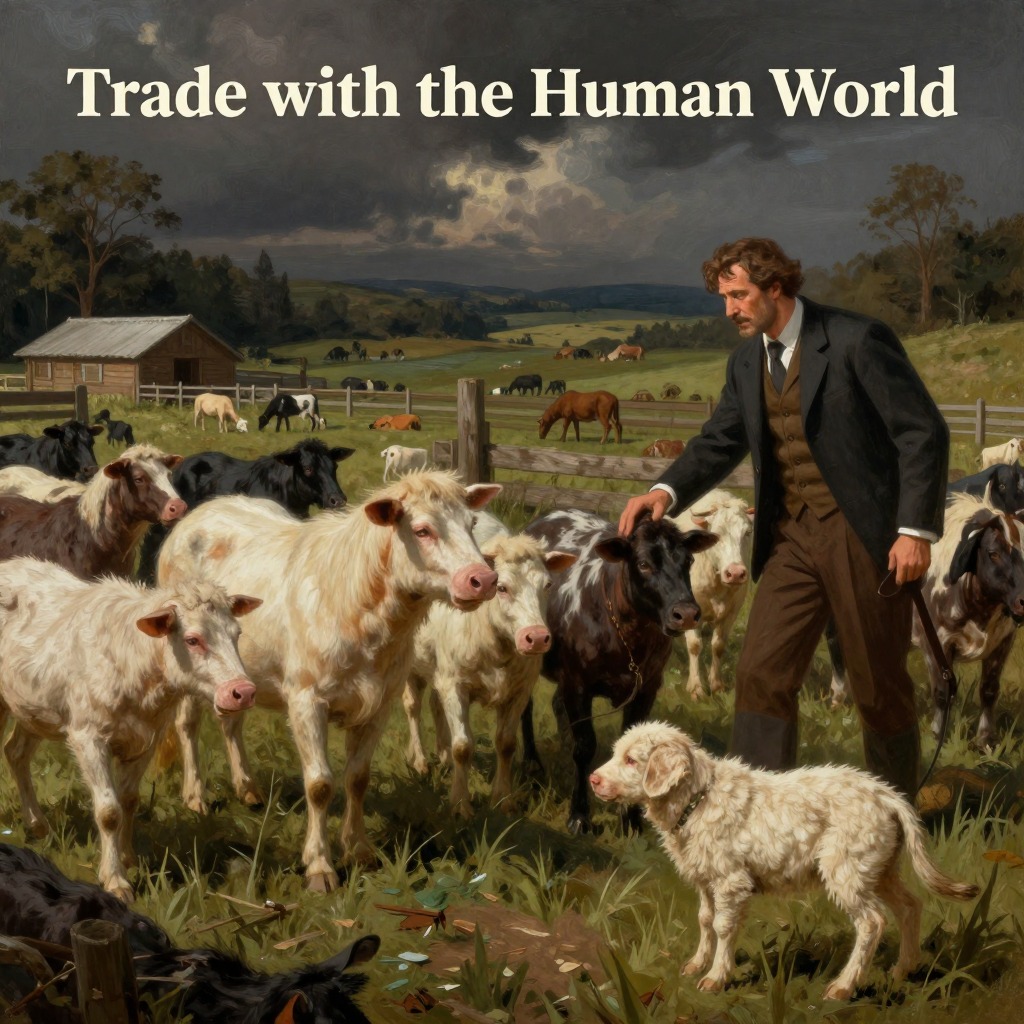
Animal FarmOne Sunday morning, during the second summer after the Rebellion, Napoleon assembled the animals and announced a fundamental shift in policy: Animal Farm would engage in trade with neighboring farms. The needs of the windmill, he declared, must override everything else, and he had already made arrangements to sell a stack of hay and part of the current year's wheat crop. If more money were needed, it would be made up by the sale of eggs, which the hens should welcome as their own contribution to the windmill. The announcement was presented as a practical necessity, but it directly contradicted one of the earliest resolutions of the Rebellion—the prohibition against any dealings with human beings, the use of money, or engagement in trade.
The animals were conscious of a vague uneasiness. They remembered the triumphant days after Jones's expulsion, when they had destroyed the harness-room and flung the whips and bits into the fire, and when Snowball had declared that ribbons were the mark of a human being. They remembered the solemn resolution that no animal should ever touch money or engage in trade, a principle that had seemed as unalterable as the Seven Commandments themselves. But when the four young pigs attempted to protest, they were silenced by the growling of the dogs. Then the sheep, as always, broke into a bleating of "Four legs good, two legs bad!" and the moment of awkwardness dissolved. Napoleon raised his trotter for silence and announced that no animal would need to come into contact with human beings—he would take the burden upon himself.
A Mr. Whymper, a solicitor living in Willingdon, had agreed to act as intermediary between Animal Farm and the outside world. He would visit every Monday morning to receive his instructions. The animals watched his coming and going with a kind of dread, but the sight of Napoleon, on all fours, delivering orders to a man standing on two legs, roused their pride. The human beings, who had continued to hate the farm, now began to call it by its proper name and ceased to pretend it was still called the Manor Farm. Yet the trade arrangement opened a door that could not be closed.
The initiation of trade marked the beginning of a deeper transformation. The animals worked harder than ever, but the farm's prosperity did not reach them. The pigs and dogs grew fat while the others endured long hours and short rations. Squealer produced endless figures proving that each class of foodstuff had increased by two hundred, three hundred, or five hundred per cent, but the animals could not remember clearly enough to dispute him. The farm grew richer, but the animals themselves did not. The original revolutionary ideal, as Old Major had taught, that no animal should ever engage in trade or touch money, was quietly erased from collective memory. The policy that began as a pragmatic compromise for the windmill became a permanent feature of the new order, and the line between the initial promise of freedom and the emerging reality of exploitation began to widen irrevocably.