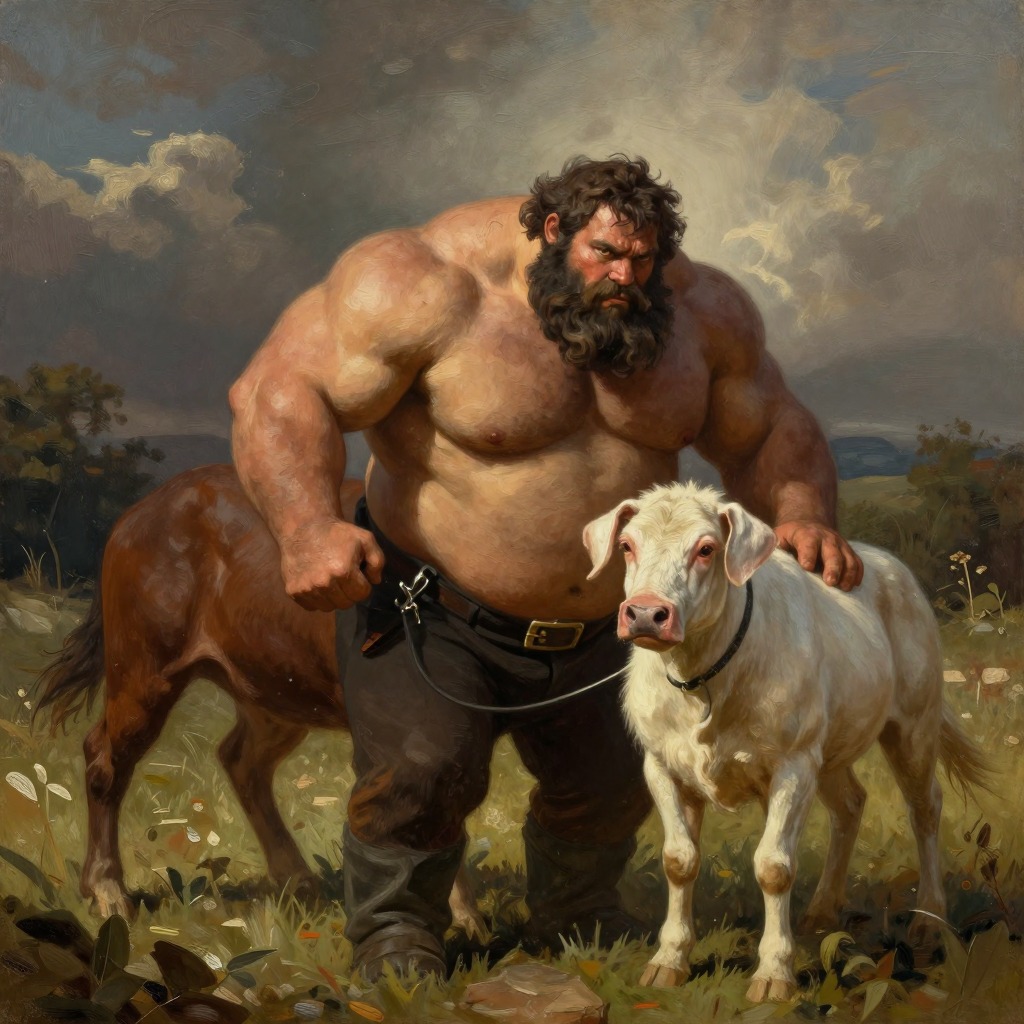
Napoleon is always right
Animal FarmAfter the expulsion of Snowball and the abolition of the Sunday Meetings, the cart-horse Boxer, who had been the most loyal disciple of the pigs, finally articulated a principle that would govern the rest of his life. Having had time to think things over, he voiced the general feeling by saying, "If Comrade Napoleon says it, it must be right." From that moment onward he adopted the maxim "Napoleon is always right" in addition to his private motto of "I will work harder." This declaration was not merely a personal conviction but a response to the atmosphere of terror and confusion that followed Napoleon's seizure of power: the nine enormous dogs had just chased Snowball off the farm, and the sheep had bleated "Four legs good, two legs bad" for a quarter of an hour, silencing any potential protest. For Boxer, a creature of immense physical strength but limited intellectual capacity, the maxim provided a simple, comforting framework: loyalty to the leader was the path to safety and purpose.
The maxim became Boxer's automatic response to any policy that might otherwise have troubled the other animals. When the pigs moved into the farmhouse and began sleeping in beds, the animals were disturbed, but Boxer passed it off with "Napoleon is always right!" while Clover sought to puzzle out the Seven Commandments. The phrase served as a mental shortcut that closed off questioning. It also fueled Boxer's tireless labor: he believed that if Napoleon said the windmill was to be built, then it must be built, and he worked ever harder, arranging to be called three-quarters of an hour earlier in the mornings, and dragging stone alone at night. The two maxims, "I will work harder" and "Napoleon is always right," seemed to him a sufficient answer to all problems.
The most severe test of Boxer's faith came during the wave of executions that followed the discovery of Snowball's supposed conspiracy. When the four pigs confessed to collaborating with Snowball and were torn to pieces by the dogs, and when Squealer claimed that Snowball had been Jones's agent from the beginning, Boxer was initially puzzled. He remembered Snowball's bravery at the Battle of the Cowshed and said, "I do not believe that." But once Squealer invoked Napoleon's authority—"Our Leader, Comrade Napoleon, has stated categorically that Snowball was Jones's agent from the very beginning"—Boxer immediately capitulated: "Ah, that is different! If Comrade Napoleon says it, it must be right." The maxim thus overrode his own direct memory and experience. It became the ultimate arbiter of truth, allowing him to accept even the most brutal acts as necessary.
After Boxer's collapse and death, the maxim was appropriated by the regime. Squealer reported that Boxer's last words, whispered in his ear, were "Forward, comrades! ... Long live Animal Farm! Long live Comrade Napoleon! Napoleon is always right." In his memorial oration, Napoleon himself reminded the animals of Boxer's two favourite maxims, "I will work harder" and "Comrade Napoleon is always right," and urged every animal to adopt them. The phrase, originally a personal expression of loyalty, was thus transformed into an official commandment, a tool to enforce obedience across the farm. It was no longer a horse's heartfelt trust but a slogan that could be repeated by any animal to silence doubt.
The trajectory of "Napoleon is always right" mirrors the broader transformation of Animal Farm from a revolutionary commune into a tyranny. The maxim replaced the original revolutionary principles of Animalism, which had been based on collective debate and the Seven Commandments. It elevated Napoleon to an infallible figure, whose word was law. The phrase became part of the cult of personality: Napoleon was referred to as "our Leader, Comrade Napoleon," and credited with every success, while any dissent was equated with treason. The green flag, the rituals, the poems composed by Minimus, all reinforced the idea that Napoleon's judgment was beyond question. In the end, when the pigs began to walk on two legs and the Commandments were reduced to "All animals are equal but some are more equal than others," the maxim "Napoleon is always right" had already paved the way by making unquestioning acceptance the supreme virtue.