Old Major's Speech
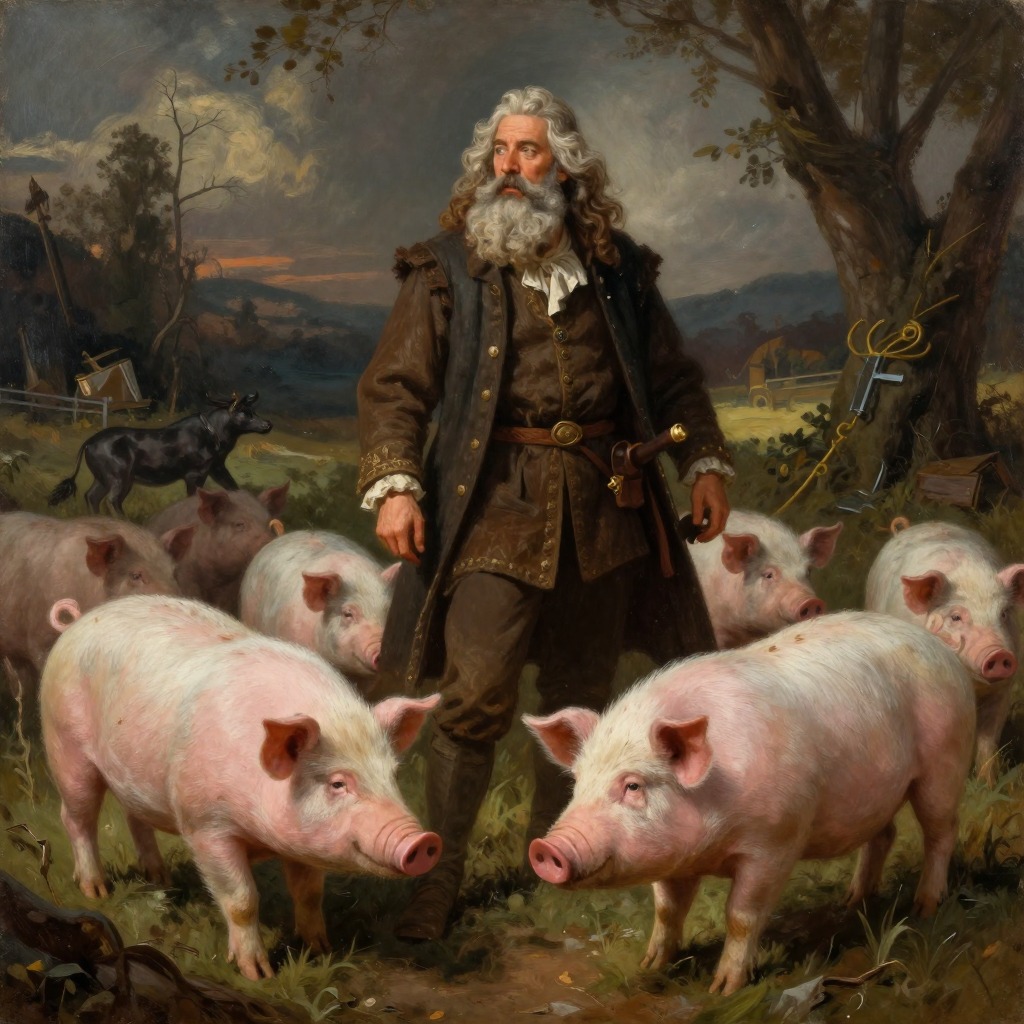
Animal FarmOne night, after Mr. Jones had drunkenly retired, the animals of Manor Farm gathered in the big barn to hear old Major, the prize Middle White boar, communicate a strange dream. Major was so highly regarded that everyone was willing to lose an hour's sleep. He began by acknowledging that his life was near its end and that he felt it his duty to pass on the wisdom he had acquired in his long years of solitary thought. The meeting was a secret, hushed affair, lit only by the lantern hanging from a beam, as the animals settled around him—the pigs, the dogs, the horses, the hens, the sheep, and others—all waiting attentively.
Major's central message was a radical indictment of human beings: he declared that all the evils of animal life spring from the tyranny of Man, the only creature that consumes without producing. He urged the animals to recognize that the produce of their labor was stolen from them, and that their lives were miserable, laborious, and short. The only remedy, he insisted, was rebellion—the overthrow of the human race. He did not know when that rebellion would come, but he was certain that justice would prevail sooner or later. He concluded his core argument with a set of fundamental precepts: whatever goes upon two legs is an enemy; whatever goes upon four legs or has wings is a friend; no animal must ever live in a house, sleep in a bed, wear clothes, drink alcohol, smoke tobacco, touch money, or engage in trade; and above all, no animal must ever tyrannise over his own kind. All animals are equal.
Then Major revealed the song that had come back to him in his dream—'Beasts of England,' a stirring tune that promised a golden future time when Tyrant Man would be overthrown and the fruitful fields of England would be trod by beasts alone. He sang it in his hoarse voice, and the animals were thrown into the wildest excitement. Within minutes, the whole farm burst out in tremendous unison, singing it five times in succession. The cows lowed, the dogs whined, the sheep bleated, the horses whinnied, the ducks quacked; the song seemed to fuse them into a single, ecstatic body. The noise awoke Mr. Jones, who fired a gun into the darkness, and the meeting broke up in a hurry, but the seed had been planted.
In the weeks that followed, Major's teachings were elaborated by the pigs into a complete system called Animalism. Snowball, Napoleon, and Squealer held secret meetings to expound the principles. The song 'Beasts of England' became the anthem of the movement, and the maxim 'Four legs good, two legs bad' was later devised by Snowball to simplify the Commandments for the less intelligent animals. The sheep took to this slogan with such enthusiasm that they would bleat it for hours on end, and it was often used to interrupt debates at crucial moments. The animals, as a group, proved highly susceptible to persuasion: they found themselves agreeing with whichever pig spoke at the moment, a pattern that would later be exploited.
Years afterward, the legacy of Major's speech persisted in contradictory ways. The song 'Beasts of England' was officially abolished by Napoleon after the executions, declared no longer needed because the Rebellion was complete. Yet the animals still knew the tune and hummed it secretly, even as they dared not sing it aloud. The ideal of equality—'All animals are equal'—was inscribed on the barn wall, but it was later amended to 'but some animals are more equal than others.' The prohibition against wearing clothes and living in houses was violated when the pigs moved into the farmhouse, slept in beds, and eventually walked on their hind legs, carrying whips. The final, chilling image of the novel—the pigs and the human farmers playing cards, no longer distinguishable from one another—stands as the ultimate inversion of Major's warning that animals must not come to resemble Man. The speech that had ignited a revolution thus became a measure of how profoundly that revolution was betrayed.