Plans
Animal FarmSnowball spent weeks elaborating the windmill plans in the former incubator shed, using the smooth wooden floor as a drawing surface. He derived mechanical details from three reference books—One Thousand Useful Things to Do About the House, Every Man His Own Bricklayer, and Electricity for Beginners—and worked with chalk gripped between the knuckles of his trotter, moving rapidly back and forth as he produced a dense tangle of lines, cranks, and cogwheels that eventually covered more than half the floor. The other animals, including the hens and ducks, came daily to inspect the drawings, finding them incomprehensible yet impressive. Only Napoleon held aloof from the start. When he finally examined the plans, he walked heavily around the shed, looked closely at every detail, snuffed at them once or twice, then suddenly lifted his leg and urinated over the entire design before walking out without a word.
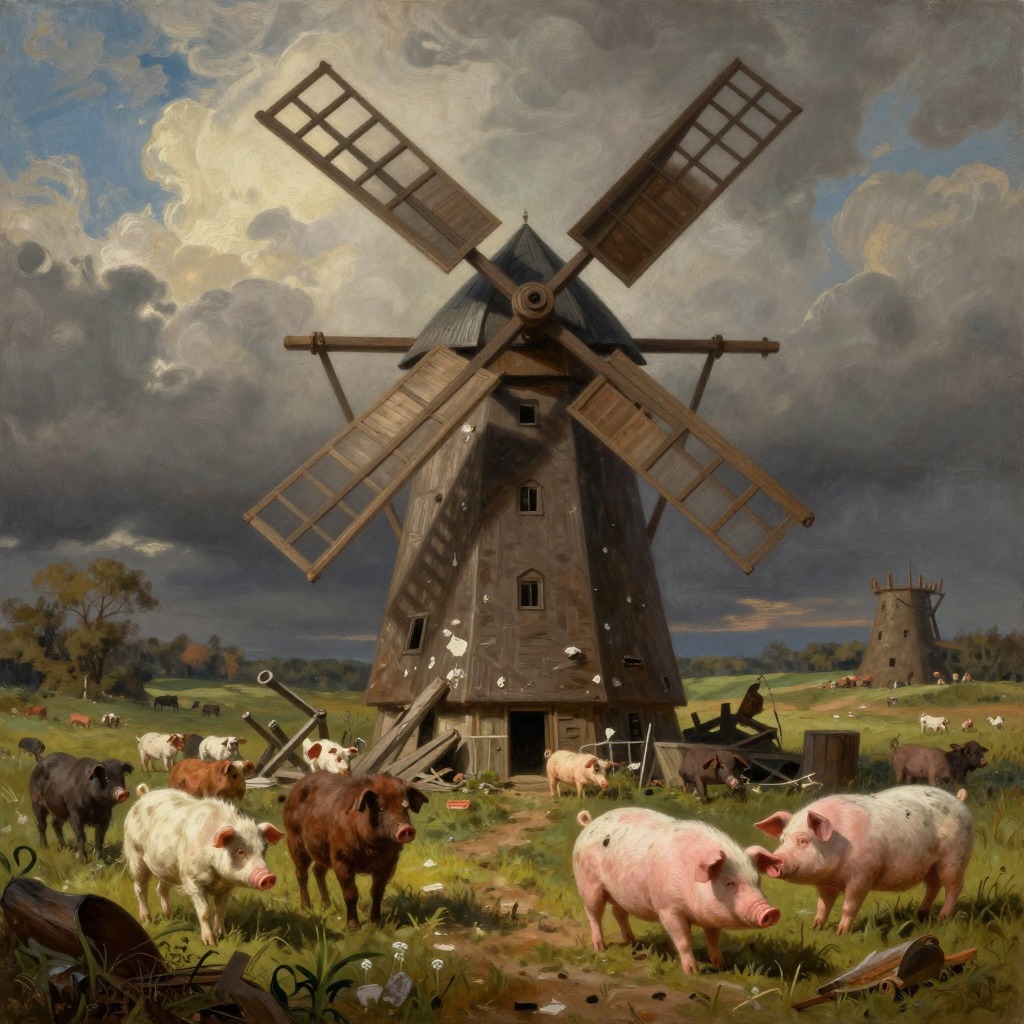
After Snowball's expulsion by the nine dogs, the shed was shut up and it was assumed that the chalk plans had been rubbed off the floor. Yet on the third Sunday after the expulsion, Napoleon announced that the windmill would be built after all, and that a special committee of pigs had been preparing the plans for the past three weeks. That evening Squealer explained that Napoleon had never really opposed the windmill; on the contrary, the plan drawn on the floor had been stolen from among Napoleon's papers, and the windmill was Napoleon's own creation. His public opposition, Squealer said, was a tactical maneuver to eliminate Snowball, a dangerous character. The animals accepted this explanation, cowed by the dogs and convinced by Squealer's persuasive rhetoric.
The physical plans thus became a contested site of memory and power. Initially a transparent expression of Snowball's inventiveness, they were first desecrated by Napoleon and then erased from the floor. In their place, a new narrative was constructed, denying Snowball's authorship and attributing the design to Napoleon. This act of re-appropriation anticipated the later systematic rewriting of the farm's history, where Snowball's role in the Battle of the Cowshed was recast as treachery, and the Seven Commandments were altered. The plans, though only chalk on a floor, embodied the struggle over who controls the story of the farm.